S&OP and IBP have been in continuous evolution since the 1980s, but the patterns through 2024-2026 are particularly worth understanding. The line between S&OP and IBP continued blurring. Executive engagement patterns shifted. Financial reconciliation moved from optional to expected. Decision execution became as important as analytical review.
The trends below are based on observed customer S&OP/IBP rhythms through 2025 — what mature organizations actually do, not what consulting frameworks recommend. The reality is messier and more interesting than the frameworks suggest.
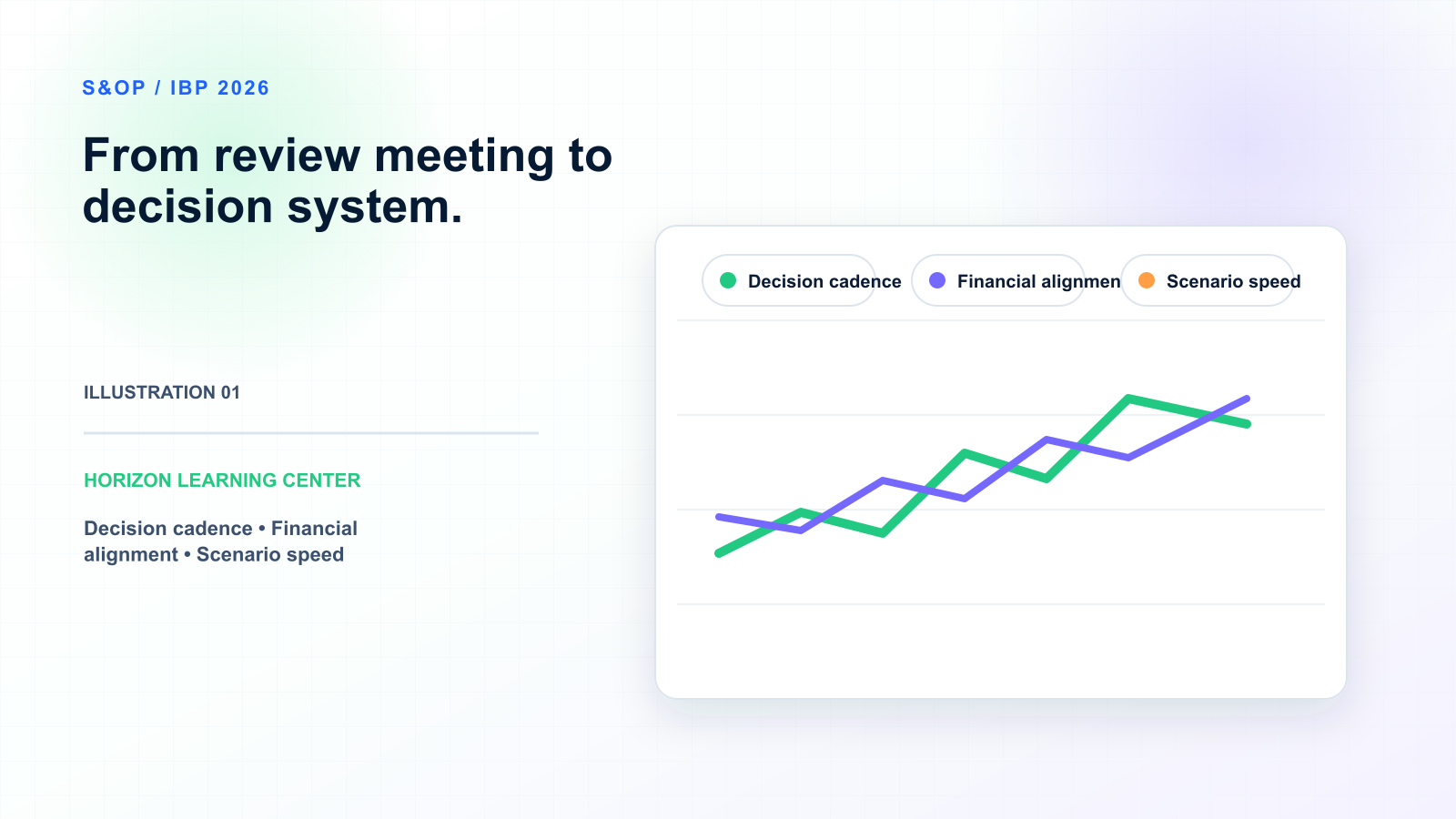
Horizon supports the S&OP-to-IBP evolution for mid-market manufacturers: financial reconciliation integrated into S&OP rhythm, scenario planning capability, decision execution layer that proposes specific actions and tracks them through to operational implementation. The platform fits supply-chain-led S&OP/IBP rhythms at mid-market scale ($100M-$3B).
Where Horizon doesn't optimize for: finance-led IBP where the rhythm is owned by finance with broader connected planning needs across non-supply-chain functions — Anaplan or finance-led platforms typically fit better. Enterprise IBP with complex multi-region governance — enterprise platforms (Kinaxis, SAP IBP, o9) typically fit better.
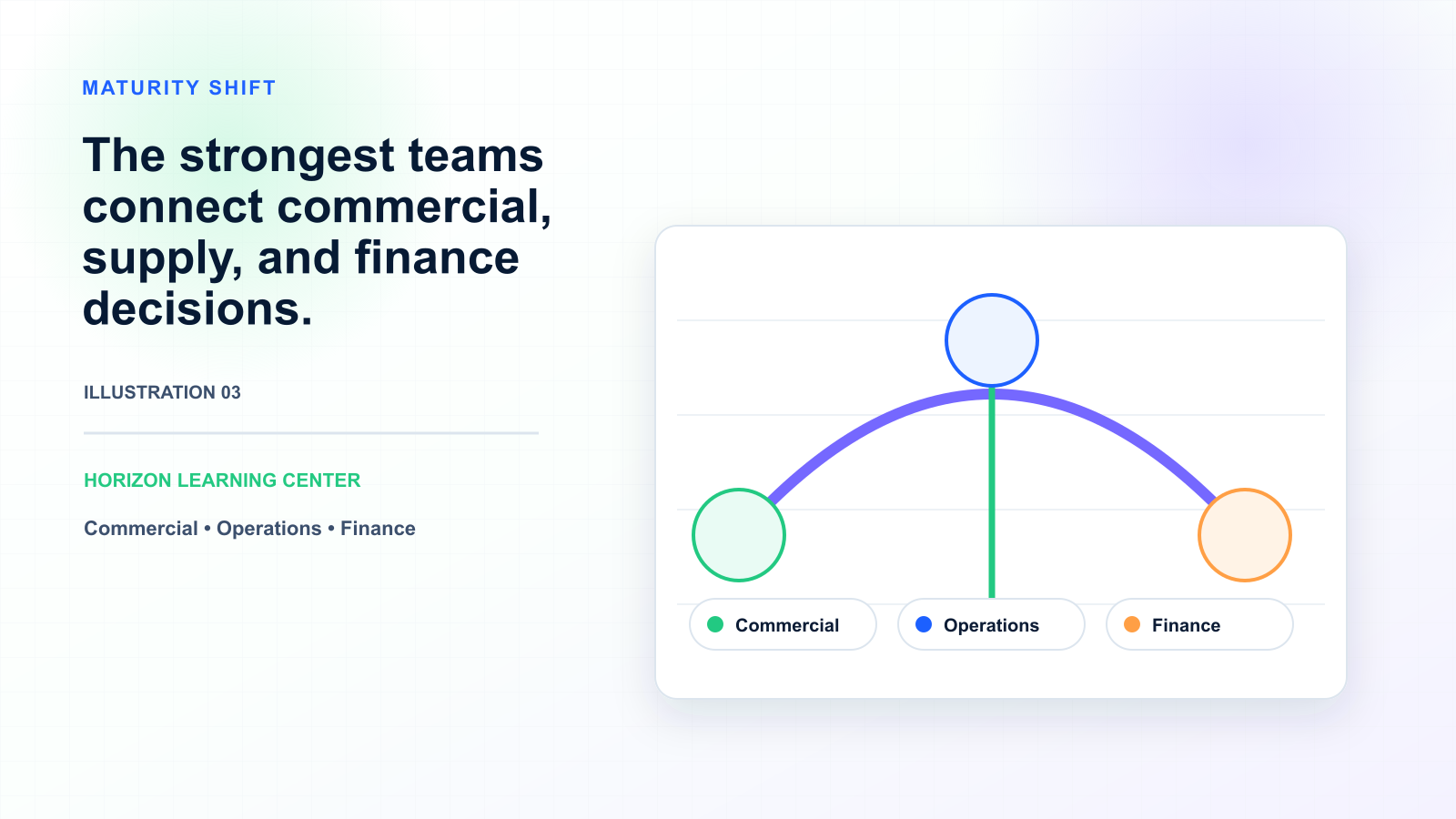
S&OP and IBP are organizational rhythms, not just software outputs. The trends below affect both platform decisions (which platforms support which patterns well) and process decisions (how to design the S&OP/IBP rhythm for current operational reality). Companies running S&OP designed for 2018 organizational patterns increasingly find executive engagement waning and operational decisions happening outside the S&OP rhythm.
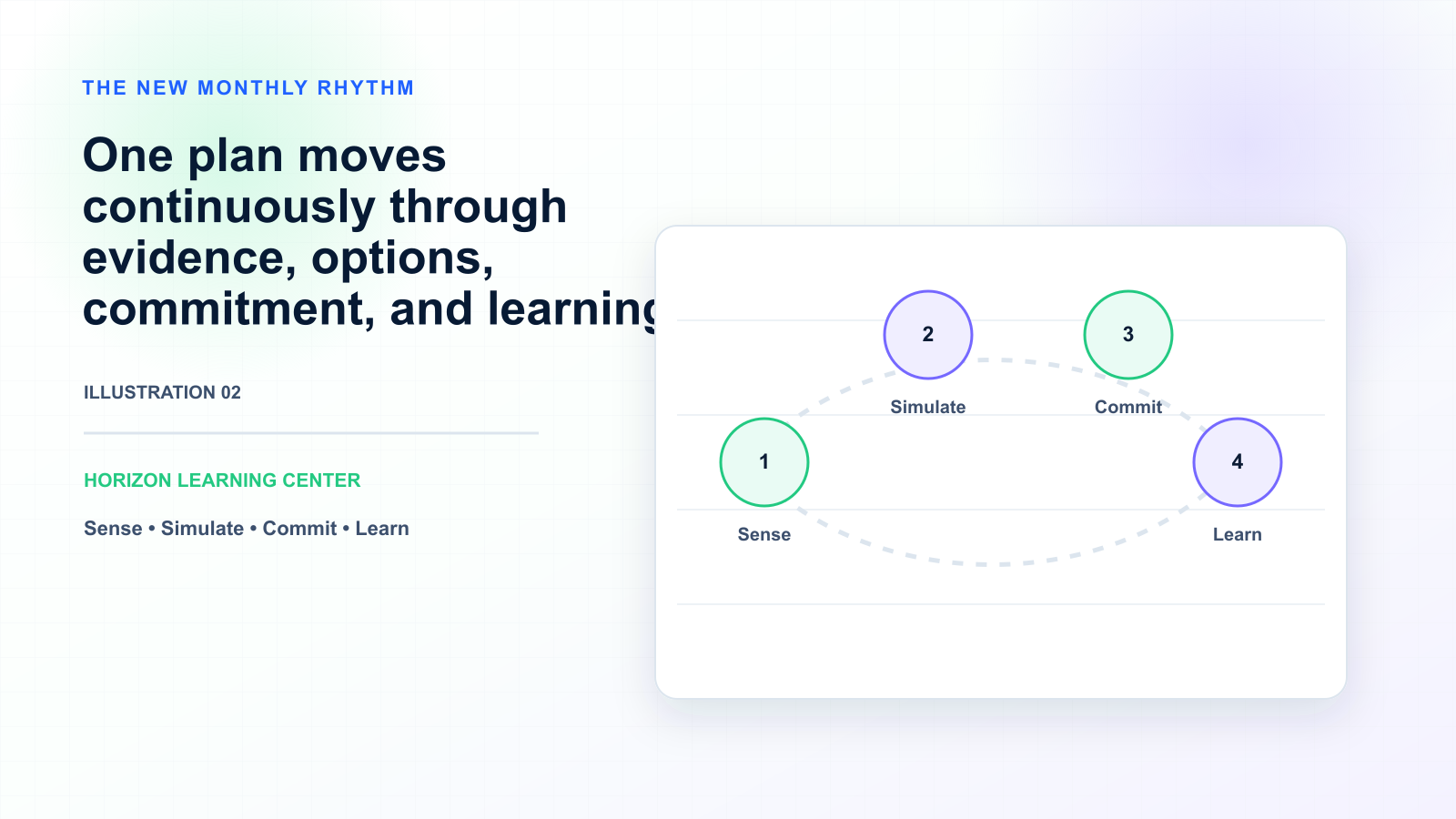
Traditional S&OP rhythms (supply-chain-led, operational focus, monthly cadence) increasingly evolved toward IBP characteristics: financial reconciliation, scenario planning, cross-functional governance, executive engagement. The pure S&OP without IBP elements is becoming rare among $500M+ organizations.
The drivers: executive teams want financial framing of operational plans (volume × margin = revenue impact). Boards want to see scenario implications, not just point forecasts. CFOs want supply chain plans reconciled to financial commitments. Operations leaders want decisions made in the rhythm rather than escalating outside it. All these forces push S&OP toward IBP territory.
S&OP/IBP meetings where the discussion stays operational (units, capacity, fill rate) struggle to maintain executive engagement over time. Meetings where operational outputs translate to financial impact (volume × margin, working capital implications, revenue at risk) maintain engagement. The successful 2025-2026 S&OP/IBP rhythms include financial reconciliation as core agenda item, not optional addition.
What this means for organizations still running supply-chain-only S&OP: expect declining executive engagement over time, with operational decisions increasingly happening outside the formal rhythm. The solution isn't more presentation polish — it's adding financial substance.
Single-point forecasts increasingly insufficient for executive discussion. Mature S&OP/IBP rhythms run scenarios (best case, worst case, base case, specific stress tests) as standard practice. The reasons: macro volatility through 2022-2024 made point forecasts feel incomplete, executive teams increasingly understand probabilistic thinking, scenario planning supports risk-based decision making.
The platforms supporting scenario planning well: enterprise platforms (Kinaxis concurrent scenarios, o9 knowledge graph reasoning across scenarios, SAP IBP scenario modeling), and modern mid-market platforms (Horizon scenario capability, Logility scenario analysis). Platforms without strong scenario capability are increasingly behind.
Traditional S&OP/IBP produced decisions in meetings that operations teams then implemented separately. The 2026 trend: decision execution increasingly built into the S&OP/IBP rhythm itself — actions identified, owners assigned, deadlines set, tracking established within the platform and process. The shift connects S&OP/IBP decisions to operational follow-through rather than treating them as separate workflows.
Platforms with strong decision execution capability deliver more value in this shift than platforms requiring separate action tracking.
Traditional S&OP/IBP runs monthly. Increasingly, organizations are exploring more frequent cadences for specific decisions — weekly cross-functional reviews for high-volatility periods, daily executive briefings during supply disruptions, real-time visibility for specific decision types. The monthly governance rhythm continues but supplemented by faster cycles for specific needs.
The challenge: maintaining executive engagement in more frequent cycles. Successful patterns: shorter, more focused executive briefings (15-30 minutes) rather than reproducing monthly meeting format weekly. Platforms supporting role-specific views and quick scenario evaluation enable this rhythm.
Traditional S&OP centered on demand and supply functions. IBP extended to finance. The 2026 trend: S&OP/IBP increasingly includes marketing (promotional planning impact), sales (customer commitments), operations beyond planning (manufacturing capacity), and HR (capacity planning for labor). The expansion strengthens decision quality but adds organizational complexity.
S&OP/IBP implementation success rates didn't dramatically improve. Despite platform capability gains and methodological maturity, many S&OP/IBP implementations still struggle with executive engagement, operational follow-through, and value realization. The dominant failure mode remained organizational: leadership commitment, change management, sustained discipline. Platforms enable better S&OP/IBP — they don't substitute for the organizational work.