Capacity planning in manufacturing is the discipline of determining whether the plant's production resources machines, labor, materials, tools can meet expected demand, and what to do when capacity falls short or exceeds need. It runs at multiple horizons, from strategic capacity investment decisions made over 3-5 years to detailed daily decisions about which work orders to expedite.
The discipline operates at four distinct levels, each making different decisions with different data and different tools. Confusing the levels is one of the most common manufacturing planning mistakes treating strategic capacity questions with operational tools, or operational capacity questions with strategic models.
This page covers the four levels of capacity planning, the questions each level answers, the tools used at each level, and how the levels integrate into a coherent capacity management discipline.
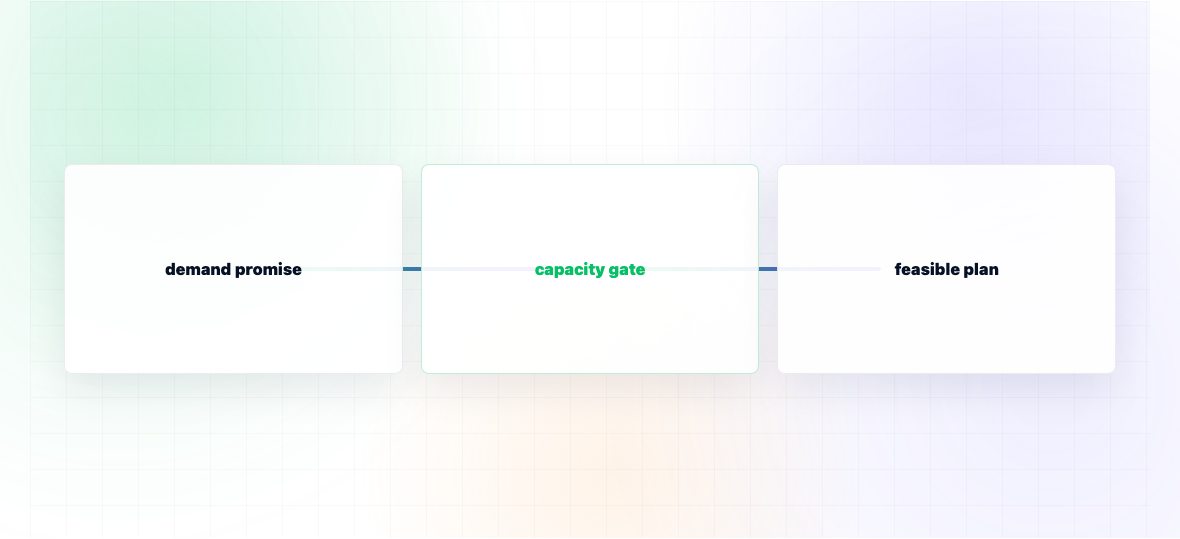
Horizon supports capacity planning at Levels 2, 3, and 4 S&OP, MPS, and detailed scheduling within a single integrated platform. Strategic capacity planning (Level 1) is typically handled outside Horizon, in dedicated strategic planning tools or in IBP scenarios that connect to Horizon's operational data.
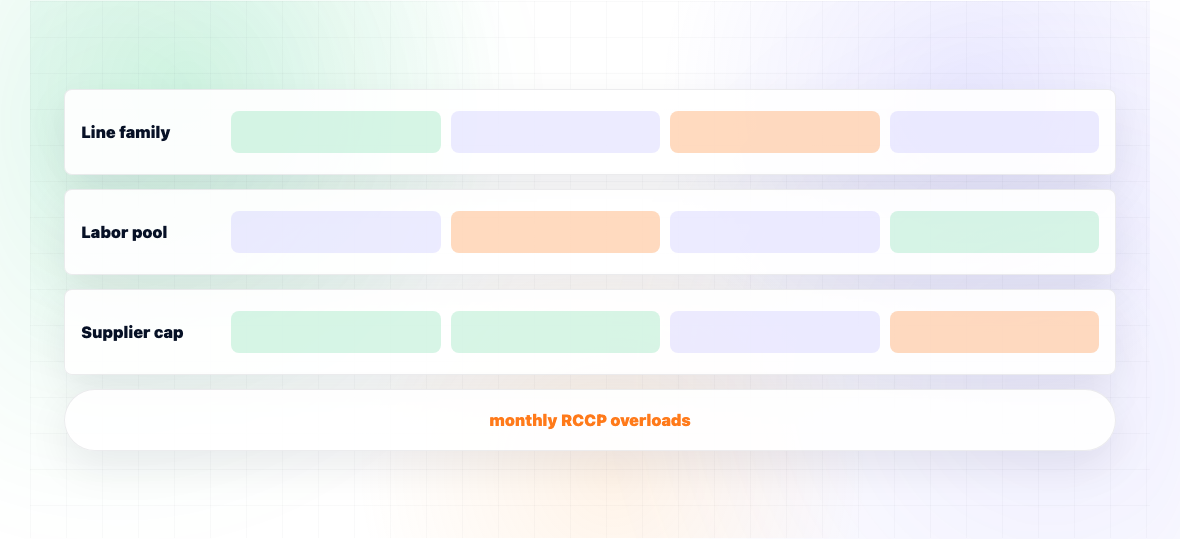
At Level 2 (S&OP), rough-cut capacity planning runs interactively as the team adjusts the family-level plan. Critical resources are configurable; the system shows capacity overloads in real time as the plan changes.
At Level 3 (MPS), capacity requirements planning validates the SKU-level plan against detailed resource availability. Infeasibility surfaces as exceptions for resolution before MRP runs.
At Level 4 (detailed), finite capacity scheduling handles work order sequencing against real machine and labor constraints. Real-time re-scheduling responds to shop floor events.
The integration across levels means information flows both directions: detailed-level exceptions become MPS exceptions, MPS-level exceptions inform S&OP decisions, S&OP capacity gaps trigger conversations about strategic capacity. This is the feedback loop that capacity planning needs to mature beyond reactive responses.
The honest scope: Horizon's strength is the operational capacity planning at Levels 2-4. For Level 1 strategic capacity decisions (new plants, major expansions), companies typically use specialized tools or scenario modeling alongside Horizon. The data integration between Horizon and those tools is well-supported, but the strategic decision itself is outside Horizon's core scope.
Capacity planning failures show up in two forms, both expensive. Under-capacity failures appear when demand exceeds production: lost sales, expedited freight, customer service damage, overtime costs, sometimes capacity investment that's panic-driven rather than strategic. Over-capacity failures appear when demand falls short of capacity: idle equipment, layoffs that damage culture and capability, stranded capital, write-downs on assets purchased for demand that didn't materialize.
The asymmetry is that over-capacity is often more expensive in capital-intensive industries, but under-capacity is more visible in commercial-led businesses. The right balance depends on industry economics, but neither extreme is desirable.
The reason capacity planning is hard is that the decision horizon is mismatched with the demand visibility. Capacity decisions made today affect operations 2-5 years from now (because that's how long it takes to build a plant, install a line, train a workforce). Demand visibility is much shorter 12-24 months at best, often less. So capacity decisions are made with limited information, and getting them right requires both rigorous methodology and judgment about how much to invest in flexibility versus efficiency.
Horizon: 2-5+ years.
Question answered: What capacity should we have, where, with what flexibility? Should we build a new plant, expand existing capacity, outsource, or divest?
Decisions made: Major capital investments, plant location, capacity reservation contracts with suppliers, capability investment (new technology, new product modes), make-vs-buy structure.
Data used: Long-range demand projections, competitive analysis, capital cost models, scenario analysis across demand outcomes.
Tools: Strategic planning tools, scenario modeling, network design optimization. Often handled within IBP or as a separate strategic exercise.
Frequency: Annual review with continuous monitoring; major decisions every 1-3 years.
Horizon: 12-36 months.
Question answered: Given current capacity, can we meet the demand forecast? Where are gaps? What near-term actions resolve them?
Decisions made: Shift additions or reductions, hiring or layoff plans, capital expenditure within annual budget, outsourcing decisions, capacity reservations, capacity-related promises to customers.
Data used: Demand forecast at family level, capacity by major resource, rough cost models, financial impact analysis.
Tools: S&OP and IBP platforms with capacity planning modules. Rough-cut capacity planning (RCCP) is the typical method.
Frequency: Monthly.
Horizon: 3-18 months.
Question answered: Within the agreed S&OP plan, what specific products should we make in each period? Is the period-level plan feasible against capacity?
Decisions made: SKU-level production allocation by period, capacity reservations on specific resources, build-ahead decisions to balance variable demand against stable capacity.
Data used: Demand at SKU level, capacity by specific resource, RCCP and CRP outputs.
Tools: Supply chain planning platforms with MPS modules. RCCP and CRP are the typical validation methods.
Frequency: Weekly or monthly.
Horizon: Days to weeks.
Question answered: Given the master schedule, can we sequence specific work orders to maximize throughput and minimize tardiness? Where are bottlenecks today, and how do we respond?
Decisions made: Work order sequencing, overtime authorization, expedite decisions, real-time resource reallocation.
Data used: Detailed routings, current shop status, real-time resource availability, urgent customer commitments.
Tools: Production scheduling software, finite capacity scheduling, MES integration.
Frequency: Daily or per shift.
The levels are linked: strategic decisions set the bounds within which S&OP operates; S&OP decisions set the bounds within which MPS operates; MPS sets the schedule that detailed scheduling executes. Decisions made at higher levels constrain lower levels.
Information also flows upward. Detailed capacity issues surface in scheduling exceptions chronic bottlenecks visible at the detailed level inform MPS adjustments. Persistent MPS infeasibility informs S&OP decisions about overtime, hiring, or outsourcing. Persistent S&OP capacity issues over multiple cycles inform strategic capacity investment.
The failure mode in immature operations: levels operate independently. Strategic decisions ignore operational reality. S&OP doesn't validate against detailed capacity. MPS produces plans that don't survive scheduling. The integration breaks at every transition, and capacity decisions are made without the feedback that would make them better.
Nameplate capacity is what equipment can theoretically produce. Effective capacity is what it actually produces after accounting for setups, downtime, quality issues, and operational realities. Most plants run at 60-75% of nameplate, sometimes less. Planning against nameplate produces optimistic plans that don't survive execution.
Annual capacity may be sufficient to meet annual demand. Specific months may not be. Capacity planning at the annual level misses seasonal mismatches that show up acutely at the monthly level. Always plan at the period (monthly minimum) granularity.
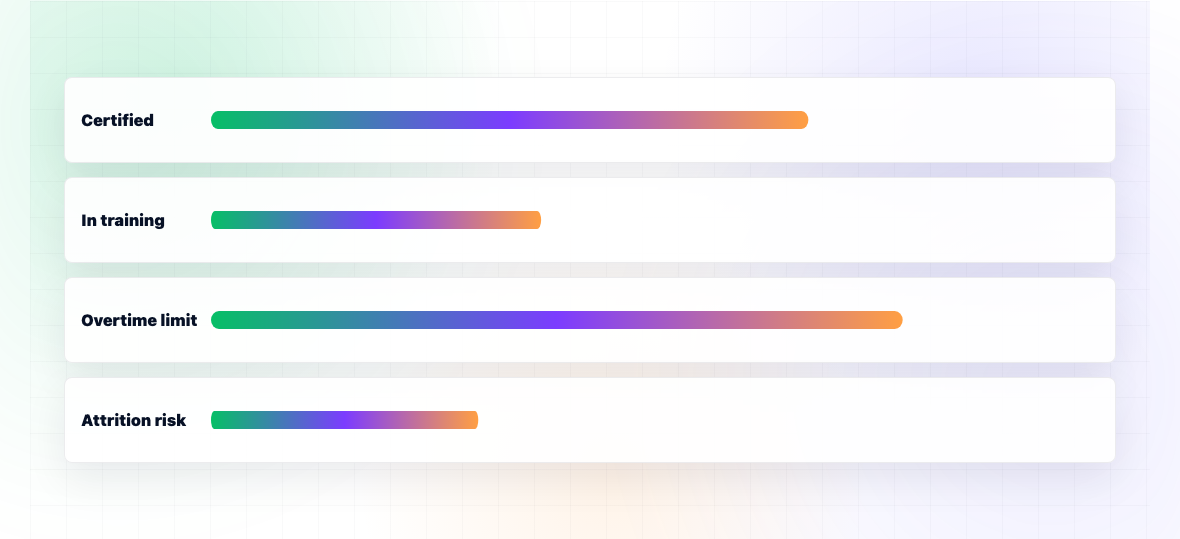
In capital-intensive industries, machines are the constraint. In labor-intensive industries including most discrete assembly labor capacity is often the binding constraint and varies week to week (attrition, hiring lags, training time). Treating labor as fixed leads to plans that machines can execute but operators cannot.