Demand planning is the process of forecasting future customer demand and turning that forecast into an aligned plan that operations, procurement, and finance can execute against. It sits at the front of the supply chain every other planning decision (inventory, production, capacity, procurement) depends on the demand plan being credible.
Demand planning is not the same as forecasting. Forecasting is the statistical or judgmental act of producing a number. Demand planning is the broader process: producing the forecast, reviewing it with sales and marketing, reconciling it with strategic targets, and converting it into a one-number plan that downstream teams use. A company can have excellent forecasting and weak demand planning if those reviews don't happen.
This page covers the five-step process most mature teams run, the three forecasting methods you'll encounter, and the KPIs that signal whether the process is working.
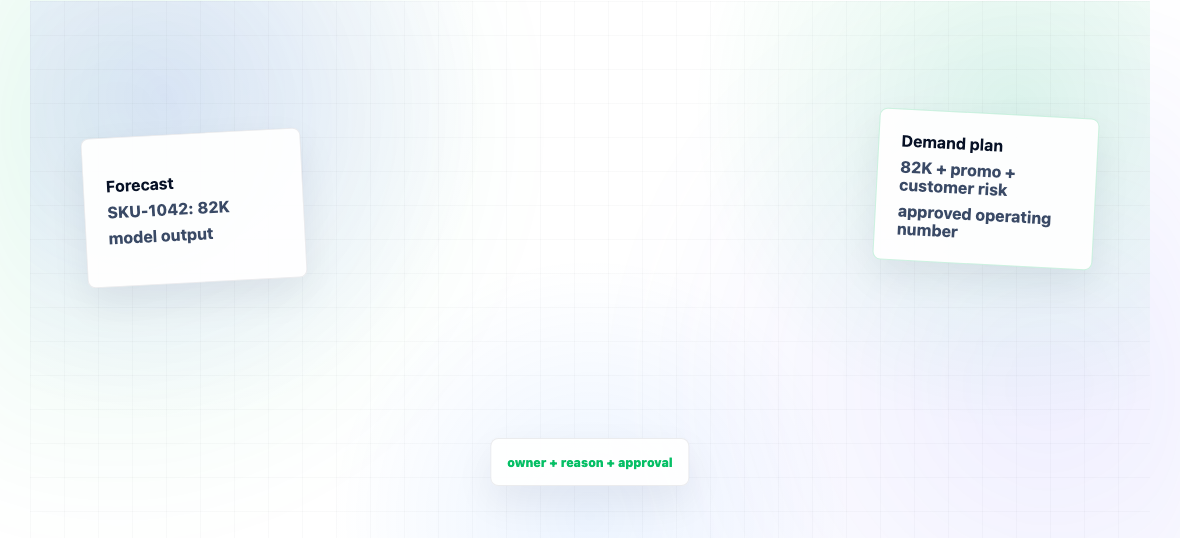
Horizon automates the statistical baseline using an ensemble of methods (exponential smoothing, ARIMA, and ML models) and selects the best-performing model per SKU automatically. The planner doesn't tune algorithms they review exceptions and add overlays where their judgment beats the model.
Overlays from sales and marketing are captured with named owners and reasons, so FVA can be calculated for each overlay over time. Teams quickly see which sales reps' inputs improve accuracy and which destroy it a conversation that's hard to have without the data.
Reconciliation to financial and strategic targets is built into the workflow rather than handled in a separate spreadsheet, so the gap between the demand plan and the budget is visible in the same view where the demand plan is approved.
Errors in demand planning compound downstream. A 10% over-forecast becomes 10% excess inventory, which becomes obsolescence write-offs, markdown campaigns, and capital tied up in stock that should have been raw material for what actually sold. A 10% under-forecast becomes stockouts, lost sales, expedited freight, and customer service damage.
The leverage is structural. Every other planning function reacts to demand. If demand planning is 80% accurate, supply planning starts with a 20% error to absorb. If demand planning is 95% accurate, supply planning starts with a 5% error to absorb. The same supply planning team and tools produce very different results depending on what they're given upstream.
This is why mature companies invest disproportionately in demand planning relative to its headcount. A demand planning team of 4-5 people in a $500M business typically has more impact on margin than a procurement team three times its size, because the procurement team is working off whatever signal the demand team produces.
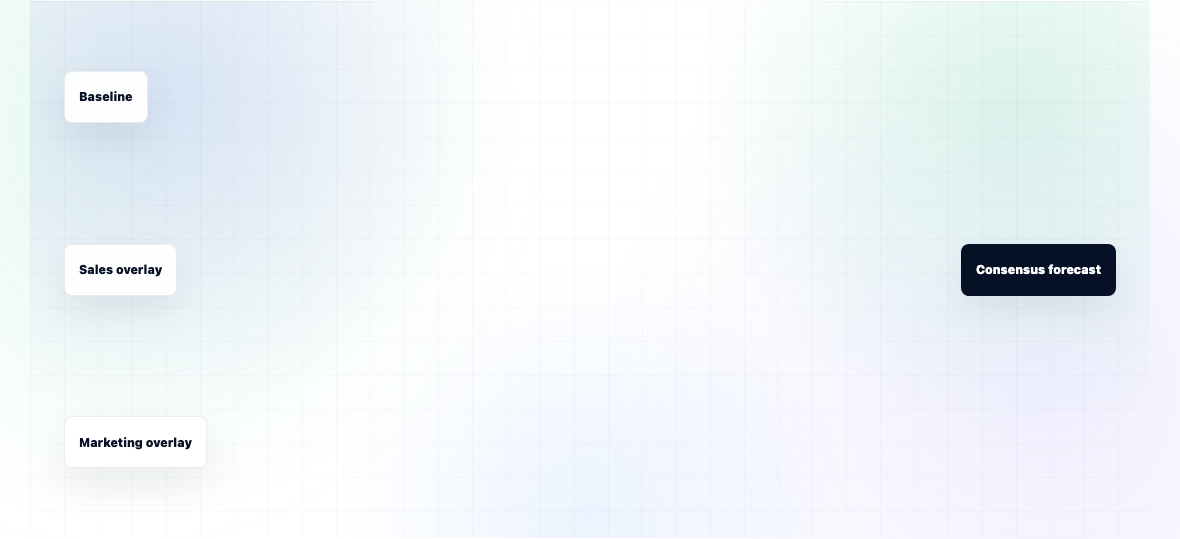
Generate a statistical forecast from historical sales data using time-series methods (exponential smoothing, ARIMA, or ML models like gradient-boosted trees). This is the unbiased starting point. The baseline should be produced automatically and not yet adjusted by humans.
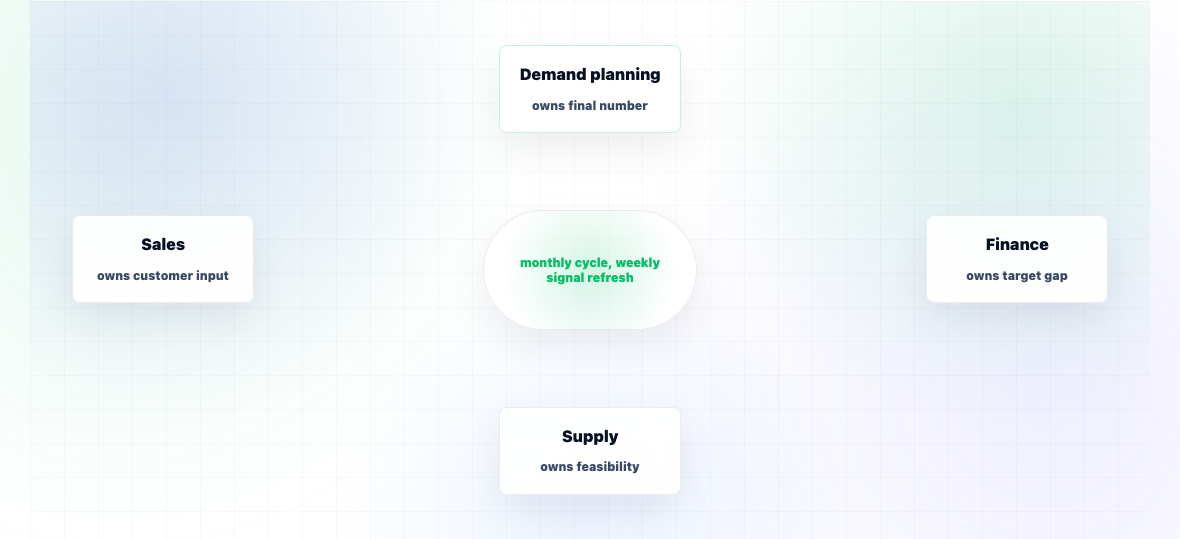
Review the baseline with sales (customer-level intelligence: known orders, customer expansions, churn risk) and marketing (promotions, launches, market shifts). The output is a series of named overlays on top of the baseline, each with an owner and a reason. The discipline is that overlays must be specific and justifiable "sales feels Q3 will be soft" is not an overlay.
Combine the baseline and overlays into a single forecast. This is the "one number" that downstream planning will use. The consensus forecast is owned by demand planning but reflects sales and marketing inputs explicitly.
Compare the consensus forecast to the financial plan and strategic targets. If there's a gap (consensus is below budget, or above commercial commitments), the gap is named and assigned an owner. The goal is not to force the numbers to match it's to make the gap visible so leadership can decide how to close it.
Publish the consensus forecast to supply planning, production, procurement, and finance. Measure forecast accuracy and bias against actuals when they arrive. Feed results back into the next cycle both as inputs to the statistical model and as feedback to sales/marketing on which overlays added value and which didn't.
Exponential smoothing (Holt-Winters), ARIMA, and similar methods. Use historical demand to project forward, capturing trend and seasonality. Best for products with at least 2-3 years of stable history. Fails on new products, demand shifts, and high-promotion categories.
Gradient-boosted trees (XGBoost, LightGBM), neural networks, and ensemble methods. Use multiple input variables promotions, weather, price, macro indicators, leading indicators alongside history. Best for high-volume products with rich data and external drivers. Requires more setup and more data quality discipline than statistical methods.
Inputs from sales reps, customer planning teams, distributors. Captures information that doesn't exist in the historical data: known upcoming orders, channel sentiment, competitive shifts. Best for B2B, project-based businesses, and new product introductions. Vulnerable to bias sales reps systematically over-forecast in incentive-driven environments.
Mature teams use all three. The statistical or ML method produces the baseline. Judgmental input is captured as named overlays. The combination outperforms any single method.
Horizon's demand planning module already runs this exact model-selection step per SKU, so the KPIs above measure the exception-and-overlay layer, not whether the baseline itself needs tuning.