Demand planning software is a category of applications that automate statistical forecasting, capture collaborative inputs from sales and marketing, and produce a single agreed demand plan that operations and finance can execute against. It sits between raw sales history (which lives in ERP or data warehouses) and the supply planning process (which consumes the forecast).
The software replaces the spreadsheet-based forecasting that most companies start with. Where Excel can produce a forecast, it cannot enforce a process, store overlays with named owners, calculate FVA, or reconcile multiple hierarchy levels simultaneously. Demand planning software does all of those.
This page covers the six core capabilities that define the category, how the software differs from ERP forecasting modules and Excel, and what to expect from a modern implementation.
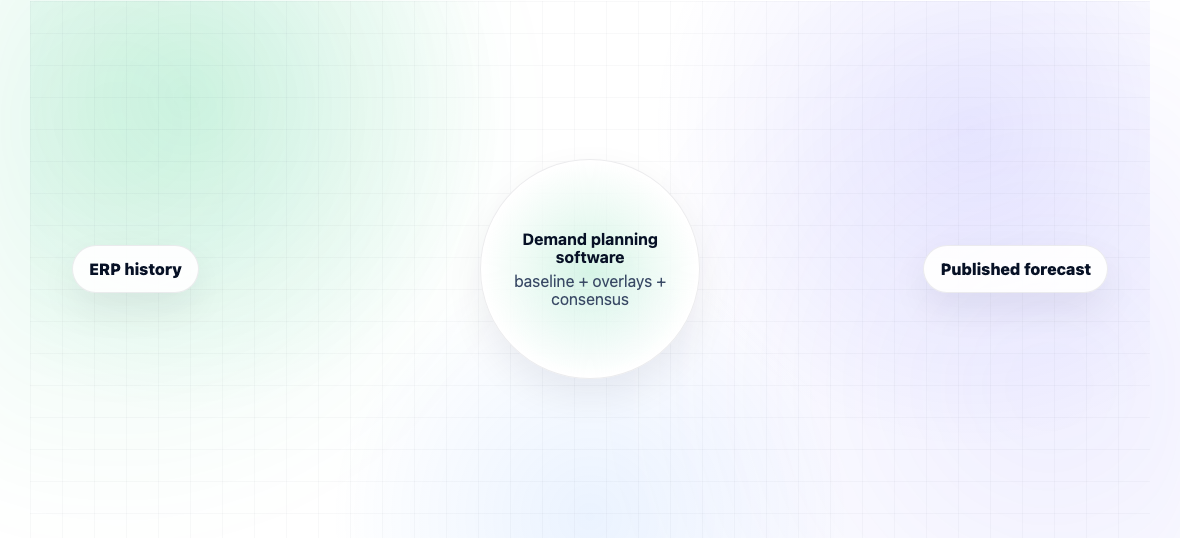
Horizon's demand planning module covers all six capabilities natively. The forecasting engine includes statistical and ML methods with automatic per-SKU model selection. The hierarchy engine handles top-down reconciliation (force a category total to match a budget) and bottom-up aggregation in the same view. Collaborative overlays from sales and marketing are captured with named owners and reasons.
The exception engine surfaces 10-20% of SKUs per cycle that need planner attention, based on accuracy degradation, bias drift, large change from last cycle, or missing actuals. This is the difference between a planner reviewing 5,000 SKUs (impossible) and reviewing 500 (manageable).
FVA reporting is native, not a separate report. Forecast snapshots at each step are stored automatically. The published forecast flows to supply planning, scheduling, and inventory modules without re-keying or integration friction.
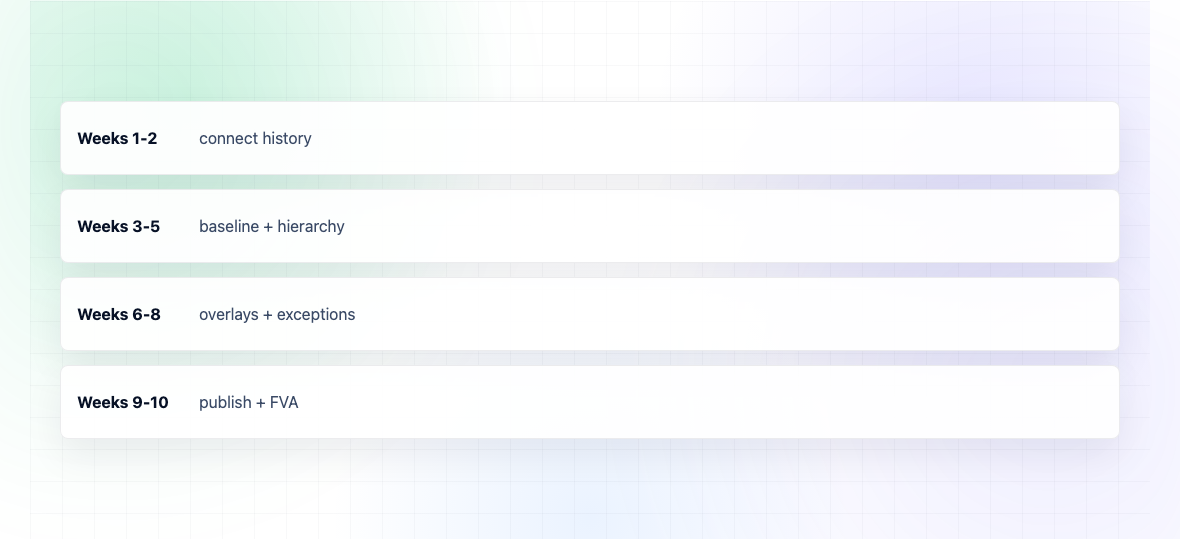
Typical deployment for the demand planning module alone is 6-10 weeks for a mid-market manufacturer.
Most planning teams begin in Excel. It's free, familiar, and infinitely flexible. The reason Excel breaks down is not features it's the lack of process enforcement and the absence of multi-user state.
Three specific failures compound over time. First, Excel forecasts have no audit trail when a number changes, you cannot reliably trace who changed it, when, and why. Second, when multiple people edit the same forecast (sales adds overlays, marketing adjusts promotions, finance reconciles to budget), the file becomes a versioning nightmare and the "real" forecast is whichever copy the planner opens last. Third, statistical methods in Excel are limited to what the planner can build and maintain no automated model selection, no ML, no SKU-level method optimization.
The cost of these failures is invisible until you measure it. Typical Excel-based forecasting in a mid-size manufacturer runs 10-15 percentage points worse on MAPE than what dedicated software achieves, costs 30-50% more planner time per cycle, and provides almost no visibility into what's driving accuracy or bias. Software is not better because it has more features it's better because it enforces a process.
The software runs multiple statistical models (Holt-Winters exponential smoothing, ARIMA, Croston for intermittent demand) and ML methods (gradient-boosted trees, neural nets) and selects the best-performing model per SKU automatically. Planners review exceptions rather than tune models by hand.
Real demand planning happens at multiple levels: SKU, brand, customer, region. The software forecasts at one level, aggregates and disaggregates cleanly to others, and handles top-down overrides (force a brand total to match a budget number) and bottom-up rollups in the same workflow.
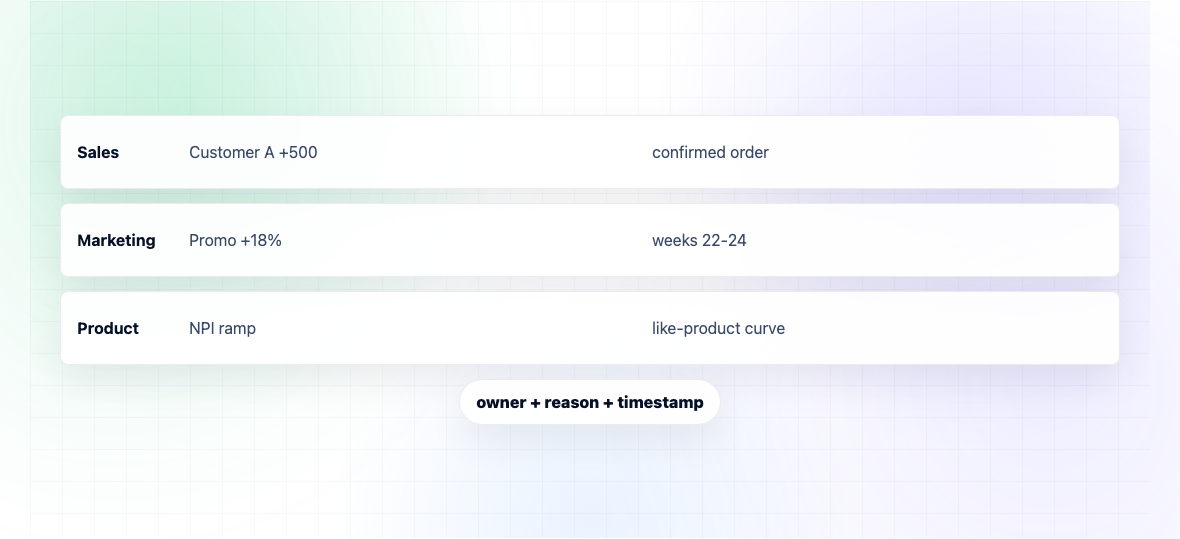
Sales, marketing, and product teams contribute structured overlays promotions, known customer orders, launches, market events through clean interfaces. Each overlay has a named owner and a reason, so FVA can be calculated and accountability is preserved.
Modern demand planners don't review every SKU every cycle that's impossible in a 5,000-SKU portfolio. The software surfaces SKUs that need attention: high error, high bias, large changes from last cycle, missing recent demand. Planners focus their hours on the SKUs where their judgment matters.
The software snapshots forecasts at each step (baseline, ML, sales overlay, consensus) and scores accuracy at each step against actuals. This tells the team which steps improve the forecast and which destroy value.
The agreed forecast is published to downstream consumers supply planning, production scheduling, procurement, financial planning. Integration with ERP for actuals and master data, and with finance systems for plan reconciliation, is typically pre-built.
Most modern ERPs (SAP, Oracle, NetSuite, D365) include a basic forecasting module. These cover statistical forecasting at a basic level but typically lack: automatic model selection per SKU, ML methods, structured collaborative overlay capture, FVA reporting, and the workflow features (exception management, hierarchy reconciliation) that dedicated demand planning software provides. ERP forecasting is sufficient for companies with simple, stable demand patterns and small SKU portfolios. Beyond that, dedicated software is what most companies migrate to.
Demand planning software produces the demand forecast. Supply planning software consumes the forecast and decides how to meet it inventory targets, production schedules, procurement. They're complementary. Integrated suites (Horizon, Kinaxis, o9, SAP IBP) cover both. Best-of-breed approaches use specialised tools for each. The integration between the two is where most failures happen, which is why most mid-market manufacturers prefer integrated platforms.
Horizon runs that reconciliation in a single view. Top-down budget targets and bottom-up SKU builds share the same demand planning data model instead of two spreadsheets that have to be manually tied out.