Demand segmentation is the practice of grouping SKUs by their demand characteristics typically volume and variability so each group can be forecasted, reviewed, and managed with the right approach. A 5,000-SKU portfolio is not one forecasting problem; it's several problems mixed together, and treating them uniformly is what causes most accuracy and inventory issues.
The most common framework is ABC/XYZ, which crosses volume importance (A, B, C) with demand variability (X, Y, Z) to produce nine segments each with different forecasting methods, review cadences, safety stock policies, and management attention.
This page covers the standard ABC/XYZ framework, how to compute each axis, what segments mean in practice, and how segmentation drives different decisions across forecasting, inventory, and review processes.
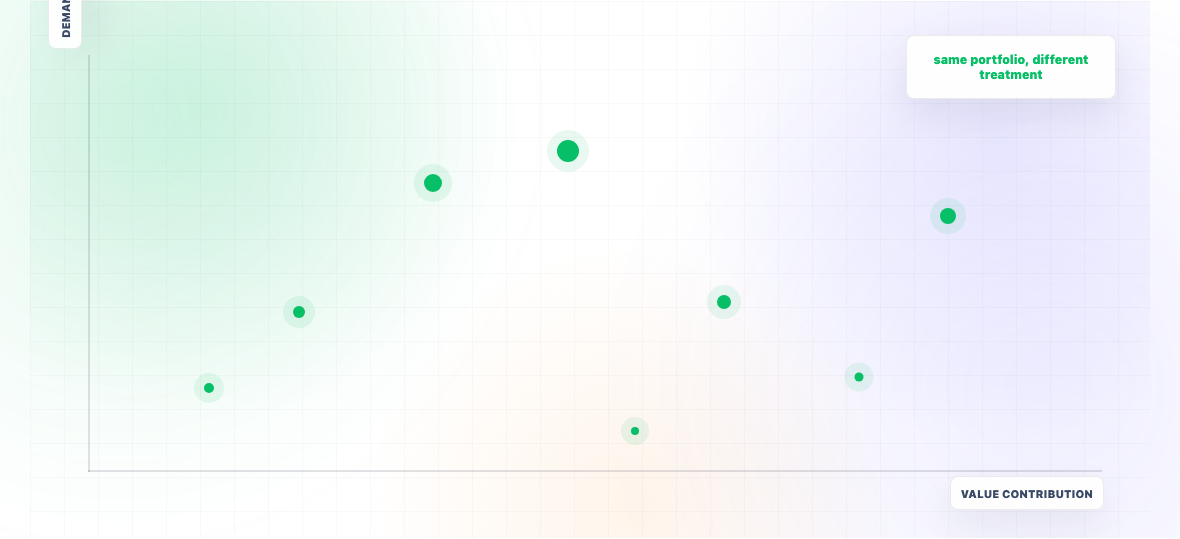
Horizon segments SKUs automatically on import, using configurable ABC and XYZ cutoffs. The default uses revenue for ABC and CoV for XYZ over a 12-month rolling window, but both can be configured per customer. Segments are visible on every SKU view, so planners always know which segment a SKU sits in.
Forecasting methods are applied differentially by segment. AX SKUs run statistical baselines with full review; AY SKUs run ML with external driver integration; CZ SKUs run on min/max or simple methods depending on the customer's preference. The forecast method per segment is configurable, but the differential treatment is built in rather than something the planner has to manually enforce.
Re-segmentation runs automatically every quarter, with the planner notified of SKUs that have moved segments. A product that has shifted from BX to AY (more important and more variable) triggers a different review approach in the next cycle.
Service level targets and safety stock policies are also configurable per segment, so the inventory module respects the segmentation downstream top SKUs get higher availability targets, tail SKUs get efficient stocking policies.
Without segmentation, planning teams apply the same methods, the same review cadence, and the same safety stock policy across the entire portfolio. The result is consistently disappointing on both ends of the distribution: top SKUs get under-attention (one of thousands), and tail SKUs get over-attention (reviewed individually even though they don't warrant it).
A real example. A mid-size industrial parts manufacturer ran the same monthly statistical forecast and the same 4-week safety stock policy across 8,000 SKUs. Forecast accuracy averaged 65%. After segmenting and applying different methods (ML for high-volume volatile SKUs, statistical for stable SKUs, Croston for intermittent demand, simple min/max for tail SKUs), accuracy improved to 79% a 14-point gain. Safety stock dropped 18% because tail SKUs no longer carried the same buffer as critical SKUs. The total project took 4 months. The underlying data and tools hadn't changed; only the segmentation and the differential treatment.
This is why mature demand planning teams invest in segmentation early. It's the structural change that makes every downstream improvement (better forecasting methods, better safety stock policies, better review processes) actually pay off.
ABC groups SKUs by their share of revenue, units, or margin (depending on what the company optimizes). Standard cutoffs:
The shape of the curve is the famous 80/20 pattern. A SKUs deserve disproportionate planning attention because they drive the business. C SKUs need to be managed efficiently accurate enough not to stock out, but not worth heavy individual review.
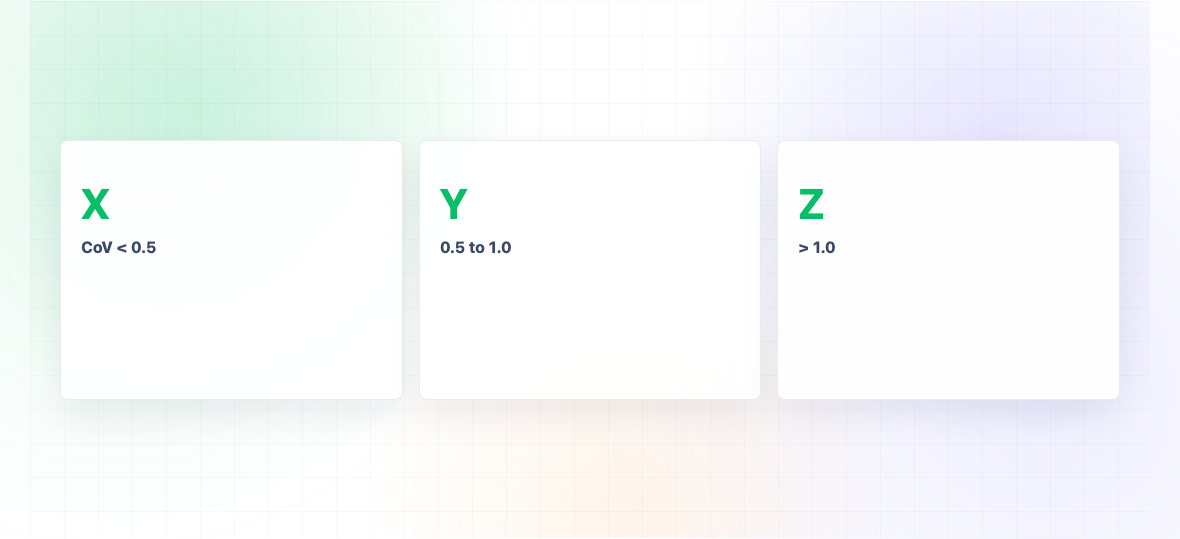
XYZ groups SKUs by how predictable their demand is, usually measured by the coefficient of variation (CoV = standard deviation / mean of weekly or monthly demand).
Crossing ABC with XYZ produces nine segments, each with a different management approach:
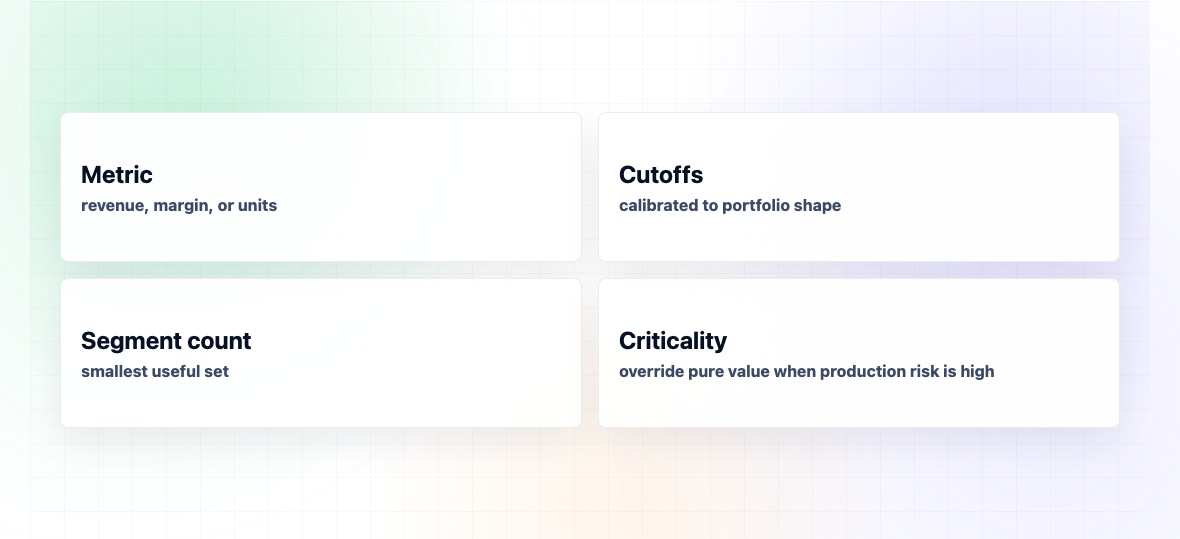
Revenue is standard for most businesses. Margin contribution is better when SKU margins vary widely. Units work for operations-focused metrics. Pick one and stick with it.
Use 12-24 months of weekly or monthly demand history. CoV = std dev / mean. SKUs with mean demand near zero are flagged as intermittent regardless of CoV.
Apply the cutoffs above. Validate the distribution if 80% of SKUs land in CZ, something is wrong (probably with the volume cutoff or the CoV calculation).
For each segment, define:
SKU classifications change over time. New products move from launch to mature. Mature products decline. Re-run segmentation quarterly or semi-annually so the treatment stays appropriate.
That ABC/XYZ split happens automatically on import, part of Horizon's demand planning. It defaults to revenue for ABC and CoV for XYZ over a rolling 12 months, and shows on every SKU view instead of a separate report to cross-reference.