Detailed scheduling is the shortest-horizon production planning function: it sequences specific work orders on specific resources at specific times, typically over a horizon of hours to weeks. It produces the executable schedule that operators and supervisors follow on the shop floor.
Detailed scheduling sits at the bottom of the planning hierarchy. Above it is master production scheduling (MPS), which decides what to make in each period at a more aggregated level. Above that is rough-cut capacity planning (RCCP), which validates the MPS against high-level capacity. Above that sits the operational plan from supply planning, and above that the strategic plan from S&OP/IBP.
This page explains where detailed scheduling fits in the hierarchy, what it computes, the constraints it handles, and how it differs from the planning layers above it.

Horizon's detailed scheduling module covers discrete and process manufacturers with native handling of sequence-dependent setups, parallel resources, multi-stage routings, batch and lot constraints, and material availability. The scheduling engine uses constraint programming for problems where the structure suits it, metaheuristics for larger problems where speed matters.
Integration with adjacent planning layers is direct. The detailed scheduler consumes the production plan from supply planning, validates capacity feasibility, and produces the executable schedule. Material requirements feed back to procurement so raw material orders reflect the actual scheduled timing, not the aggregate MRP estimate.
For shop-floor execution, the schedule publishes to MES (or to direct operator interfaces for plants without MES) with detail at the operation level. Status updates flow back from execution: completed operations, downtime events, quality holds. The scheduler uses the updates to refresh the schedule on the configured cadence typically daily, with real-time options for high-variability environments.
The honest scope: Horizon's detailed scheduling handles routings and constraint structures typical of discrete (auto parts, industrial equipment, consumer electronics), process (food, chemicals, pharma in standard configurations), and CPG manufacturing. Some specialized contexts semiconductor fab, refinery, complex aerospace are better served by industry-specific tools.

Each planning horizon makes different decisions with different data. Strategic planning decides what plants to build and what markets to enter five-year decisions made annually. S&OP/IBP balances demand and supply at the family level over 24-36 months. MPS decides what to make in each weekly bucket over 12-24 weeks. Detailed scheduling decides which work order runs on which machine at 2:35 PM tomorrow.
The reason these layers exist as distinct functions is that the math and the data are fundamentally different. S&OP works on aggregate units (categories, families) with monthly granularity. Detailed scheduling works on specific work orders with minute-level granularity. Trying to do both in the same tool with the same math produces either coarse decisions where fine ones are needed or impossibly slow computation on aggregate problems.
The other reason for the distinction is that decisions made at different horizons are revised at different cadences. The strategic plan is revised annually; the S&OP plan monthly; the MPS weekly; the detailed schedule daily or per shift. Different cadences require different workflows, different stakeholders, and different tools.
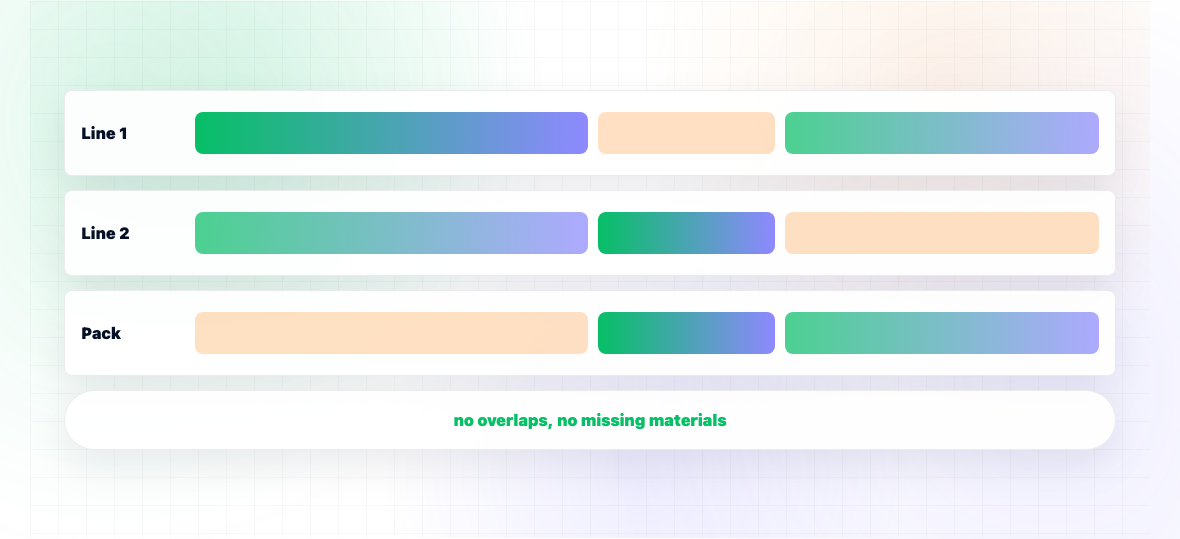
The detailed schedule answers: for each work order in the next 1-4 weeks, when does it start, when does it end, on which specific resources (machines, operators, tools)? The output is a Gantt chart that can be displayed by resource (one row per machine), by work order (one row per order), or by product family.
The schedule must be feasible. Every work order is sequenced on resources that exist, with setup times accounted for, with operators available during the scheduled hours, with materials available when needed. Infeasible schedules are not "almost there" they're useless to operations, which is why detailed scheduling fundamentally differs from MPS.
Detailed scheduling typically optimizes against one or more of:
Objectives often conflict minimizing setup may delay specific orders. Detailed schedulers typically support weighted multi-objective optimization or sequential application (e.g. minimize tardiness first, then minimize setup among schedules with equal tardiness).
MPS decides what to make in each period (typically weekly) at an aggregate level e.g. "1,200 units of Product A in week 12." It checks rough capacity but doesn't sequence work orders. The MPS feeds the detailed scheduler, which produces the executable schedule from the period-level requirement.
MRP computes material requirements from the MPS what raw materials and components need to be available when. It doesn't schedule production; it just identifies material need. Detailed scheduling typically runs after MRP, using MRP's material availability dates as constraints.
CRP validates whether the MPS is feasible against detailed capacity typically run after MRP. It identifies capacity overloads but doesn't sequence work orders to resolve them. Detailed scheduling does the actual sequencing.
The supply plan operates at the monthly level over 12-24 months. It tells the company how much product family X to make in month Y. Detailed scheduling operates at the work-order level over 1-4 weeks, telling the shop floor exactly what to run when.
Detailed schedules refresh more often than any other planning layer:
The right cadence matches the rate of change in the shop floor. Stable operations don't need shift-level re-scheduling. Operations with significant variability benefit from it.