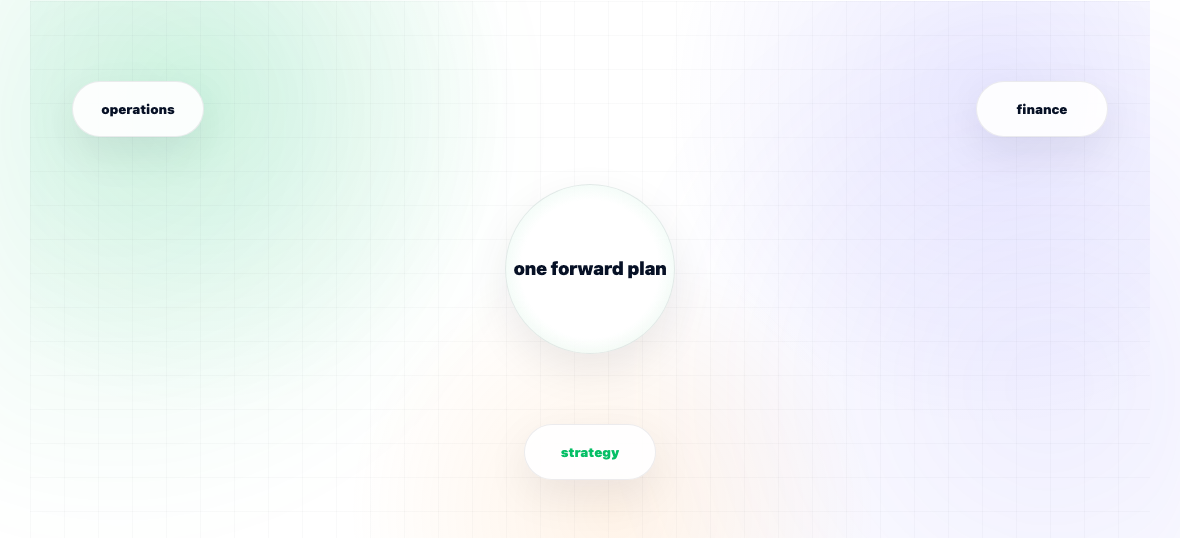
Integrated Business Planning (IBP) is a monthly executive rhythm that aligns operations, finance, and strategy on a single forward plan covering the next 24-36 months. It produces a feasible operational plan that has been reconciled to financial targets and strategic commitments so the volume plan, the revenue plan, and the strategic plan are all the same plan.
IBP evolved from S&OP (Sales and Operations Planning) by extending the scope. S&OP balances demand and supply in volume terms. IBP extends that to balance volume and value including margin, working capital, and strategic initiatives. The participants change accordingly: where S&OP is typically run by supply chain, IBP is owned by the COO or CEO with finance as a peer participant.
This page covers the five-step process most mature IBP rhythms follow, what each step actually produces, and the difference between IBP done well and IBP that's just S&OP with finance in the room.
Horizon supports each of the five steps in a connected workflow. Product Management Review is supported by lifecycle status tracking on every SKU. Demand Review uses Horizon's demand planning module with structured overlays and FVA. Supply Review tests the demand plan against production capacity, raw material availability, and distribution constraints automatically identifying gaps.
The Financial Integration step is where Horizon differentiates from pure S&OP tools. The operational plan flows into a financial model that translates volume changes into revenue, margin, and working capital impact. Mix-driven margin shifts surface as exceptions. Gap-to-budget analysis runs in the same view where the operational plan is reviewed.
For the Management Business Review, Horizon provides executive views designed for non-planners gap-to-target dashboards, scenario comparisons on both volume and value, named action items with owners and due dates. The same source of truth that drove the operational decisions drives the executive review.
The honest caveat: deploying IBP is more about process design and executive sponsorship than tool deployment. Horizon supports the rhythm, but the rhythm itself is something the company has to commit to. Most companies that try to deploy IBP without changing the executive operating model end up with software supporting a process that doesn't fully exist.
See how Horizon supports the full IBP rhythm in one workspace

Most companies have multiple parallel planning processes that produce inconsistent plans. Sales runs a quota and pipeline forecast. Operations runs a production plan. Finance runs a budget and rolling forecast. Strategy runs investment cases. Each process has its own assumptions, its own time horizon, and its own number and the numbers don't match.
The cost of parallel planning is visible at month-end. Operations delivered the production plan. Sales hit volume targets. Yet the P&L misses because the mix shifted (operations made what was easy to make, not what was most profitable to sell). Or the cash flow misses because inventory built up in the wrong SKUs. Or the strategic investment didn't deliver because the operational plan didn't actually execute it.
IBP exists to collapse these parallel processes into one rhythm. The same monthly cycle produces the volume plan, the financial reconciliation, and the strategic alignment so when the executive team approves the plan, they're approving one consistent set of numbers, not three sets that might or might not reconcile. Companies that move from parallel planning to true IBP typically see 2-4 points of margin improvement within 12-18 months, mostly from mix and capital allocation decisions that previously fell through the gaps between processes.
Reviews the product portfolio: launches, discontinuations, lifecycle transitions, NPD pipeline. Confirms which products are in scope for the cycle and what assumptions apply to each phase.
Owner: Product/Marketing. Output: Validated product master list with lifecycle status. Typical duration: 2-3 days.
Builds the consensus demand plan. Statistical baseline plus structured overlays from sales and marketing, reconciled to commercial targets. Multiple scenarios may be developed (base, upside, downside).
Owner: Demand Planning / Commercial. Output: Demand plan by SKU, customer, and channel for the next 24-36 months. Typical duration: 4-5 days.
Tests whether the demand plan is feasible from a supply perspective. Reviews production capacity, raw material availability, supplier constraints, distribution capacity. Identifies gaps and proposes resolution: additional shifts, alternative sourcing, capacity investment, demand reshaping.
Owner: Supply Chain / Operations. Output: Feasible supply plan, named gaps, proposed resolutions. Typical duration: 4-5 days.
The step that distinguishes IBP from S&OP. The operational plan (demand + supply) is converted into financial outcomes: revenue, margin, working capital, cash flow. Gaps versus the financial plan and strategic targets are identified, with named owners for closing each gap. Scenario analysis runs against financial outcomes comparing the impact of different operational choices on the P&L.
Owner: Finance / FP&A. Output: Financially-reconciled plan with gap-to-target analysis. Typical duration: 3-4 days.
The executive review. CEO, COO, CFO, plus functional heads. Decisions made: approve the plan, escalate unresolved gaps, allocate resources to close gaps, adjust strategic priorities if needed. This is the company's primary operating cadence, not a supply chain meeting.
Owner: CEO or COO. Output: Approved monthly plan, decisions log, action items with owners. Typical duration: 2-3 hour meeting following 1-2 days of pre-read review.
Finance owns the financial integration step and participates in scenario decisions as an equal partner not as a reporter who shows up at the executive meeting to read out numbers.
New product launches, capacity investments, market entries, M&A integration all reviewed in the same rhythm as the operational plan, not in parallel meetings.
The plan is not just "the plan." It's "the plan we approved among three considered alternatives." The other scenarios are documented and the trade-offs are visible.
If the CEO uses the IBP meeting as the place where the company's monthly direction is set, IBP is real. If the CEO sets direction in other meetings and IBP reports out, it's still S&OP.
IBP runs further out than S&OP because the decisions it informs (capacity investment, strategic launches, market entries) have lead times longer than 12 months. The near-term months (1-6) are bucketed monthly with high detail. The middle horizon (6-18 months) bucketed monthly with summary detail. The far horizon (18-36 months) bucketed quarterly. The longer horizon is what enables strategic decisions to be folded into the operational rhythm rather than handled separately.