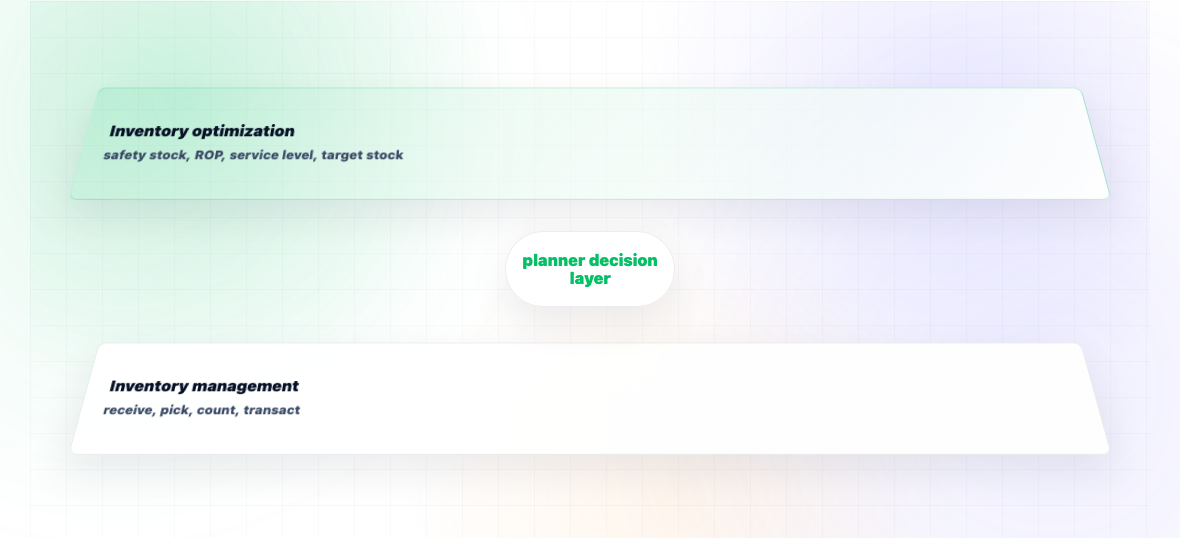
Inventory optimization is the discipline of setting safety stock levels, reorder points, and replenishment policies using mathematical optimization rather than rule-of-thumb methods minimizing total working capital tied up in inventory while meeting defined service level targets. It's the analytical layer above traditional inventory management, which focuses on transaction control (receiving, putaway, picking) rather than the math of how much to hold.
The distinction matters because inventory management can be done well without optimization, and inventory optimization can be done badly without management. The two are complementary: management handles execution, optimization handles policy. A warehouse with excellent management running on rule-of-thumb inventory policies typically carries 20-35% more inventory than necessary.
This page covers how inventory optimization actually works mathematically, the methods used at different levels of sophistication, where it pays back, and how it integrates with demand planning and supply planning.
Horizon's inventory optimization module covers all three levels statistical safety stock for simple cases, single-echelon with lead time variability for moderate complexity, and full multi-echelon optimization for networks with multiple stocking locations. Method selection per customer is based on network structure and SKU portfolio characteristics.
The integration with demand planning is direct. Forecast accuracy metrics (MAPE, bias, tracking signal) feed automatically into safety stock calculations. Forecast accuracy improvements translate into safety stock reductions in the next cycle without manual policy updates. The integration is what allows the inventory benefit of better forecasting to actually reach the working capital line.
MEIO handles networks of any topology plant to regional DC to local DC, plant to central DC to regional DC, multi-plant to multi-DC matrices. Risk pooling math at upstream nodes typically reduces total network inventory by 15-25% versus single-echelon calculations.
For customers in pharma and life sciences (where Horizon has IQVIA and Pharma Status integrations), the inventory module respects regulatory minimum requirements as constraints optimization runs within bounds set by compliance, not against them.
The honest scope: Horizon's inventory optimization is built for manufacturers with 500-10,000 active SKUs across 2-20 stocking locations. Very large networks (50,000+ SKUs, 100+ locations) sometimes need specialized inventory tools that scale further. We'll be explicit about that fit in early conversations.
The most common inventory policy in mid-size manufacturers is some version of "weeks of supply" hold 4 weeks of cover for SKU A, 6 weeks for SKU B. The policies are set by experienced planners using judgment and updated occasionally based on stockout experience. They work, sort of. The problem is that they don't reflect the math of inventory.
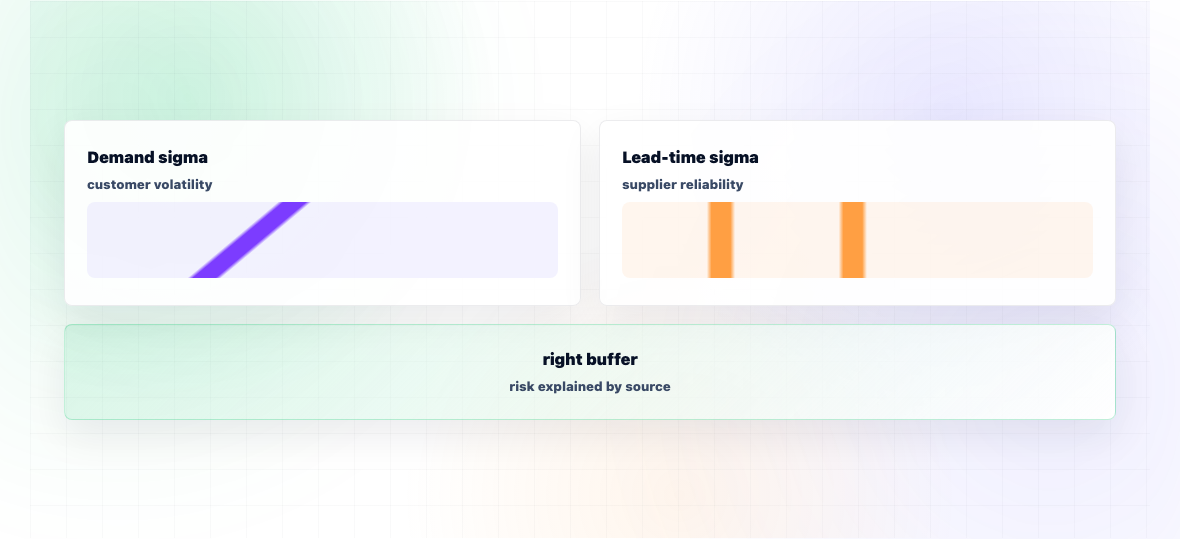
The mathematical reality: the right safety stock for a SKU depends on demand variability (standard deviation, not just mean), lead time variability, service level target, and cost asymmetry between stockouts and excess. A SKU with stable demand and reliable lead time can hold less safety stock than the rule of thumb suggests; a SKU with volatile demand and variable lead time needs more. Rule-of-thumb policies don't differentiate, so they over-stock the predictable SKUs and under-stock the volatile ones.
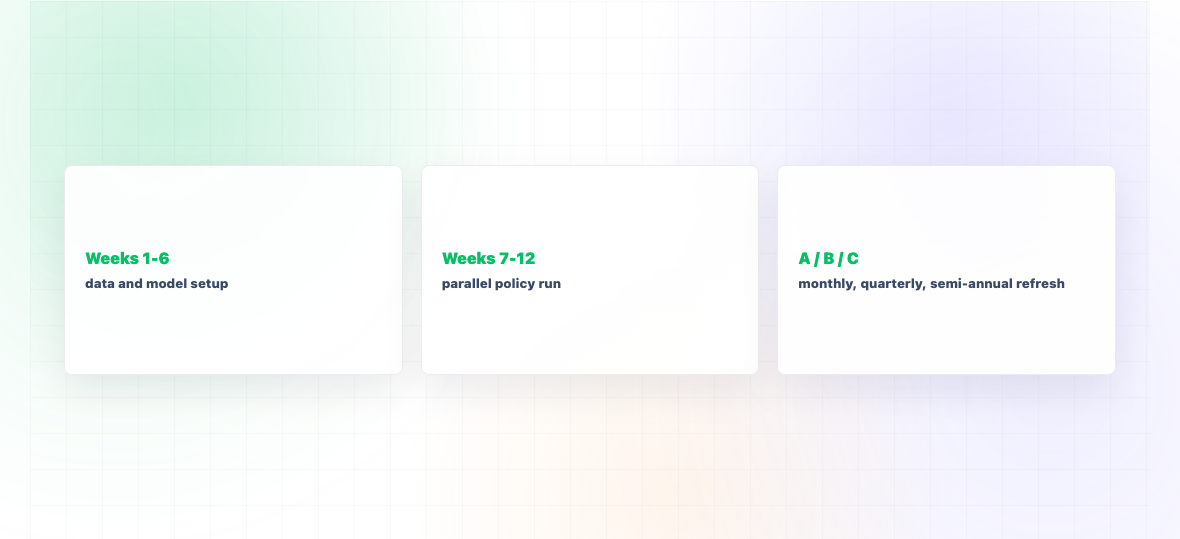
The financial impact is consistent across implementations. Mid-market manufacturers moving from rule-of-thumb to optimization-based policies typically release 15-25% of working capital for a $500M manufacturer, often $5-15M of cash freed up while improving or maintaining service levels. The cash is real; the math works.
The reason this opportunity remains unexploited at many companies is that the math requires data (demand variability per SKU, lead time variability per supplier) and tools (multi-echelon optimization for networks) that aren't in ERP or Excel. Building it manually for thousands of SKUs is impractical. Buying the capability is what unlocks the value.
The foundational level. Compute safety stock per SKU using the classic formula:
Safety stock = Z × σ × √LT
Where Z is the service factor (number of standard deviations corresponding to the desired service level 1.65 for 95%, 2.33 for 99%), σ is demand standard deviation per period, LT is lead time in periods.
Worked example: SKU has mean weekly demand 100 units, standard deviation 25 units, lead time 3 weeks, target service level 95%. Safety stock = 1.65 × 25 × √3 = 71 units. The reorder point is the safety stock plus expected demand during lead time: 71 + (100 × 3) = 371 units.
This level is a big improvement over rule-of-thumb but still treats each SKU independently and doesn't account for lead time variability or echelon structure.
Extends Level 1 by adding lead time variability and refining the safety stock calculation:
Safety stock = Z × √(LT × σ²_d + d̄² × σ²_LT)
Where d̄ is mean daily demand, σ_d is demand standard deviation, σ_LT is lead time standard deviation. This formula recognizes that uncertainty in both demand and lead time contributes to required safety stock.
Level 2 typically reduces safety stock requirements by 5-15% versus Level 1 because it more accurately captures the actual uncertainty, often discovering that lead time variability matters more than demand variability for many SKUs.
For networks with multiple stocking locations (plants, central DCs, regional DCs), MEIO optimizes inventory across the entire network rather than per location. The key insight: holding safety stock at upstream nodes provides risk pooling that reduces the safety stock required at downstream nodes.
Example: A manufacturer has one plant feeding three regional DCs. Each DC serves customers in its region. Without MEIO, each DC holds safety stock based on its own demand variability. With MEIO, some safety stock is held at the plant (or central DC) that can be deployed to any region as needed, plus reduced safety stock at each regional DC. The total inventory across the network is 15-25% lower than the sum of independent single-echelon calculations.
MEIO is computationally significant and requires sophisticated software. It's typically the largest single source of working capital reduction in inventory optimization projects.
Inventory optimization consumes the demand forecast and forecast accuracy from demand planning. The forecast provides expected demand; the accuracy metric (MAPE or MAD) provides demand variability. Both feed into the safety stock calculation.
The integration matters because forecast accuracy improvements automatically translate to safety stock reductions when the two systems share data. A 5-percentage-point MAPE improvement might allow a 10-15% safety stock reduction at maintained service levels. Without integration, this improvement is invisible to the inventory policy.
Optimization sets the policies (safety stock, reorder points, target levels). Supply planning executes them generating replenishment orders, planning production to maintain stocking levels, coordinating across echelons. The integration is bidirectional: optimization adjusts policies as conditions change; supply planning surfaces capacity or supplier constraints that affect feasibility of the policies.