Manufacturing optimization software uses mathematical models (linear programming, mixed-integer programming, constraint solvers, and increasingly machine learning) to recommend the best production, capacity, and scheduling decisions against a defined objective usually maximum throughput, minimum cost, or maximum on-time delivery, often all three with weightings.
The category is wider than most buyers assume. It spans capacity planning (which products to make in which plant), production scheduling (which order runs on which machine in which sequence), and increasingly inventory and distribution optimization where decisions cascade into the plant floor. The common thread is that the software does not just display data it chooses a plan from millions of feasible options.
This page explains what the category covers, how it differs from ERP and MES (the two systems it is most commonly confused with), and the four capabilities to evaluate before buying.
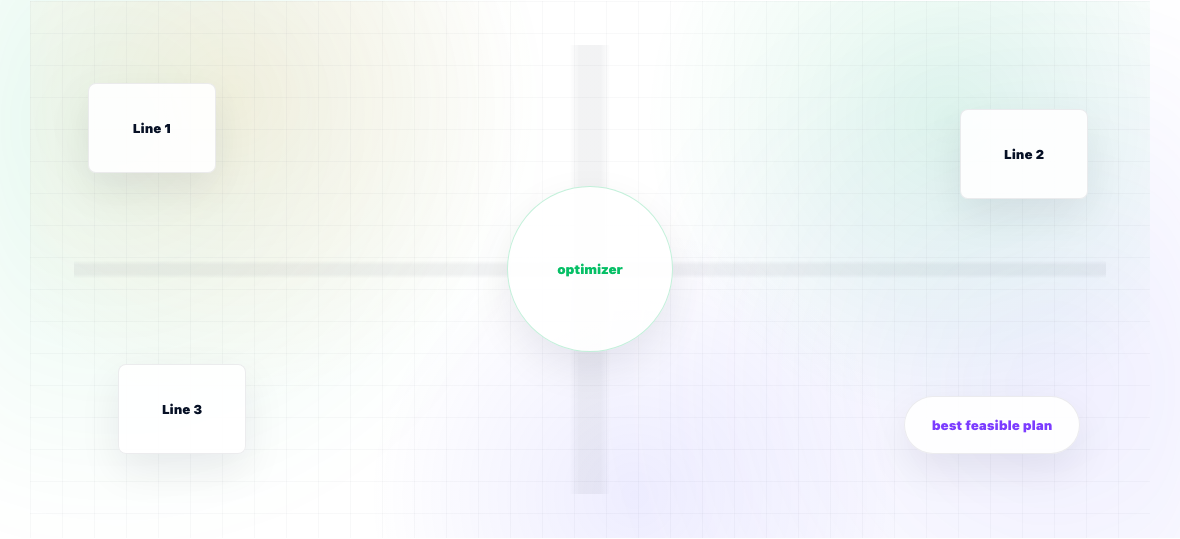
Horizon's optimization stack covers production planning, capacity planning, and detailed scheduling in a single model so the medium-term capacity plan and the daily shop-floor schedule use consistent constraints and the same source of truth. This avoids the common failure mode where the capacity plan promises something the detailed schedule cannot deliver.
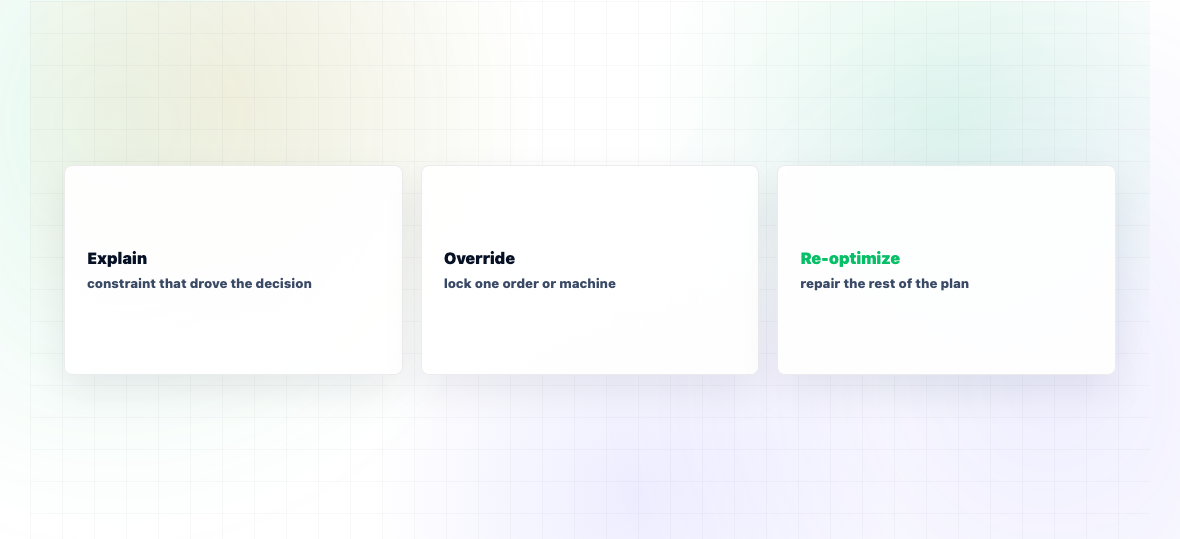
The underlying solver uses linear and mixed-integer programming for capacity decisions, with metaheuristic refinement for detailed scheduling with sequence-dependent setups. Plans re-optimize in seconds when demand changes or machines go down, and planner overrides are treated as additional constraints rather than schedule resets.
For manufacturers with multiple plants, Horizon optimizes the production allocation across the network alongside the within-plant schedule, so the decision of where and when to make something is solved together rather than in sequence.
Most plants run on heuristics: longest-job-first, earliest-due-date, run-similar-products-together. Heuristics are easy to explain and easy to override. They are also wrong more often than people realize.
A real example: a mid-size injection moulding plant in Pune was scheduling by due date and similar-mould-grouping. A mixed-integer scheduler that optimized the same shop floor against the same constraints improved on-time delivery from 78% to 94% and reduced changeover hours by 22% without any new equipment. The plant's planning team was good. The math problem was simply too large for human pattern-matching to solve well: roughly 40 machines, 200 active SKUs, sequence-dependent changeovers, multiple shift constraints, and rolling demand. That is hundreds of millions of feasible schedules per week.
The reason optimization wins is structural. As machine count, SKU count, and constraint count grow, the gap between "the schedule a person can build" and "the best possible schedule" grows non-linearly. By the time a plant has 30+ work centres and 100+ active SKUs, the gap is usually 15-25% of capacity left on the table. Optimization software is the only practical way to close that gap.

The category is broad. Most products cover one or more of these four functions.
Decides which products are made in which plants, over which weeks or months, given demand forecasts and capacity constraints. Common output: a make-vs-buy plan, plant load levelling, overtime/shift recommendations. Solves with linear or mixed-integer programming.
Sequences specific work orders on specific resources, accounting for sequence-dependent setups, machine eligibility, labour, tooling, and maintenance windows. Common output: a Gantt chart with start/end times per work order. Solves with constraint programming or metaheuristics.
Translates demand into a feasible master production schedule and material requirements. Common output: weekly production quantities and raw material requirements. Overlaps with ERP MRP but adds capacity feasibility.
For manufacturers with multiple plants, decides production allocation across the network considering freight, tariffs, lead times, and plant cost structures. Common output: a network production plan minimizing landed cost.
ERP records transactions. Optimization software makes decisions. ERP knows you have 500 units of raw material and 3 open work orders. Optimization software decides which work order to run first to maximize on-time delivery. They are complementary optimization software typically reads master data and orders from ERP, then writes back the recommended plan.
MES (Manufacturing Execution System) runs the shop floor in real time: dispatching, tracking, quality, downtime. It executes the schedule. Optimization software creates the schedule MES executes. Some MES products include basic scheduling, but it is usually rule-based, not optimization-based.