Multi-echelon inventory optimization (MEIO) is a mathematical method for setting inventory levels across a supply chain network multiple plants, central distribution centers, regional DCs, customer-facing stocking locations by optimizing across the entire network rather than each location independently. The defining capability is risk pooling: holding some safety stock at upstream nodes that can be deployed to any downstream location, which reduces the total inventory required across the network.
The alternative single-echelon optimization, which treats each location independently produces safe inventory levels per location but ignores the risk-pooling opportunity. The math difference is significant: a typical multi-location network running single-echelon methods holds 15-25% more total inventory than MEIO would recommend, at the same service levels.
This page covers the math of MEIO, how risk pooling actually works, the data requirements, and where the method delivers real value versus where it adds complexity without proportional benefit.
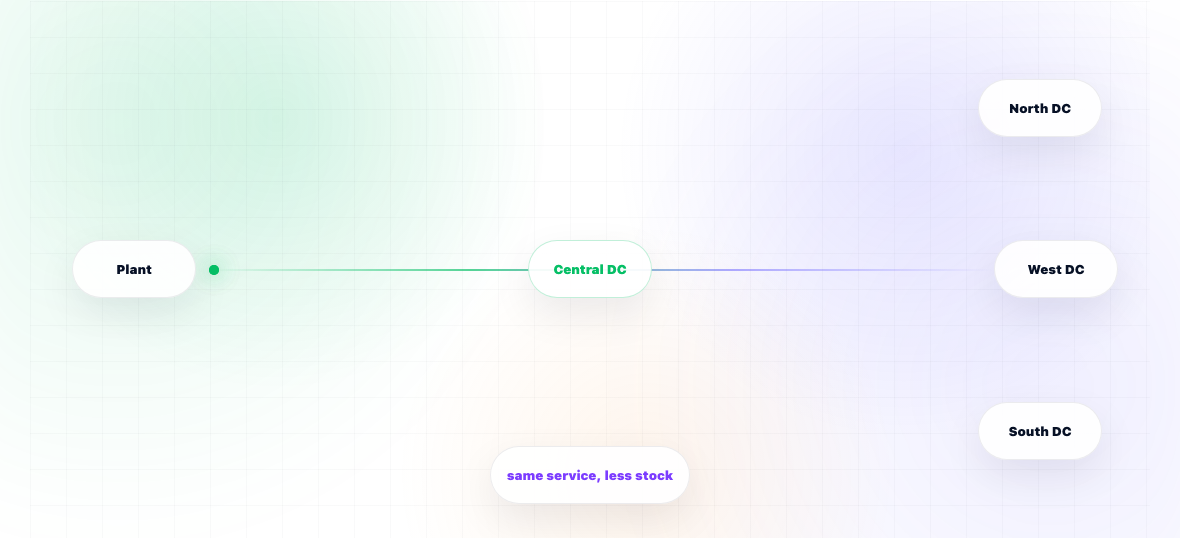
Horizon's MEIO module supports networks of any topology linear (plant → DC → location), matrix (multi-plant to multi-DC), and complex (multi-tier with cross-shipments). The optimization engine handles stochastic service-level evaluation using simulation-based methods, typically running in minutes for networks up to 20 locations and several thousand SKUs.
Network topology is configured during deployment based on actual physical flows. Lead time variability is derived from historical receipt data; demand variability from sales history. Service level targets are configurable per customer-facing location and per SKU classification (A SKUs get higher targets than C SKUs).
The output includes both the recommended inventory levels and the operational policies (reorder points, reorder quantities) needed to achieve them. The policies flow into Horizon's supply planning module so replenishment orders execute against the optimized policies automatically.
Integration with demand planning means forecast accuracy improvements automatically translate to safety stock reductions in the next MEIO cycle. The compounding effect of better forecasting plus MEIO often delivers 25-35% working capital reduction in the first year versus the rule-of-thumb baseline.
The honest scope: Horizon's MEIO handles networks up to roughly 30 stocking locations and 10,000 SKUs effectively. Larger networks (50+ locations, 50,000+ SKUs) sometimes require specialized MEIO tools that scale further we'll be explicit about that fit in early conversations.
Single-echelon inventory optimization sets safety stock per location based on that location's demand variability and lead time. It's mathematically correct for each location in isolation. The problem is that locations aren't isolated they share an upstream supply source, and inventory at the upstream source can serve any downstream location.
A concrete example. Imagine a manufacturer with one plant feeding three regional DCs, each serving customers in its region. Each DC has demand standard deviation σ. Single-echelon analysis computes safety stock per DC based on σ call it S per DC, so 3S total across the network. But variability at the three DCs is partially uncorrelated: when DC A is busy, DC B and DC C may be average. The variance of the combined demand across all three DCs is less than three times σ². The combined standard deviation is √3 × σ ≈ 1.7σ rather than 3σ.
MEIO exploits this. By holding inventory at the upstream plant (or a central DC) plus reduced inventory at each regional DC, the total network inventory comes down. The upstream node acts as a buffer that can flex to wherever demand is highest, while each downstream node holds less because it can pull from upstream when needed. The math: total network inventory typically drops 15-25% at the same service levels.
The reason this isn't done more widely is computational. MEIO is mathematically complex solving the network optimization across all locations simultaneously is significantly harder than solving each location independently. It requires specialized software, and many companies never deploy it despite the working capital opportunity.
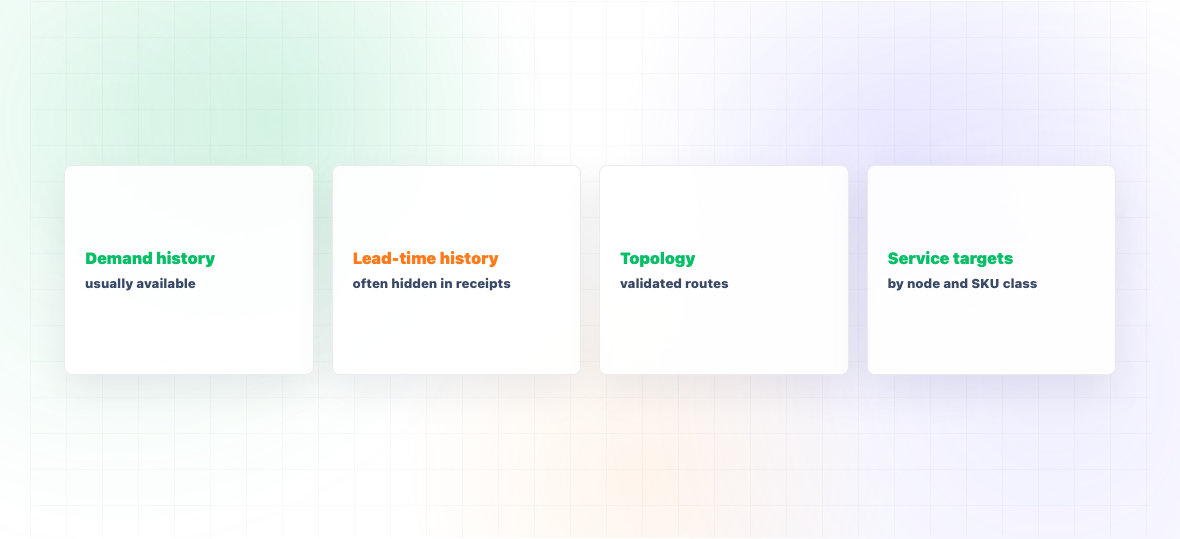
MEIO requires representing the network explicitly: which nodes (plants, DCs, customer-facing locations) exist, which nodes supply which downstream nodes, what the lead times are between nodes, what the demand patterns are at each node. The network can be linear (plant → central DC → regional DC → customer) or matrix (multiple plants supplying multiple DCs which supply multiple regions).
The mathematical formulation: given demand distributions at customer-facing nodes, lead times between nodes, and service level targets at customer-facing nodes, find the inventory levels at each node that minimize total network inventory cost subject to meeting the service level constraints.
The math handles two key effects. First, risk pooling: variance reduction when demand from multiple downstream locations is partially uncorrelated. Second, time-phased coverage: how much safety stock at the upstream node covers downstream demand during the upstream-to-downstream lead time.
Methods used: most commercial MEIO tools use stochastic optimization with simulation-based service level evaluation. Some use closed-form approximations for tractable cases. The math typically takes minutes to hours to run for networks of typical complexity, not real-time.
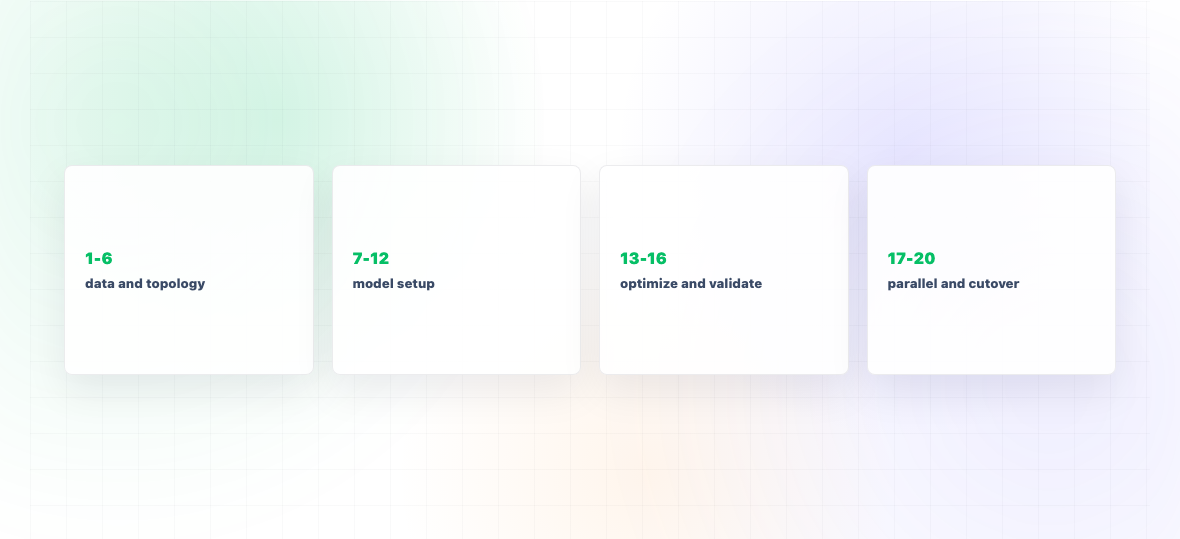
The data preparation is often the longest pole in MEIO implementations. Companies typically have demand history but lack reliable lead time variability data because they've treated lead times as constants. Building lead time history requires 4-8 weeks of work.
The classic MEIO opportunity. A manufacturer with one or two plants feeding 3+ regional DCs typically sees 15-25% network inventory reduction from MEIO. The risk-pooling math is most powerful when downstream demand is partially correlated.
Companies with multiple plants producing the same SKUs benefit from MEIO at the plant level. The central plant inventory acts as a buffer for plants whose production is delayed or whose demand spikes.
Service parts networks often have many SKUs at many locations with intermittent demand. MEIO with intermittent demand methods can deliver dramatic inventory reductions (sometimes 30%+) by pooling slow-moving parts at central locations rather than holding them at every regional location.
For companies that influence inventory at supplier or distributor locations (VMI, consignment), MEIO can optimize across the boundary. Treating supplier inventory as part of the optimization scope typically reveals that inventory has been pushed to suppliers without netting benefit to the overall network.