Production scheduling software generates feasible shop-floor schedules sequencing specific work orders on specific resources at specific times accounting for capacity, sequence-dependent setups, material availability, labor, and customer due dates. It's the planning layer that sits between supply planning (which decides what to make in each period) and execution (MES, operators, and shop-floor systems).
The category encompasses both standalone production scheduling tools (often called APS Advanced Planning and Scheduling) and the scheduling modules within integrated supply chain planning platforms. Both serve the same function; the difference is whether scheduling is bought as a point solution or as part of a broader platform.
This page covers what production scheduling software actually does, the six capabilities that distinguish good tools from limited ones, and how the category integrates with ERP and MES.
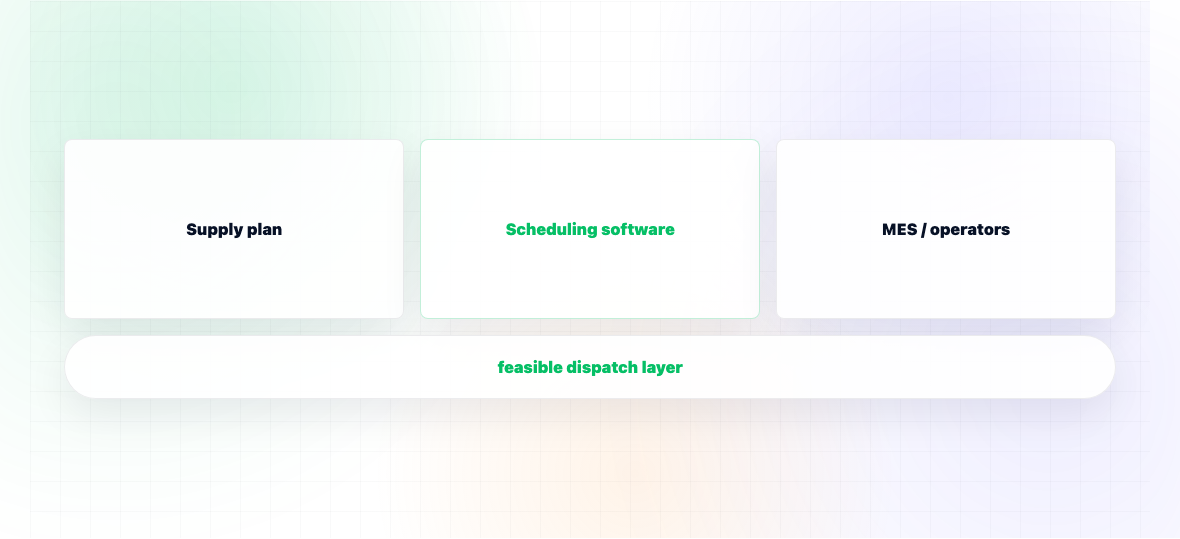
Horizon's production scheduling module is part of the integrated platform connected natively to demand planning, supply planning, and inventory optimization. The scheduler reads work orders from ERP and BOMs/routings from master data, computes the feasible schedule, and publishes to MES.
The scheduler handles sequence-dependent setups, parallel resources, multi-stage routings, batch and lot constraints, and material availability. Multi-objective optimization is configurable per customer most discrete manufacturers optimize for tardiness minimization with secondary setup minimization; process manufacturers often invert this weighting because changeovers are more expensive.
Real-time re-scheduling responds to shop-floor events: machine downtime, material shortage, urgent customer order. Partial re-scheduling takes 2-5 minutes and updates only the affected portion of the schedule. Full schedule regeneration takes 10-30 minutes and runs daily or at shift boundaries.
Pre-built integrations exist for SAP S/4HANA, Oracle NetSuite, D365, and Infor. MES integration varies by customer environment but typically requires 2-4 weeks of configuration.
The honest scope: Horizon's production scheduling is strongest for discrete and process manufacturers with 1-10 plants, moderate routing complexity, and standard constraint structures. Semiconductor fabs, refineries, and some specialised process operations are better served by industry-specific tools.
ERPs handle the basics of production planning material requirements, period-level production plans, work order release. But they generally don't sequence work orders on specific resources with constraint-aware optimization. The math is too specialized, the computational requirements too unusual, and the planning paradigm too different from the transactional model that ERPs are built for.
The visible symptom is well-known to manufacturers. ERP generates work orders. A scheduler usually a senior person with deep plant knowledge manually sequences them on a whiteboard or in Excel, accounting for what the ERP didn't: changeover times, machine availability, tool conflicts, operator skills, material timing. The schedule that goes to the shop floor isn't the schedule the ERP generated; it's the scheduler's adjustment of the ERP output.
This works, but with costs. The schedule depends on the scheduler's tacit knowledge when that person leaves, the schedule degrades for months. The schedule isn't optimal it reflects what the scheduler could compute by hand, which is much less than what a constraint-aware optimizer could compute. And the schedule isn't reproducible running it again produces different results because so much depends on judgment.
Production scheduling software exists to encode the scheduling logic into a system that runs consistently, optimally, and reproducibly. The goal isn't to eliminate the scheduler it's to give the scheduler tools that handle the combinatorial complexity automatically while preserving their judgment for the cases that genuinely require it.
The schedule respects real capacity of machines, labor, and other constrained resources. Infinite-capacity scheduling where the math assumes capacity is always available produces schedules that look feasible but don't survive execution. Finite capacity scheduling produces schedules that are executable as scheduled.
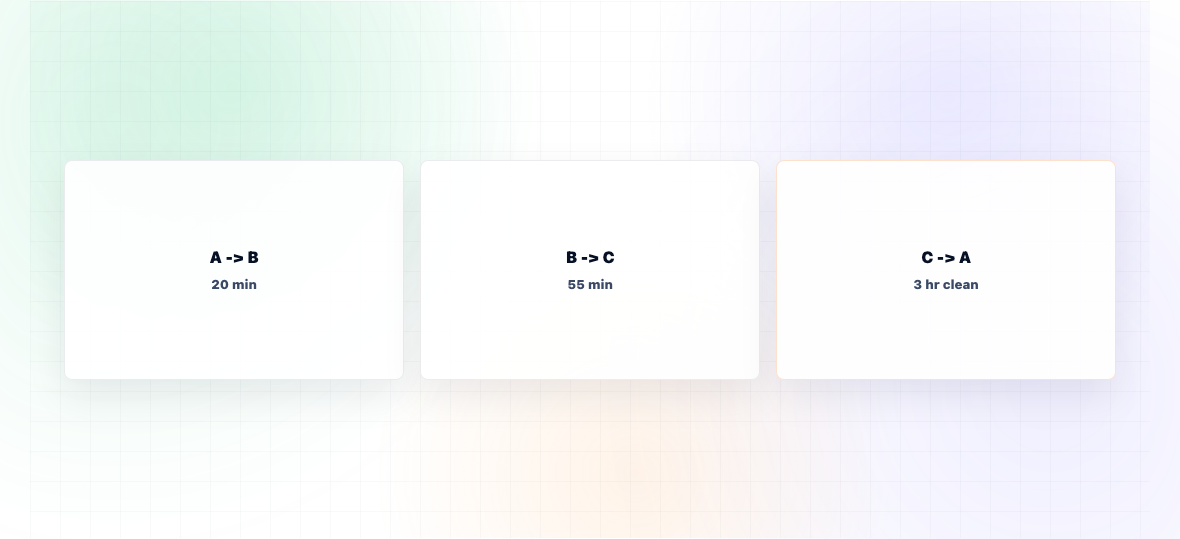
Most discrete and process operations have changeover times that depend on the sequence of products. Running Product A before Product B has different setup than B before A. The scheduler should treat setup time as a function of the sequence, not as a fixed constant per product. Operations with significant changeover variability can see 20-40% throughput improvement from intelligent sequencing alone.
Real scheduling balances competing objectives: minimize tardiness, minimize setup time, maximize throughput, balance load. The scheduler should support multi-objective optimization with configurable weights, not single-objective optimization that ignores the trade-offs.
The shop floor changes constantly. Machines break, materials arrive late, urgent orders come in. The scheduler should support re-scheduling that responds to events while preserving work-in-progress and updating only the affected portion of the schedule. Full schedule regeneration takes too long for shift-level decisions.
The scheduler reads work orders, routings, BOMs, and inventory from ERP. It publishes schedules to MES (or to direct operator interfaces). Status updates flow back from execution. Integration depth determines how much manual data movement the scheduler requires versus how much runs automatically.
The scheduler produces a Gantt chart. The Gantt chart needs to be human-readable, support drill-down to individual work orders, allow manual overrides where the scheduler has context the system doesn't, and clearly show exceptions. Tools that produce schedules in tabular formats rather than visual Gantt charts are much harder to use in practice.
From ERP to scheduler:
From scheduler to MES (or direct execution):
From MES back to scheduler:
Pre-built connectors for the specific ERP and MES products in use. Bidirectional data flow without manual export/import. Configurable mapping between scheduler entities and ERP/MES entities. Automatic conflict resolution when both sides have updated the same record. Status feedback that allows the scheduler to refresh based on actual shop floor events.
Integration is often the longest pole in production scheduling deployments. Companies with multiple ERPs, custom ERP modifications, or MES systems that aren't well-supported by scheduler vendors typically face 8-16 weeks of integration work that's not visible in the software demo.
Standalone production scheduling tools (Quintiq/DELMIA, Preactor, Asprova) offer deep specialization but require integration with upstream supply planning and demand planning. Integrated platforms (Horizon, Kinaxis, o9, SAP IBP) cover scheduling alongside the rest of the planning stack. For most mid-market manufacturers, integrated platforms win on TCO and integration overhead. Standalone tools win when scheduling requirements are unusually complex (semiconductor, refinery, specialised industries).
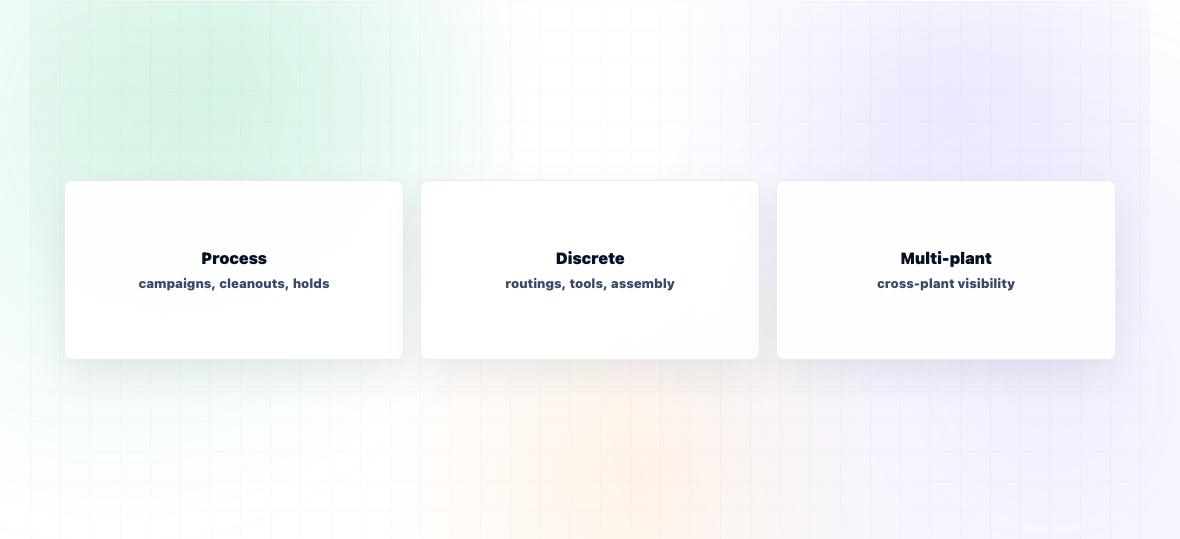
Schedulers vary in their handling of process-specific constraints (campaign-based planning, holding times, sequence-dependent cleanouts) versus discrete-specific constraints (multi-resource operations, tool conflicts, assembly sequences). Verify the vendor has reference customers in your specific manufacturing mode.
Some tools handle single-plant scheduling beautifully but struggle with multi-plant coordination. If the goal is to schedule across multiple plants with cross-plant material movements, verify multi-plant capability explicitly rather than assuming it works.