Replenishment planning software automates the decision of when to reorder and how much, based on inventory levels, demand forecasts, lead times, and target stocking policies. It generates purchase orders for raw materials, transfer orders for moving stock between locations, and production orders for items produced in-house all timed to maintain inventory within optimized policy bounds.
The category overlaps with adjacent functions. MRP also generates orders, but works from production schedules rather than inventory policies. Inventory optimization sets the policies, but doesn't execute them. Replenishment planning sits between optimization (policy) and execution (purchase orders, transfers), automating the decisions that turn policy into action.
This page covers what replenishment planning software actually does, how it differs from MRP and inventory optimization, and where it's most valuable.
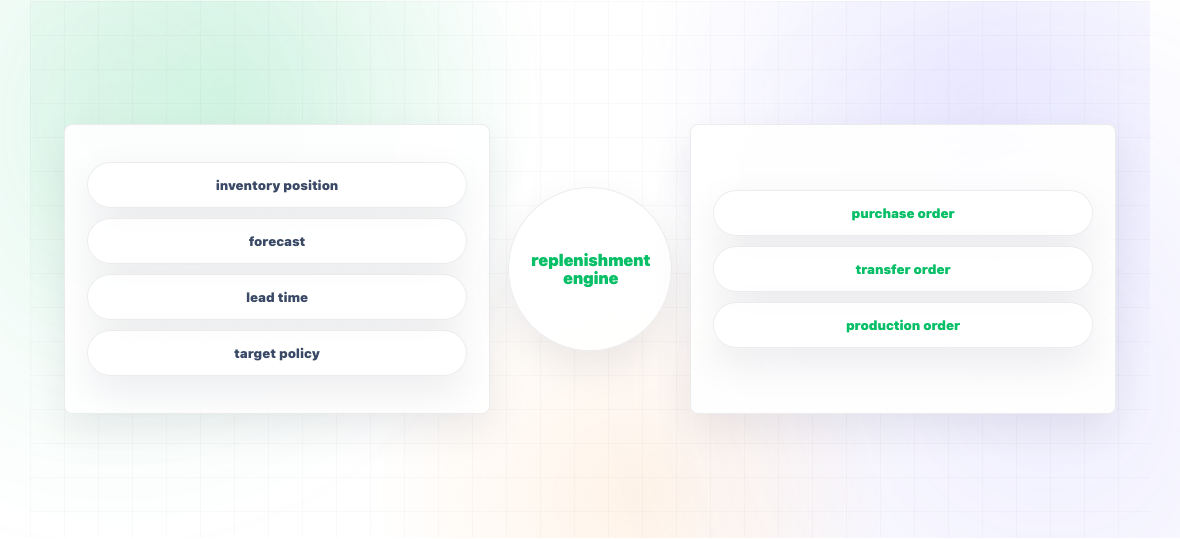
Horizon's replenishment planning module operates as the bridge between inventory optimization (policy) and ERP (execution). The module reads target inventory levels from the optimization module, current inventory and on-order status from ERP, demand forecasts from demand planning, and lead time data from supplier records. It produces replenishment recommendations that flow back to ERP as planned purchase orders, transfer orders, or production orders.
For multi-location networks, the module coordinates replenishment decisions across locations deciding whether to source from upstream supplier or transfer from another location, considering total network cost and service impact.
Constraint handling is configurable per customer: supplier MOQs, container utilization targets, storage constraints, budget constraints. The recommendations respect constraints rather than producing infeasible orders that planners have to fix.
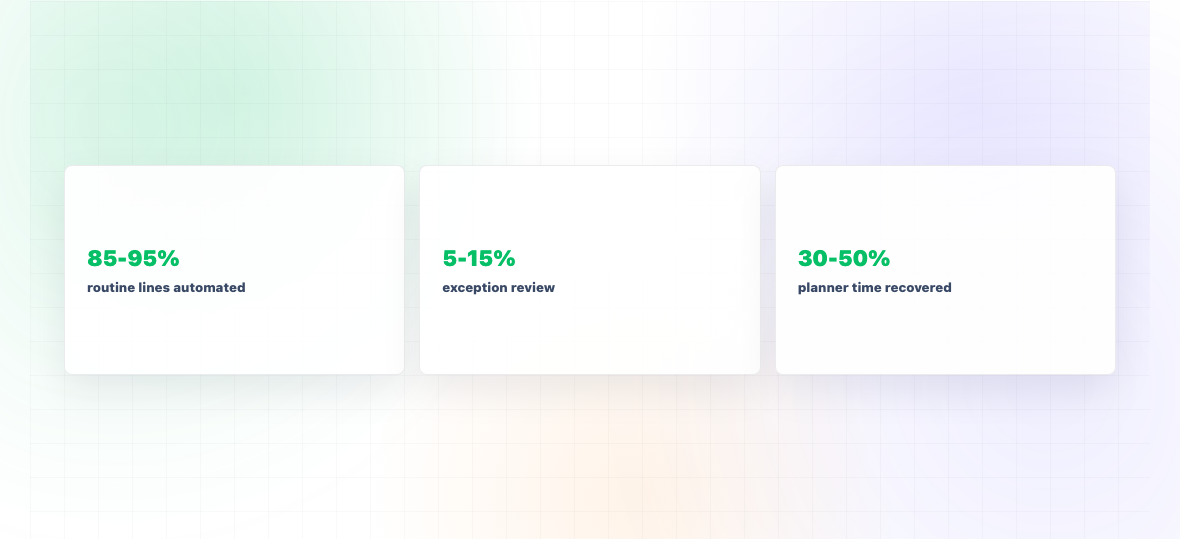
Exception management surfaces 5-15% of recommendations per cycle for planner review unusually large orders, lead time-affected SKUs, policy deviations. The rest run automatically.
The honest scope: Horizon's replenishment planning is built for manufacturers and distributors with 500-10,000 SKUs across 2-30 stocking locations. Larger retail-style networks (500+ stores) often need specialized retail planning tools. We'll be explicit about that fit in early conversations.
Without replenishment planning software, the decision of when and how much to reorder typically falls to one of three approaches. Manual reorder by planner judgment works at small scale but doesn't scale to thousands of SKUs. Rule-based reorder in ERP using min/max parameters works but with rigid logic that doesn't adapt to demand and lead time changes. MRP-driven reordering works for make-to-stock production but doesn't handle distribution replenishment well.
The visible failure modes when replenishment isn't automated well: chronic over-stocking on some SKUs (because conservative rules over-order to avoid stockouts), chronic stockouts on others (because rules don't catch demand shifts fast enough), excessive expedited freight (because reorders happen too late), and significant planner time spent on reorder decisions that are largely mechanical.
Replenishment planning software automates the mechanical decisions while preserving planner judgment for the exceptions. The replenishment recommendations flow from inventory policies, demand forecasts, and current inventory levels the math is consistent across SKUs and across cycles. The planner reviews exceptions: SKUs where the recommendation looks unusual, where lead times have changed, where demand has shifted significantly. Routine reorders run automatically.
For each SKU-location, the software evaluates current inventory against target levels and lead times. When inventory drops below the reorder point, a replenishment order is recommended. The size of the order is determined by target level (order up to a target), economic order quantity (order an optimal batch), or other configurable methods.
Standard logic: If current inventory + on-order inventory < reorder point, then generate replenishment recommendation for quantity = target level − (current + on-order). Adjust for lot-sizing constraints (minimum order quantity, package size, supplier minimum).
In networks with multiple stocking locations, replenishment decisions interact. Should we transfer from DC A to DC B, or reorder from the supplier? Should the central DC stock more so regional DCs can pull on demand? The software handles these decisions by considering the full network state, not just one location at a time.
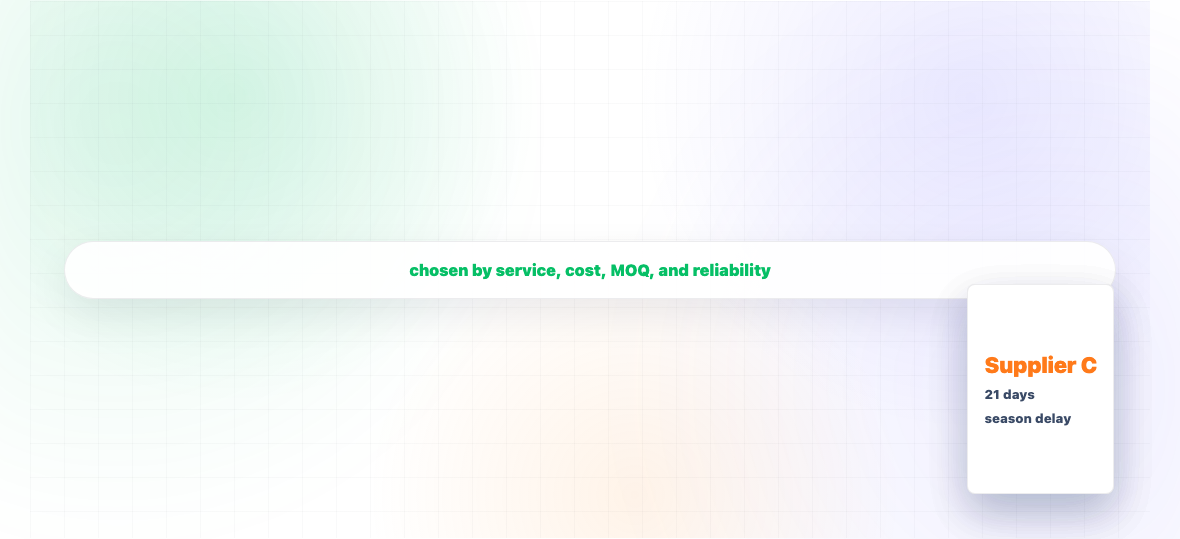
Lead times vary by supplier, by SKU, by season. The software incorporates current lead time estimates (which may differ from historical averages) into reorder timing. For SKUs with multiple suppliers, the software can recommend which supplier based on lead time, cost, and reliability.
Real replenishment has constraints. Supplier minimum order quantities. Container utilization (don't order a quarter-container when shipping costs the same as a full one). Storage constraints at the destination (don't order what doesn't fit). Budget constraints. The software handles these as part of the recommendation, not as manual overrides after the fact.
Most replenishment decisions are routine and should run automatically. A subset are exceptions that need planner review: unusually large recommendations, SKUs where lead times have recently changed, SKUs with chronic deviation from policy. The software surfaces exceptions while letting routine reorders execute.
MRP generates orders based on production schedules what materials need to be available to support the MPS. Replenishment planning generates orders based on inventory policies what should be reordered to maintain target stocking levels. The two coexist: MRP for production-driven material flow, replenishment for inventory-driven flow. For pure make-to-stock production, MRP can substitute for replenishment planning. For distribution and stocked items, replenishment planning is more appropriate.
Inventory optimization sets the target inventory policies (safety stock, reorder points, target levels). Replenishment planning executes against those policies generating the actual orders that achieve the target levels. The two functions are complementary: optimization decides what to hold; replenishment decides when to order to maintain it.
Distribution planning handles broader network flows production allocation across plants, inventory deployment across DCs, freight planning. Replenishment planning is the narrower execution of inter-location replenishment within the distribution plan. Distribution planning may decide that DC A serves Region X; replenishment planning decides when DC A reorders from the upstream source.