Rough-Cut Capacity Planning (RCCP) is a higher-level capacity check that validates whether the master production schedule (MPS) is broadly feasible against the company's critical resources typically bottleneck machines, key labor categories, and constrained suppliers. It runs before MRP and detailed scheduling, catching infeasibility early when it's cheaper to fix.
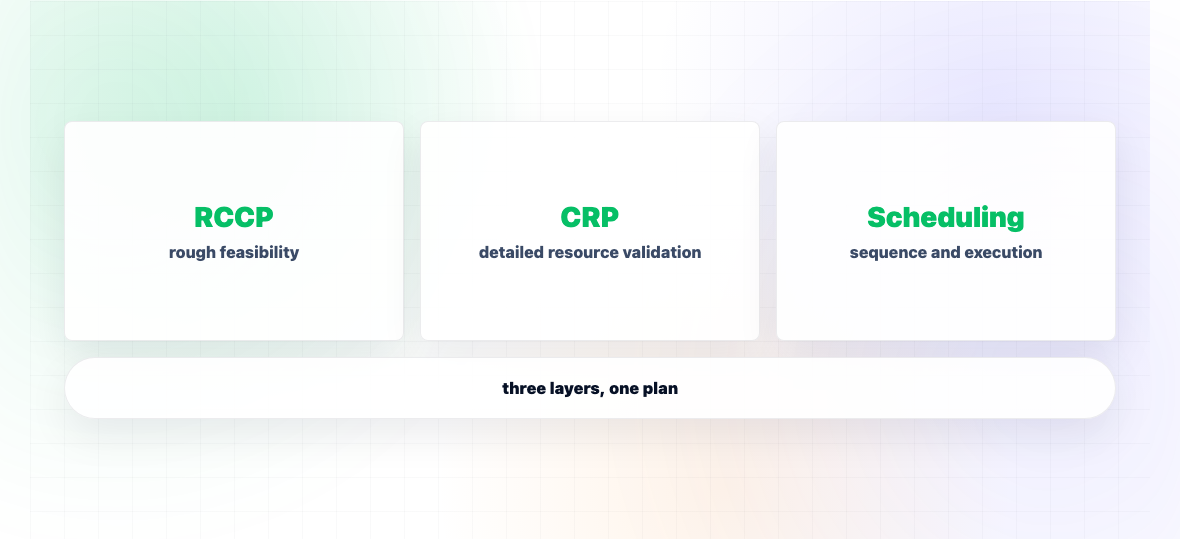
RCCP differs from CRP (Capacity Requirements Planning) by scope and timing. CRP runs after MRP, checks every resource in the routing, and operates at a detailed level. RCCP runs before MRP, checks only critical resources, and operates at an aggregated level. Both have their place RCCP for fast directional feedback during MPS development, CRP for detailed validation before execution.
This page covers how RCCP works, the three common methods used, where it fits in the planning hierarchy, and why it's experiencing a resurgence in modern planning systems despite being one of the older planning concepts.
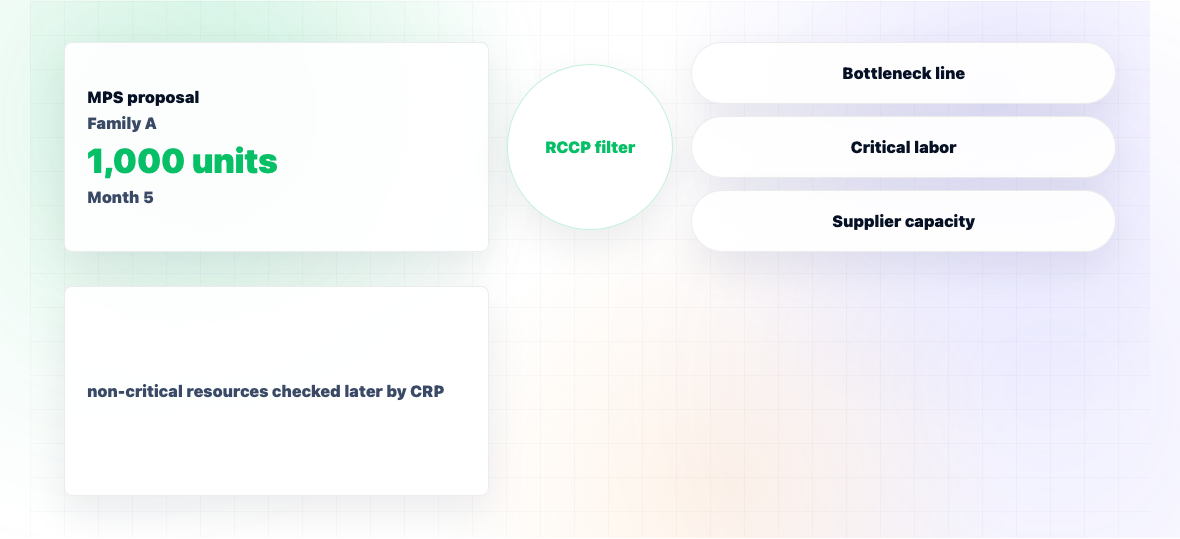
Horizon supports RCCP using the bill of resources and resource profile methods, with method selection per customer based on data availability and required fidelity. The RCCP calculation runs interactively, so planners see the capacity impact of an MPS change as they make the change not after a separate batch run.
Critical resources are configurable per customer. Most manufacturers identify 5-15 truly critical resources whose capacity drives the feasibility of the entire MPS. RCCP runs against these resources only, providing fast validation that focuses on what actually matters. Non-critical resources are checked later by CRP and detailed scheduling.
The integration with S&OP and IBP is direct. As the S&OP team reviews the proposed plan, RCCP provides real-time feedback on whether the plan is broadly feasible. This shifts the S&OP conversation from "approve the plan and hope it works" to "approve the plan that we've verified can be made." The shift is structural planning decisions get made with capacity context, not in isolation.
The honest scope: RCCP is more valuable for operations with capacity-constrained critical resources than for operations with significant excess capacity throughout. If your plant runs at 50% utilization across all resources, RCCP rarely catches anything. If you have one or two bottleneck resources running at 85%+, RCCP earns its keep continuously.
The planning hierarchy creates a tradeoff: high-level plans run fast but don't validate detailed feasibility; detailed plans validate feasibility but run slow. Without an intermediate check, planners face a choice develop an MPS quickly without knowing whether it's feasible, then discover the infeasibility after MRP and CRP have run; or develop the MPS slowly with detailed checking at each step.
RCCP exists to provide fast directional feedback during MPS development. A planner adjusting the MPS to absorb a demand surge can run RCCP in seconds to see whether the proposed plan is broadly feasible. If it's not, the adjustment can be revised before MRP runs. The cost of catching infeasibility at the RCCP stage is roughly 10% of catching it after MRP and CRP because the cascading replanning of materials, schedules, and commitments hasn't happened yet.
The reason RCCP is having a resurgence in modern planning systems is computational. Older ERPs ran RCCP as a separate batch process, which limited its usefulness. Modern systems run RCCP interactively a planner sees the capacity impact of an MPS change in real time as they make the change. This converts RCCP from a quarterly validation exercise to a continuous decision support tool.
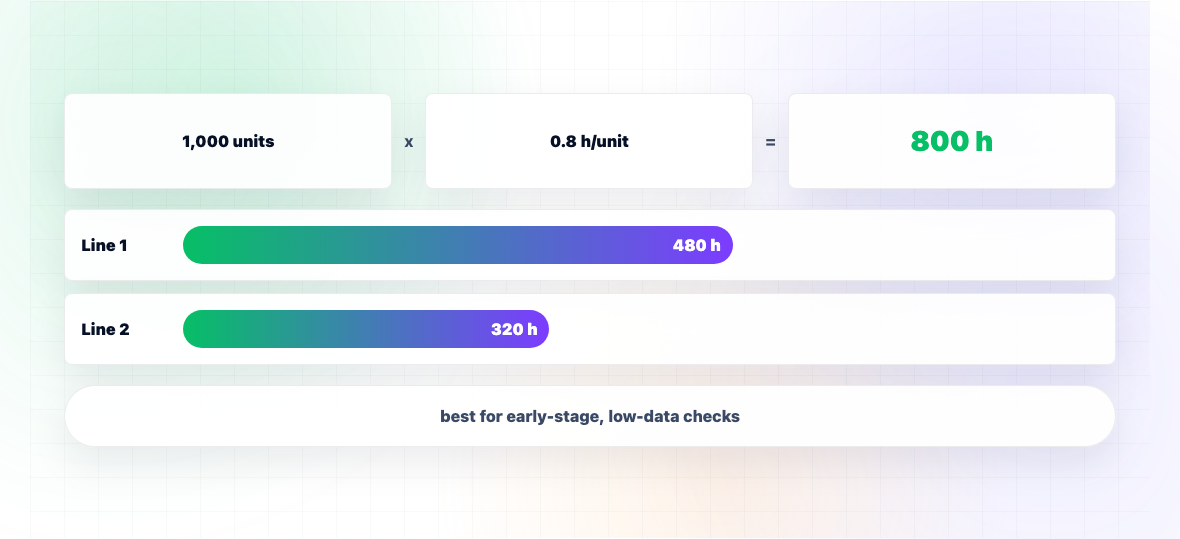
The simplest method. Compute the total capacity required by the MPS using an overall hours-per-unit factor for each product family, then compare against total available capacity. Allocate the load to specific resources using historical proportions.
Example: MPS calls for 1,000 units of Family A in month 5. CPOF factor for Family A is 0.8 hours per unit. Total load: 800 hours in month 5. Historical allocation: 60% to Machine Line 1, 40% to Machine Line 2. So 480 hours on Line 1, 320 hours on Line 2.
Strengths: Fast. Minimal data requirements. Good for early-stage MPS development where precision isn't critical.
Weaknesses: Inaccurate when the actual product mix differs from historical proportions. Misses non-bottleneck resources entirely.
More precise. Each product family has a "bill of resources" that lists the specific resources it uses and the hours per unit on each. RCCP traverses this bill and accumulates capacity requirements per resource.
Example: Product A's bill of resources specifies 0.5 hours on Machine Line 1 plus 0.3 hours on Machine Line 2 per unit. The 1,000 units of Family A in month 5 generate 500 hours of Line 1 load and 300 hours of Line 2 load accurate to the resource level.
Strengths: Accurate enough for most decision-making. Handles different products with different resource profiles correctly.
Weaknesses: Requires bill of resources data to be maintained. Doesn't account for sequence dependencies or specific work order interactions.
The most detailed RCCP method. Uses the full routing for each product (the same data CRP uses) but applies it at the period level rather than the work-order level. Captures lead time offsets so capacity requirements are accumulated in the periods where work would actually occur.
Example: Product A's routing requires operation 1 on Machine Line 1 (0.4 hours, week 1 of production), operation 2 on Machine Line 2 (0.3 hours, week 2). For 1,000 units due in month 5, week 4, the resource profile method puts 400 hours of Line 1 load in week 3 and 300 hours of Line 2 load in week 4.
Strengths: Most accurate. Captures lead time effects. Approaches CRP-level fidelity without the detailed scheduling overhead.
Weaknesses: Requires routing data. Slower than CPOF or bill of resources.
RCCP sits between MPS development and MRP. It validates that the proposed MPS is broadly feasible before the company commits to running MRP and the cascade of decisions that follow.
RCCP doesn't replace CRP or detailed scheduling. It provides fast, approximate validation. CRP provides detailed validation against every resource. Detailed scheduling provides feasible work-order sequencing. The three layers complement rather than substitute. RCCP alone is insufficient for operations where sequence-dependent setups, work order interactions, or detailed labor availability matter which is most operations.