Supply chain forecasting software predicts future values across multiple supply chain dimensions customer demand, supplier lead times, transportation capacity, raw material availability, returns and feeds those predictions into planning decisions. It's broader than demand forecasting alone, which focuses only on customer demand.
The category exists because supply chain decisions depend on more than knowing what customers will buy. A factory needs to know what raw materials will arrive on time, what capacity will be available, what lead times to expect from each supplier, and what returns to plan for. These are all forecasting problems, and they share enough methodology (time series, ML, external drivers) that integrated tools cover them together.
This page explains what supply chain forecasting software covers beyond demand, how it differs from dedicated demand planning tools, and where the boundaries actually fall between supply chain forecasting and adjacent categories.
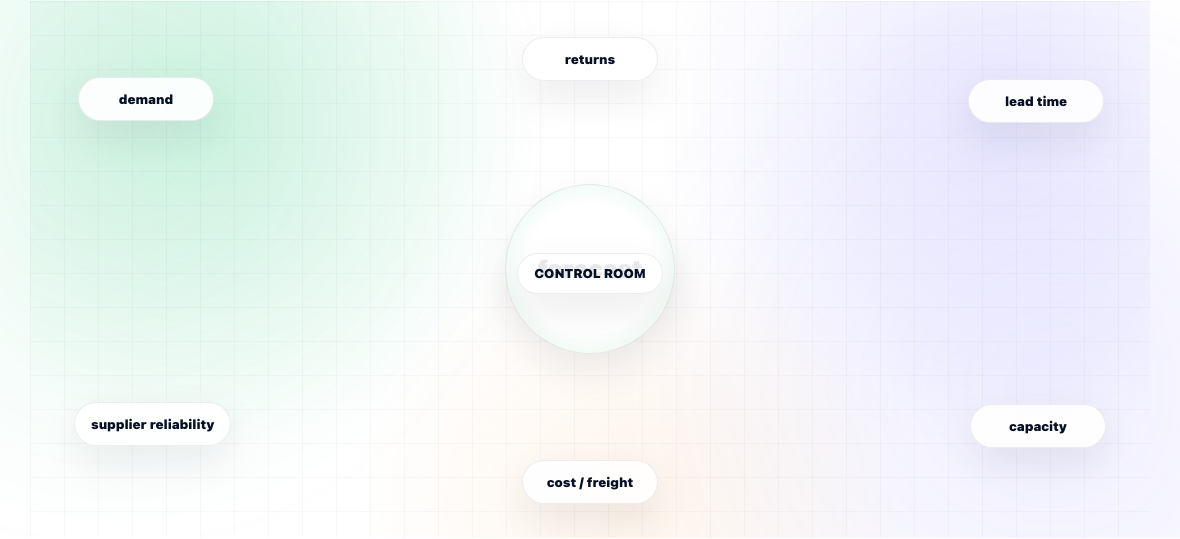
Horizon's forecasting engine covers demand, supplier lead times, and capacity utilisation in a single model meaning the same statistical and ML capabilities applied to demand are applied to other supply chain variables. Lead time forecasts use supplier-level history with ML adjustments for recent drift, rather than fixed historical averages.
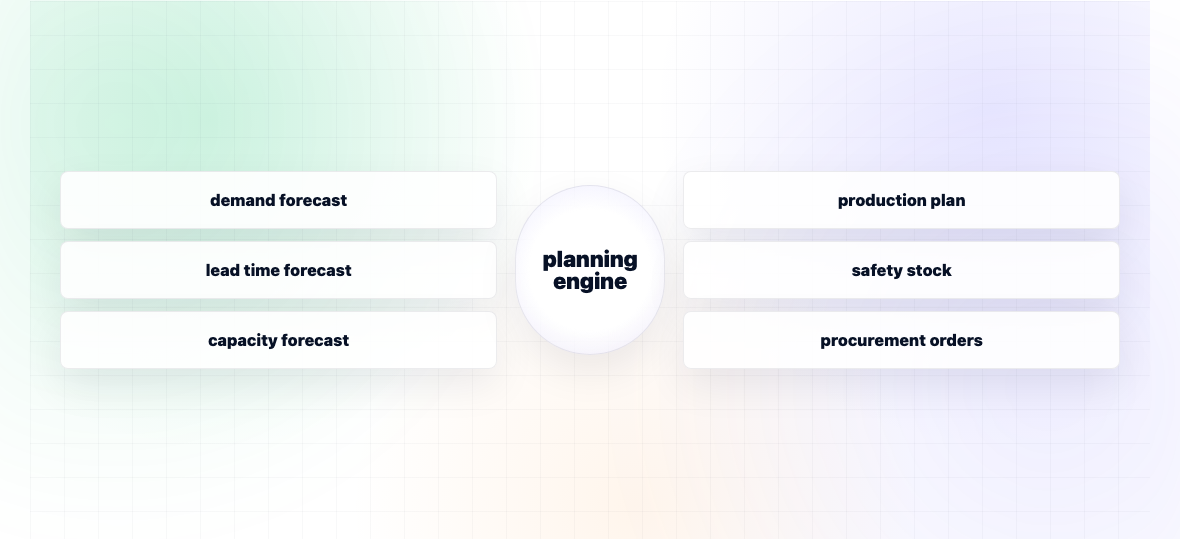
The forecasts feed directly into adjacent planning modules. Lead time forecasts flow into safety stock calculation. Capacity forecasts flow into production scheduling. Supplier reliability flows into procurement decisions. The integration means a forecast update changes the downstream plan in the next cycle without re-keying.
The honest scope: Horizon's supply chain forecasting is deepest on demand and lead times. Returns forecasting is supported for customers in apparel and B2B with consigned inventory. Price and cost forecasting are not core to the current product companies needing rich commodity hedging models typically use specialised tools alongside Horizon for that specific capability.
Most planning failures don't happen because demand was mis-forecast. They happen because something else in the supply chain a supplier lead time, a freight delay, a capacity constraint was assumed stable and turned out not to be. Demand can be 95% accurate and the plan can still fail if the supply assumptions break.
A concrete example. A pharmaceutical manufacturer in Pune ran demand forecasting at 92% MAPE excellent for the category. But they assumed supplier lead times were constant at the historical average. When a key API supplier's lead times stretched from 6 weeks to 10 weeks due to upstream raw material shortages, the entire production schedule fell apart because the safety inventory had been calibrated to a 6-week lead time. The demand forecast was right; the lead time assumption was the failure.
Supply chain forecasting software addresses this by treating lead time, capacity, and supplier reliability as forecasting problems in their own right with their own historical data, their own seasonality, and their own external drivers. A supplier lead time forecast that captures the recent trend is more useful than a historical average that's now six months out of date.
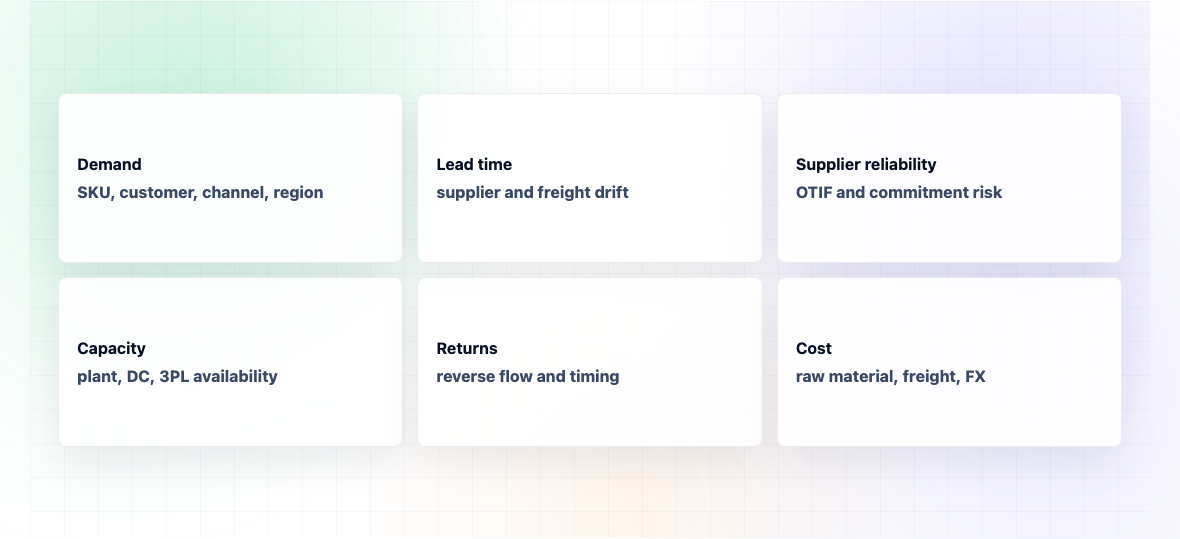
The core capability: predicting future customer demand at SKU, customer, channel, and region levels. Uses statistical methods, ML, and external drivers. This overlaps fully with dedicated demand planning software.
Predicting how long it will take suppliers to deliver, distributors to fulfill, or freight to arrive. Lead times are not constant they drift with supplier capacity, port congestion, seasonal effects, and macro conditions. Treating them as forecasting problems (rather than historical averages) catches drift early.
Predicting on-time-in-full performance from suppliers based on recent history, communicated commitments, and external indicators (financial health, geopolitical risk). Used to set safety stock differently for reliable vs unreliable suppliers.
Predicting available capacity at plants, DCs, and 3PLs accounting for planned maintenance, labour availability, seasonal hiring, and historical effective capacity vs nameplate.
For categories with significant returns (apparel, e-commerce, B2B with consigned inventory), predicting return volume and timing affects reverse logistics, refurb capacity, and net available inventory.
Predicting raw material cost trajectories, freight rates, and FX exposure. Feeds into make-vs-buy decisions, hedging, and cost-of-goods planning.
Dedicated demand planning software focuses deeply on customer demand: extensive collaboration features, hierarchy management, FVA, exception management for the demand forecast specifically. Supply chain forecasting software covers more breadth but often less depth it forecasts many supply chain variables but may have less rich collaboration tooling for any single one.
The practical question for buyers: does the depth in demand collaboration matter more than breadth across supply variables? For mature demand planning teams running complex collaborative processes, depth usually wins. For supply chain teams managing multiple uncertain variables (supplier lead times, capacity, freight), breadth usually wins. Most integrated planning platforms (Horizon, Kinaxis, o9, SAP IBP) provide both.
Horizon is honest about where that depth runs out. It's deepest on demand and lead times, not built for commodity hedging, so the demand planning side of the platform is the strongest reason to evaluate it over a narrower point solution.