Supply planning software translates the demand forecast into a feasible plan covering production, raw materials, inventory positioning, and distribution. It's the function that decides how to meet demand what to make, when, where, with what materials versus demand planning's function of forecasting what demand will be.
The category sits between demand planning (which produces the forecast) and execution (production scheduling, replenishment, procurement). Supply planning consumes the forecast and produces the operational plans that drive what actually gets made and bought. It operates at multiple time horizons: the rough plan over 12-24 months, the master production schedule over 3-18 months, and the material requirements over the next few months.
This page covers what supply planning software actually does, how it differs from demand planning and from production scheduling, and the core capabilities that define modern tools.
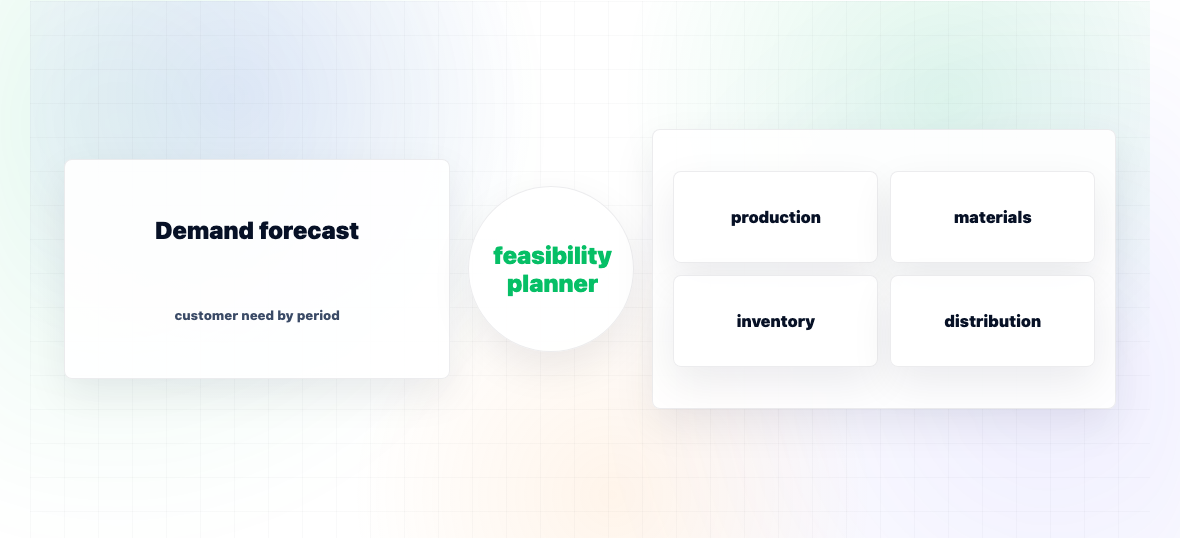
Horizon's supply planning module covers all six capabilities production planning, material requirements, capacity validation, inventory positioning, scenario analysis, and integration with execution. The math uses multi-period optimization with mixed-integer programming for tractable problems and metaheuristics for very large problems.
Integration with adjacent modules is direct. The demand forecast flows from demand planning automatically. Inventory targets come from the inventory optimization module. The approved supply plan publishes to production scheduling for work-order-level execution and to procurement for purchase order generation.
For multi-plant networks, the production allocation across plants happens within supply planning which plant makes which products, with what allocation rules. The optimization considers plant capabilities, capacity, transportation cost, and strategic allocation policies.
Scenario analysis is interactive. A user can adjust demand assumptions, capacity assumptions, or supplier assumptions and see the impact on the plan immediately. Scenarios save for comparison and approval in the S&OP review.
The honest scope: Horizon's supply planning is built for discrete, process, and CPG manufacturers in the $200M-$3B revenue range with 1-10 plants. Highly specialized manufacturing modes (refineries, semiconductor fabs) often need specialized supply planning tools. We'll be explicit about that fit in early conversations.
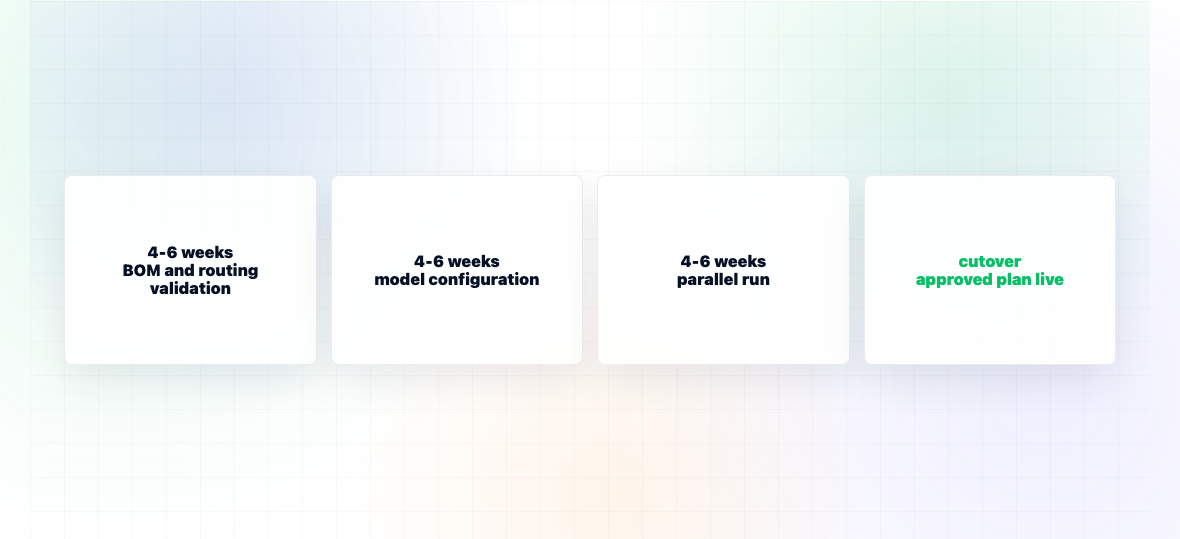
Demand planning answers "what will customers buy?" Supply planning answers "how do we make sure we have it?" These are different math problems with different inputs and different stakeholders. Demand planning operates on sales history, market data, and customer information; supply planning operates on production capacity, supplier capacity, BOMs, lead times, and inventory.
Treating them as one function creates predictable failures. When supply planning is buried inside demand planning, the demand plan reflects what supply can actually deliver rather than what customers will buy producing artificial demand-supply balance that hides real gaps. When demand planning is buried inside supply planning, the supply plan optimizes for production efficiency rather than customer service. Separating the two preserves the integrity of each.
The integration between them is where most planning fails or succeeds. The demand plan feeds supply planning; supply planning feedback (capacity constraints, lead time issues, material shortages) feeds back to demand planning as scenarios. The S&OP rhythm provides the structure for this exchange, and the supply planning software is where the supply-side analysis happens.
For each product family or SKU, determine how much to make in each period across the planning horizon. The plan accounts for current inventory, demand forecast, target stocking levels, and production capacity. The output is the master production schedule (MPS) what gets made, when.
For multi-plant networks, production planning also decides which plant makes which products. The decision considers plant capabilities, capacity, transportation cost to demand regions, and strategic allocation policies.
From the production plan, derive what raw materials and components need to be purchased or produced. This is the classic MRP function exploding BOMs, applying lead times, and netting against current inventory and open orders. Modern supply planning tools enhance MRP with: lead time variability, supplier reliability, and integration with inventory optimization.
The production plan must be feasible against capacity. Supply planning software validates this through rough-cut capacity planning (RCCP) at the family level and capacity requirements planning (CRP) at the detailed level. When the plan exceeds capacity, the software surfaces the gap and supports resolution options: overtime, alternative routing, outsourcing, demand deferral.
Inventory exists across the network at plants, central DCs, regional DCs. Supply planning decides where to position inventory to balance service against working capital. This integrates with inventory optimization, which sets the policies; supply planning executes the positioning decisions over time.
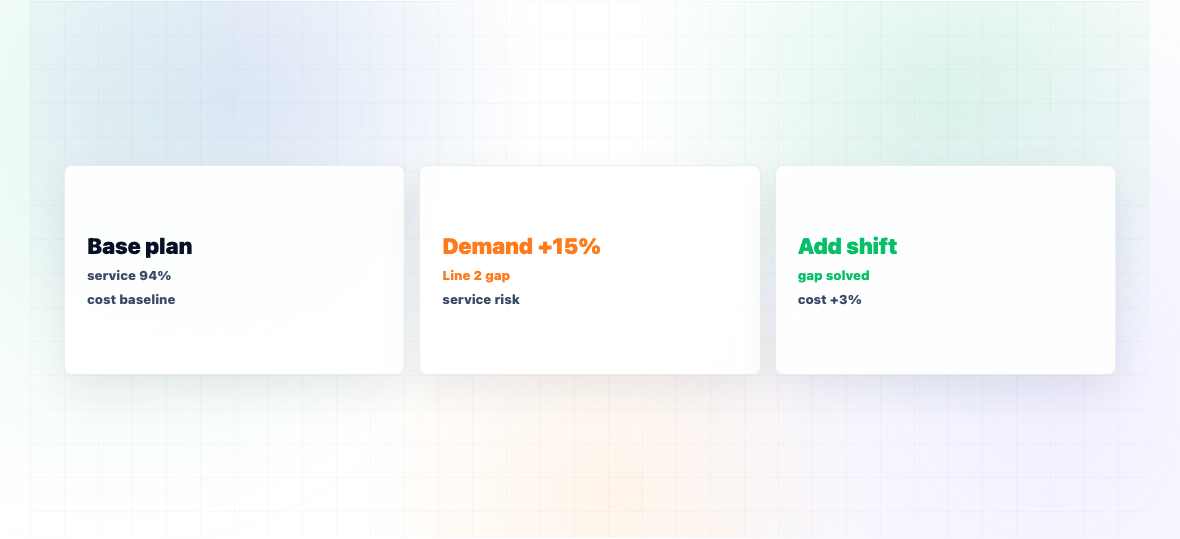
Supply planning supports "what-if" analysis: what happens if demand grows 15%? If supplier X capacity drops? If we add a shift at Plant 2? The analysis covers production feasibility, inventory implications, and cost impact. Scenarios feed into S&OP discussions where strategic decisions get made.
The approved supply plan publishes to downstream execution: production scheduling (which sequences the work orders), procurement (which places purchase orders), and inventory management (which deploys inventory to locations). Modern tools handle this integration natively rather than through manual handoffs.
Demand planning forecasts customer demand. Supply planning decides how to meet it. Different math, different stakeholders, different data. They integrate through the S&OP rhythm: demand planning publishes the forecast, supply planning tests feasibility, gaps are surfaced for executive decision.
Supply planning operates at the period level (typically monthly) over 12-24 months. Production scheduling operates at the work-order level (typically daily) over 1-4 weeks. Supply planning decides what to make in month 5; production scheduling decides which work order runs on Machine 3 at 10:30 AM next Tuesday. The two coexist supply planning sets the boundaries within which scheduling operates.
Supply planning identifies what materials need to be bought; procurement executes the purchases. Strategic decisions (which supplier, contract terms, volume commitments) are procurement's domain. Tactical decisions (when to reorder, how much) flow from supply planning to procurement execution.
At its core, supply planning is a multi-period optimization problem. Over the next N periods, decide what to make in each period, how much inventory to carry between periods, and what materials to order, subject to capacity constraints and demand requirements. The objective is typically minimizing total cost (production + inventory + setup + tardiness) while meeting service level constraints.
Modern supply planning tools solve this using mixed-integer programming or constraint-based methods, often with thousands of decision variables. The math handles the trade-offs: should we build inventory in low-demand months to absorb high-demand months (level production)? Or should we vary production by demand period (chase production)? The optimal answer depends on capacity costs, inventory holding costs, setup costs, and demand patterns.