"AI forecasting" spans a wider category than AI demand planning specifically. It includes pure ML platforms (Amazon Forecast, Google Vertex AI Forecast) used by data science teams to build forecasting capability, demand-planning-focused AI platforms designed for supply chain teams, general ML platforms applied to forecasting use cases (H2O.ai, DataRobot), and enterprise supply chain platforms with AI forecasting embedded.
The right choice depends on who's doing the forecasting and what they need from it. Data science teams building bespoke models often choose pure ML platforms. Supply chain teams forecasting demand operationally typically need demand-planning-focused platforms. This page covers both perspectives.
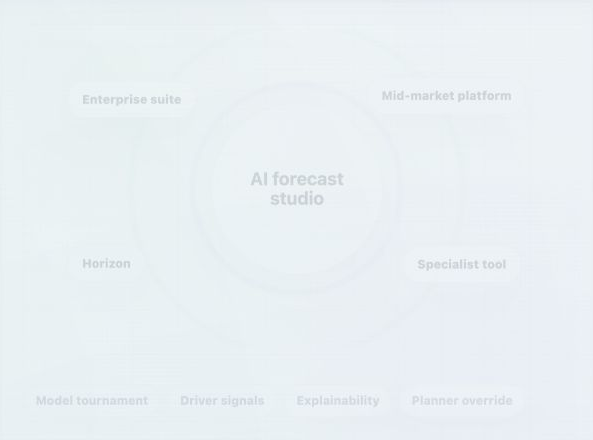
Horizon fits mid-market manufacturers where supply chain teams (not data science teams) need to operationalize AI forecasting integrated with broader planning. The ensemble approach (multiple methods per SKU with automatic selection) handles the heterogeneous demand patterns typical in mid-market portfolios. The integrated platform context means forecasts flow directly into supply and inventory planning without re-keying or integration projects.
Where Horizon doesn't fit: data science teams building bespoke forecasting capability typically choose pure ML platforms (Amazon Forecast, DataRobot, H2O.ai) for the modeling flexibility. Enterprises with very complex relational demand patterns often fit o9's knowledge graph approach better. Operations whose forecasting needs are simple statistical methods (stable demand, no AI lift opportunity) can use simpler tools. We'll be specific about fit in early conversations.
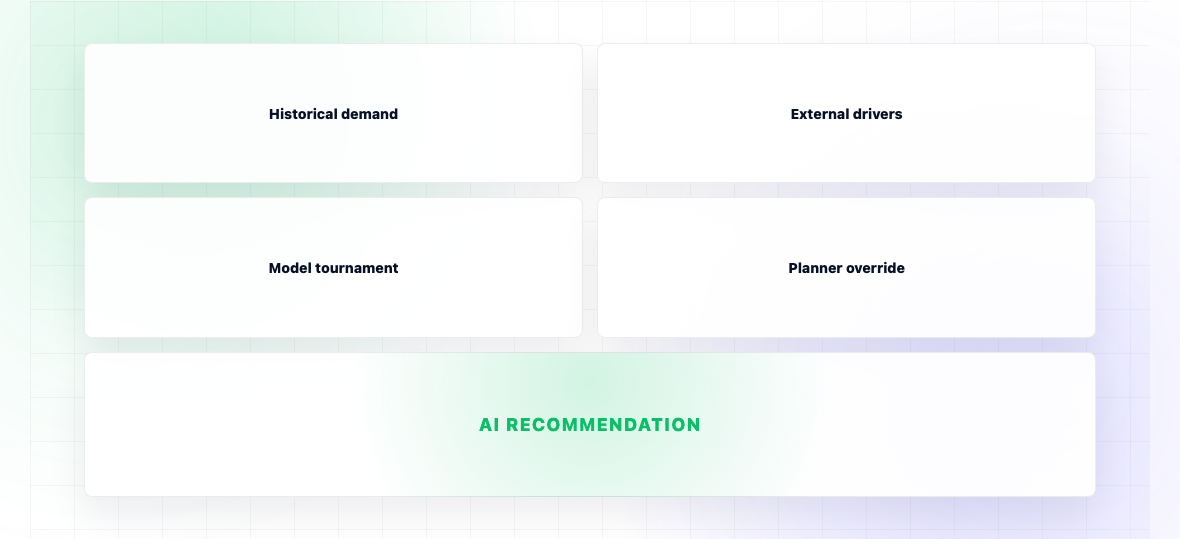
The common confusion: companies hear "AI forecasting" and assume any AI/ML platform can replace demand planning software. They can't, generally. ML platforms like Amazon Forecast or DataRobot are excellent at producing forecasts — but lack the operational layer that demand planners need (forecast review workflows, overlay capture, exception management, integration with supply and inventory planning, FVA tracking, S&OP rhythm support).
The platforms below distinguish along this dimension. Pure ML platforms are powerful tools for data science teams or for companies building bespoke forecasting capability. Demand-planning-focused AI platforms add the operational layer that supply chain teams need. Choose based on who's actually doing the work and what surrounding workflow they need.
Built for: Data science teams building forecasting capability on AWS.
Strengths: Strong ML methods. Native AWS integration. Pay-per-use pricing.
Limitations: No demand planning workflow layer. Requires data engineering to operationalize.
Built for: Data science teams building forecasting on Google Cloud.
Strengths: Strong ML methods. Native GCP integration.
Limitations: Same as Amazon Forecast — no demand planning workflow.
General ML platforms applied to forecasting use cases. Strong for bespoke model development. Require data engineering and ML expertise.
Built for: Mid-market manufacturers wanting probabilistic AI forecasting integrated with planning workflow.
Strengths: AI forecasting with confidence intervals. Fast deployment. Strong handling of demand variability.
Built for: Large enterprises wanting AI forecasting within broader planning platform.
Strengths: Knowledge graph supports AI reasoning across complex relationships. Embedded ML.
Built for: Mid-market manufacturers $100M-$3B revenue.
Strengths: Ensemble forecasting (statistical and ML methods) with automatic per-SKU model selection. Promotional uplift modeling. Integrated with supply and inventory planning. NVIDIA Inception membership.
Probabilistic AI methods integrated with inventory optimization.
AI forecasting embedded within IBP for SAP-centric enterprises.
AI forecasting added to concurrent planning foundation.
AI forecasting with strong retail-CPG demand sensing.
Modeling platform with AI extensions. Best for finance-led planning where forecasting is one of several connected models.
Three factors drive the shortlist. First, who's doing the forecasting: data science teams favor pure ML platforms (Amazon Forecast, DataRobot); supply chain teams favor demand-planning-focused platforms. Second, scope: standalone forecasting fits ML platforms or specialists; integrated forecasting (where forecast feeds supply and inventory) fits demand-planning platforms. Third, scale: enterprise platforms fit $3B+ operations; mid-market integrated (Horizon, Logility, RELEX, ToolsGroup) fit $100M-$3B; specialists fit specific use cases.