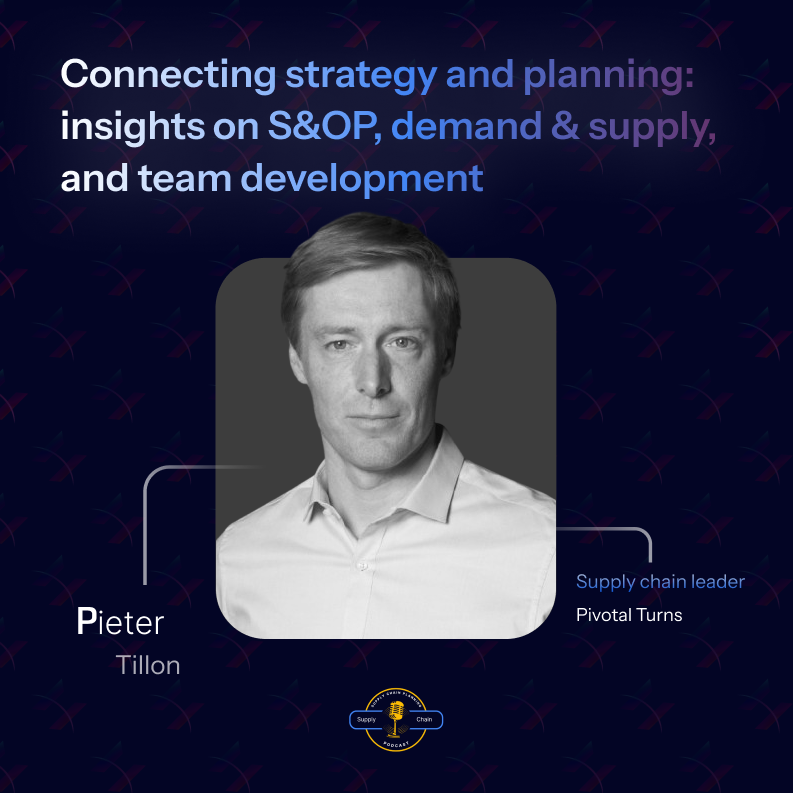
Demand, not sales: how Pieter Tillon started demand planning small and cut inventory 20% at Miele

About Pieter Tillon
Supply chain generalist who has covered every box of the SCOR model: consulting at S&V Management Consultants (now PwC Strategy& and Operations), regional supply chain and demand planning at Miele, demand and supply planning at Omega Pharma (now Perrigo), MRP and DRP at scale-up Edgard & Cooper, Daikin Europe, and most recently Clarebout. Listen to the episode.
Planning is not an island
Pieter Tillon describes supply chain planning as "the orchestration of it all": purchasing, production and delivery each plan themselves, and planning is the layer that connects them. What matters most to him is that it connects upwards too. "It's very important that planning is not a standalone island, but is actually connected to your business strategy."
His reference is Treacy and Wiersema's three value disciplines. Product leaders like Nike and Apple compete on innovation and range; operational excellence players like Aldi, Lidl and McDonald's compete on cost and standardisation; customer intimacy companies compete on customisation and experience, "flying Ryanair compared to flying Emirates". From the business strategy follow the tactical choices, make or buy, make-to-stock or make-to-order or assemble-to-order, decided in S&OP or IBP. Below that sits operational planning and S&OE. "If you don't have the strategic and the tactical level correct, it's very difficult as a planner to plan."
The failure he sees most often is companies that "think they have to be best at all", which produces contradictions in the plan. "We are a make-to-stock company, but when a customer orders something and it's not in stock, we directly start make-to-order. I have encountered that quite often."
Start small: the Miele story
At Miele, responsible for delivery and demand planning across several affiliates, Pieter inherited SAP APO, a 12-month rolling forecast per SKU, and a moving-average proposal that nobody challenged. "Each month someone pressed the button: what APO suggests is good. What did we face? A lot of inventory, and a lot of stock-outs at the same moment."
His approach was deliberately incremental. He asked sales and marketing what data they had, and they shared "all kinds of Excels". He asked whether they met, and joined their monthly meeting. Then he identified where the variation came from: sales were stable except around marketing campaigns, so the product managers were the people he needed. "I said, what's in it for you if you sit with me once a month for one hour: you will have fewer out-of-stocks. In return, consolidate what you already have." The customer-level detail they had was more than APO needed; aggregated, it was exactly right.
The agenda grew meeting by meeting: next time forecast accuracy, which it turned out APO already reported; then a narrowing of scope, because of 500 SKUs "the only problems we have are phase-in items, phase-out items and the promo items", a few dozen. "Gradually we made it smaller, and our input was better and better. We managed to get our inventory down in one year by 20% while maintaining customer service."
Why incremental? "That depends on your company culture. Miele is a German family company, very traditional. If you come out with breaking ideas and push them right through, you will get a lot of resistance. Just get started. What's there, take it and use it to your advantage. Add little steps, and in the end you get a huge result."
Demand, not sales
Everywhere he has run supply chain, Pieter has started with demand planning, for one reason. "Garbage in is garbage out. You can have a bad demand plan and a great supply plan, but if the demand is not good, you'll never be able to match it with your supply. Make sure your demand, not sales, demand is under control."
The distinction is the heart of the episode. Borrowing an example from Nicolas Vandeput: if all the children want vanilla and you run out, sales of vanilla are zero, but "the children still want vanilla. Your sales is zero, but your demand remains." In B2B the noise is worse. At Daikin Europe, the chain runs from headquarters to country affiliates to wholesalers to installers to the end customer, and "sometimes they buy stock because there are cheap prices. Then you think, demand is going up. No: sales is going up, demand might remain the same. You need to bypass all the noise your own supply chain creates."
The way through is external indicators. For Miele's kitchen business, "you could buy the data of building permits, and based on your market share you know your potential demand for appliances". Getting quality data, linked to the right timing, is the hard part, so his sequence is: "Start simple, start with your sales. Correct for out-of-stocks. You need to do that eventually. And with data lakes and machine learning you can find certain things with external data." That, he says, is how you find true demand rather than sales.
One planner for demand and supply?
At Perrigo a new tool made it possible to combine demand and supply planning in one role per brand. The organisation had grown as two separate groups, "so the major difficulty was people". Ben noted that most companies move the other way, splitting as they grow. Pieter sees pros and cons, depending on size, specialism and product similarity, and prefers breadth. "I do believe in as broad as possible." His compromise: the demand specialists stay the experts and key users for their area, lead any tool change there, and coach colleagues, while doing some supply in daily work. "It's not that you're on your own. If you start switching people and the specialist never helps you again, no."
Wim, whose first role was combined "market planning", agreed with a caveat: "You need to find the people, and you need product scopes that are manageable, either similar or a number you can wrap your head around."
Best of breed for planning, SAP for transactions
At Edgard & Cooper, Pieter ran MRP and DRP during the scale-up and would choose specialist tools for planning. "SAP is good for transactional data, for sales order entry. No doubt about that. But I have better experience with smaller local providers who provide more assistance in cloud tooling. If you're a small company or a dynamic company, I would not recommend the big software." MRP for sourcing and production planning, fine; "the overarching things, strategy, tactics, that's more difficult".
Big company or scale-up, the planning is the same. "Whether you sell 10 or 10,000, you need to predict it anyway. The major difference is people and company culture. At Edgard & Cooper, a young bunch of enthusiastic professionals who do not see boundaries. In an established company you have more roles, more silos, and you need to go slower to reach the finish line with everyone."
Hiring for attitude: what gave you energy today?
Pieter does not hire on diplomas. "Skills you can teach. For me it's all about personality and attitude, whether it fits the culture." His interviews are situational. "I don't want to hear, I was responsible for sales order entry. Tell me the last time you had an angry customer on the line. How did that make you feel?" And his favourite: "After the working day, when you close the door and say, yes, today was a great day, what did you do? What gave you energy? And the opposite: what was the bad day?"
On the generational question, he is relaxed. "My father worked far too hard. The generation now has a different approach to work, but I'm sure they want to do their job in a good way. Clearly align expectations. I don't expect planners to be available 24/7. If you give the best you can in those eight hours, I'm happy."
The rare breed
Why are good planners hard to find? "Planning is a very ambiguous job. You want to be structured, you want a plan, and from the moment the plan is created you have to accept that it is outdated. You have to be a dynamic personality as well. I think it's rare." Wim added the second half: people associate planning with analytics, "but once you get into it, it's really a people job", influencing sales, marketing, customer service, plants and transport. Pieter's career advice follows: "If you want to make a career in planning, don't take trainings in analysis. Take presentation skills, convincing skills, influencing skills. The higher you go, that's what it's about, based on objective numbers."
Trust first, then push
Pieter admits to small tests of new team members: a Friday six o'clock call during COVID to ask whether something could be done before the weekend. "If she wouldn't have done it, no problem. But because she did it, I knew." From there he builds on Lencioni's five dysfunctions, trust at the base, with a fixed weekly hour with every direct report. "I don't care if you have a topic or not. If we don't need the hour, we skip it. It's not about Monday you did that and then that. It's about: I saw you were kind of absent, something going on?"
He gives freedom rather than control. "A lot of companies say, trust is good, control is better. I am not a fan. I do it the opposite way." And he pushes people out of their comfort zone deliberately: a planner who says she doesn't know how to talk to salespeople gets introduced to the right salesperson, with the context set in advance, and a one-to-one afterwards. "How did it make you feel before, after? If you see them starting to become enthusiastic, you can see people grow."
Your next steps
- Write down which of the three value disciplines your company competes on, and check the plan for contradictions such as make-to-stock that quietly becomes make-to-order.
- Start demand planning with what exists: the sales data, the spreadsheets sales and marketing already keep, and their monthly meeting.
- Narrow the forecast review to the items that actually cause problems: phase-in, phase-out and promotions.
- Correct sales history for stock-outs, then look for one external indicator tied to your demand.
- Hire planners for attitude and train the skills; invest in influencing and presentation skills for the ones who want to grow.
Pieter's reading recommendation is the Heath brothers, Chip and Dan, and their image of the rider and the elephant. "The rider is the rationality and the elephant is the emotion. If the elephant is loose, it's loose. They give very precise advice on how to direct the elephant in the good direction, with compelling stories. Page-turners."