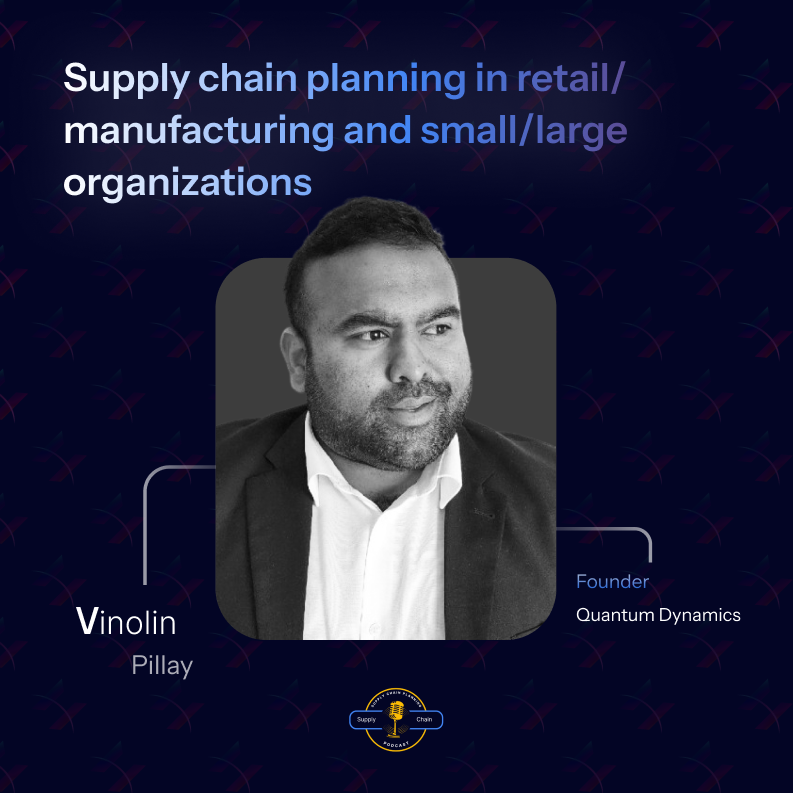
Demand planning in retail and manufacturing: the Demand Matrix, mobility data through COVID, and best of breed versus ERP, with Vinolin Pillay

About Vinolin Pillay
Supply chain manager at a cosmetics company in South Africa, responsible for planning, procurement and quality. Fourteen years in planning before that: replenishment planner at Shoprite, Africa's largest retailer; production planner at packaging manufacturer Nampak; and group demand planning manager at G.U.D. Holdings, the automotive aftermarket manufacturer of filters, brake pads and lubricants. Listen to the episode.
From the retailer's side of the table to the supplier's
Vinolin Pillay's move from retail to manufacturing was deliberate. At Shoprite, as a replenishment planner, he spent his days demanding delivery from suppliers. "I always wanted to understand what stress and what drive am I putting on my suppliers, so I can understand why they're not delivering on time. When a business as big as Shoprite says the supplier needs to deliver, I went from that side to: let us see what the delivery side is. And I think I'm a sucker for punishment, which kept me in manufacturing for this long."
What keeps him in planning after 14 years is the moving target. "We are constantly bombarded with new threats, new opportunities. Every day you're not sure what the next goalpost is. For me, that's a thrill factor." And every business has its nuance: "With that nuance, your knowledge and your experience continue to grow."
Big company first, or small?
Shoprite taught him what a mature supply chain looks like. "Very structured, well designed, cared for the future in systems and processes. People were masters in their field and knew exactly how to run that behemoth of a supply chain. That's where I learned what you could do with data, properly designed systems and people."
The family-owned businesses that followed were the opposite. "How do you take these first-world processes and systems and translate that into a founder-owned business with legacy systems, and professionalise the supply chain and people's mindsets? It taught me patience, understanding that people are cut differently, and how to get the best out of them. It was an internal goal to develop as an individual, not just as an expert."
Which order should a young planner choose? "It depends who you are. If you're the hotshot out of university who wants to get to the pinnacle faster, go to a large corporation and make your name. At a smaller organisation you'll get frustrated; what takes two years will take five or more. But if you're hands-on, want to get your hands dirty and build something special with a family-owned company, and they give you the rewards that keep you there, that's an option as well."
Skills: data, detail, and a sixth sense
For a planner at any level, Vinolin names two skills. "The ability to understand and interpret data, to make the correct assumptions for an effective plan. If you don't have an integrated planning system, you need the appetite to crunch large datasets and find the patterns." And attention to detail: "I've come across major catastrophes that could have happened for lack of it. A simple comma misplaced in a sequence of numbers can make or break a company."
As a manager, the skills shift. "Your skills gravitate towards the bigger picture, framing and testing the assumptions, and that sixth sense from experience that lets you trust the data without delving into every detail." One more thing he insists on is above the planner's pay grade: "Business leadership from the top and clear direction, because continuously shifting goalposts create chaos with planning and optimisation. I'm a strong believer in a functioning S&OP process for leadership understanding, clarity and direction."
Retail runs on integrated systems; manufacturing runs on nested formulas
Asked about the difference between the two worlds, Vinolin is wry. "Retail environments leverage integrated systems and the power of big data, because that gives them the ear to the ground, close to the heartbeat of the customer. In manufacturing it's a bit like: nice spreadsheet, wow, nested formulas. Now make sure you keep everything on time in full with 99% forecast accuracy and a reduction in inventory."
In small companies in a growth phase, "the goalposts shift by the minute", and a badly designed system adds strain. His approach is phased: "A phased approach usually works to ramp up people's confidence and skills, which tends to lead them to success. As processes become ingrained, systems tend to follow."
Forecasting the aftermarket through COVID with mobility data
His best example of outside-in planning was his own initiative, during COVID, at G.U.D. "The need arose to create a more accurate demand plan based on market dynamics." He built a relationship model from Google and Apple mobility statistics for South Africa, government fuel consumption data, market sales, the active car parc and service-interval assumptions, then tested the correlations and turned the results into market assumptions for the demand plan.
The hard part was the start. "At first it was quite long, because you weren't clear which variables would impact your demand plan. Once the data started flowing, it became much easier." And a warning for anyone doing the same alone: "You end up overthinking the solution and the data points, going down a rabbit hole with a different endgame each time. Structure and breaking the issue into pieces is key."
The Demand Matrix
To make conversations with sales productive, Vinolin designed a four-quadrant tool he calls the Demand Matrix, "to aid sales' understanding of planning and to empower planning to ask the correct questions". Quadrant one is quantitative: data, trends, analysis. Quadrant two is qualitative: macro and micro-economic factors, market trends, "adding the meat to the bone". Quadrant three is promotions: past, current and future, shaped into the plan. Quadrant four is target areas: what the organisation is pushing, "to crush competition via a price war, for example".
He has used it in two companies. "The general principles stay static. If you answer the questions in those four quadrants, you'll be able to answer the demand." The weighting changes with the business: a promotion-heavy company goes deep on quadrant three; a company with few promotions and no target areas concentrates on the quantitative. The matrix came from pattern-spotting: "Once you understand the needs of each stakeholder, you can put them into clusters. Based on the patterns of people's questions and demands, I developed the four quadrants."
Where the conversation happens also differs. "In larger organisations it's structured, with a process such as S&OP. In smaller organisations it is informal and unstructured, which is risky, because it creates ambiguity and frustration with the stakeholders who need to be aligned."
Three columns, three names for one product
Data access tracks company size: more structure, more data points, more mining. In a small company, "just trying to get the data to work becomes a nightmare, especially if your master data isn't accurate. I've been in organisations where three different people identify a single product three different ways, because they're looking at three different columns." One person codes a hygiene product as 123/5, the next decides 5 makes no sense and appends HYG, "and now you have a mixed mesh of data that you need to make sense of. That's a crippling factor when it comes to getting data clean."
Best of breed or integrated? The empty-box test
Vinolin has worked with a fully integrated system and with in-house customisation taken a long way to save cost. His summary of the trade-off: integrated systems bring "relative stability between applications and ease of cross-functionality, but at the cost of high pricing, forced updates and rigidity: you only get what they give you, and if you don't like it, there's the door". Best of breed on top of the ERP allows customisation to the business, "but with flaws: communication between applications, the shiny-toy syndrome, and extended development lead times that end up with people not really knowing what they want". And on ERP: "If it's cheap at the beginning, you'll pay for it later in the customisation phases. A properly investigated approach with a list of non-negotiables and nice-to-haves makes selection much easier."
His preference, for niche businesses, is customisation, because of who uses the tool. "Off-the-shelf software is a group of engineers put together. Is the person on the floor able to use those functionalities, or does he have a better idea of what it should be like?" His story: a company shipping empty boxes to customers considered spending tens of millions on sensors and weighing machines. One line always hit 100%. They asked the operator what he did differently. "He picks up his fan, puts it at the edge of the table, and turns it on." Empty boxes blew off; full ones didn't. "Can the person utilise the tool effectively in his hands? That's why customisation matters if you focus on the person using it."
A type A planner learns to manage
Managing himself was easy, Vinolin says; managing planners, buyers and quality staff was not. "You're dealing with different types of people, who don't necessarily have a planning mindset, the communication level you're used to, or the ability to understand complex datasets. Some people in my team had no Excel skills, no proper email skills. Clarity and ambiguity were a problem." His answer was an eight-week soft-skills course the team worked through and presented back in groups.
The harder change was his own. "When you are a type A person, emotions, feelings and empathy usually take a back seat. For me there was a personal growth phase: just sitting and understanding what a person really means, who this person is, and why they're thinking and reacting that way."
Your next steps
- Decide deliberately whether a large structured company or a smaller founder-owned one fits your goals, and plan the timeline accordingly.
- Before any analytics project, fix product identification: one code per product, agreed across every column and every person who touches it.
- Run your next demand review through four quadrants: quantitative data, qualitative drivers, promotions, and the company's target areas.
- If you try outside-in data, pick a structured list of candidate variables first and test them one at a time.
- Write the non-negotiables before an ERP or planning tool selection, and ask the person who will use it daily what they need.
Vinolin's advice to new planners is to keep learning and keep questioning. "Focus on upskilling yourself, especially in understanding big data and driving analytics from information. Keep abreast of the trends and economic factors that influence supply chains; it keeps you relevant. And shift your mind from why fix it if it's not broken. Challenge the norm and explore the bounds of the field."