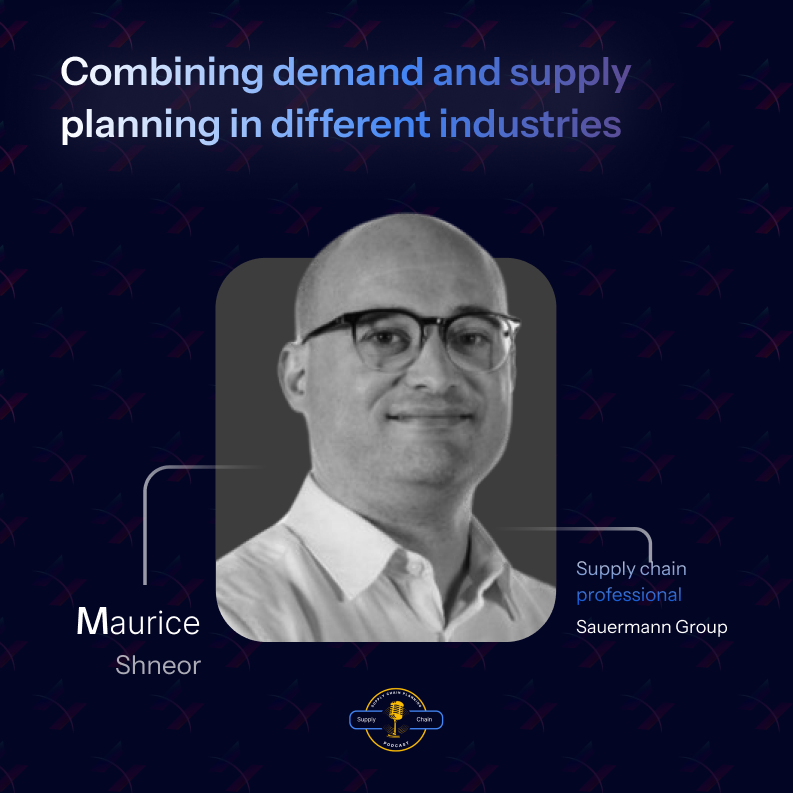
Demand planning in a small company: when sales does the forecast, and why you can't have S&OP without it, with Maurice Shneor

About Maurice Shneor
S&OP lead at Sauermann Group, the HVAC and refrigeration instrumentation company. Before that, warehouse and transport network projects and then combined demand and supply planning at Bridgestone, supply planning at GSK, and demand planning at the DIY retailer Maxeda. An economist who found supply chain through one professor. Listen to the episode.
Why he prefers demand and supply in one role
Maurice Shneor has done demand and supply planning together, at Bridgestone, and apart, at GSK, where the pharmaceutical complexity made supply planning a discipline of its own. Asked which he prefers, he doesn't hesitate. "Personally, I prefer to have both together. It's more interesting to really have the end-to-end view of the full supply chain flow of the product. We are in a function where we need to break silos, and having one person managing demand and another managing supply can really create silos. It's all about connection, communication and alignment."
His role today is different again: S&OP, "more on the strategic to tactical part", where he does neither demand nor supply planning himself. "I'm here to align both sides, make them work together, highlight potential bottlenecks, and challenge both sides to achieve the company objectives."
When sales does the forecasting
Sauermann is a small company, and small companies make a trade-off Maurice names plainly. "In a small company, we sometimes cannot afford to have sales guys and then demand planners, like a big organisation. The commercial guys are doing the demand planning activities."
Ben asked how that works. "It's more difficult. The understanding of what is demand, what is a sale, what is an invoice, what is an order, all these different terminologies with different things behind them, is not easy for commercial people. Secondly, their first objective is to sell. Doing forecasting is not their priority. They don't really like to commit on numbers. So it's really a challenge."
The contrast is Maxeda, where Maurice was a dedicated demand planner, not reporting to commercial, in the middle of implementing forecasting software, producing a forecast by item and by store across the whole network. In retail, he found, the forecast serves a different audience: "It's seen as an added value to manage the supplier relationship and to give suppliers more visibility on our demand."
You can't have S&OP without demand planning
Sauermann had the beginnings of an S&OP when Maurice joined. "If you look at the maturity level, we are really at the low level, which is very good because it's quite challenging. We have a lot to do, especially to educate the people working within the S&OP process about its added value and how it will make a difference in our business." The bases transfer from his earlier companies, he says, even if products, networks and customers differ.
Ben raised Jochen Bansemir's view from an earlier episode, that a company should start with S&OP rather than demand planning. Maurice sees them as two different processes, closely related. His formulation, which Wim immediately adopted: "You can have demand planning without S&OP, but you cannot have S&OP without demand planning."
Wim pressed on whether Sauermann's process is yet S&OP or still S&OE. Maurice is honest. "Due to our low level of maturity, we are sometimes more an S&OE than S&OP. That's something we need to work on: a longer horizon of visibility. What we have improved a lot is that within the process, management takes decisions which are beneficial for the company and make an impact. But sometimes I have the feeling we are too much on the mid-short term and not enough on the long term."
Baseline, promotions, and only then the weather
Beyond history, Maurice's advice on what to add to the forecast is sequenced. "First try to capture the promotions, the marketing campaigns. You don't need to think big. Do trial and error and start with quick wins. Promotions should not be so difficult to capture if you manage to work with sales and marketing."
Ben noted that these are basics that have been around for decades, while the AI conversation is about weather and stock markets. Maurice has used weather: at Maxeda his portfolio was heavily weather-driven, and the team added weather forecasts to the model. The rule is the driver, not the fashion. "First understand what the main drivers are that impact your business. If it's the weather, look at the weather. If it's the stock market, look at the stock market."
Leave the office
Maurice's second practical rule is for demand planners to get out of the building. "It's important that demand planners do not stay at the office. If they work in retail, they should be on the ground, discuss with the people working at the stores. They can go with the business development people to visit customers. This is how they really understand the business. Not staying behind the laptop computing your numbers."
Wim recognised it: a former manager who got up early before every demand review to check the big stores, "and then came to the demand review and popped the balloon of all the wishful thinking sales had. Your displays are not selling out, you lost shelf space in that store." Maurice: "Each time I was able to go with salespeople and visit customers or stores, it always brought me added value for my job."
Two skills: curiosity, and the nerve to make mistakes
Asked for the core skills of a planner, Maurice named two mindsets rather than techniques. "First, be curious. Curious about people, about events, about things, curious to learn and to meet people. Planning is a people matter. Talking with people helps you understand your business, make connections, and capture information whenever you need it."
"The second one, which I personally like a lot, is dare to make mistakes. Mistakes are good. What I see from young people is that they don't really dare to make mistakes. It's by making mistakes that we learn, that we improve ourselves, the process, the planning activity, and move forward." Analytical skill and a helicopter view matter too, he adds, but those two mindsets are what he wants to emphasise.
Wim wondered how you would test curiosity in an interview. Maurice's answer is that you mostly don't; you feel it in conversation, and you cultivate it on the job. His tool for that at GSK was rotation: a team of three, each responsible for a product portfolio, swapping every year. "You need to balance the loss of expertise with the development of the people. And we back each other up."
His own mistake: going too fast
Asked which mistakes he has made, Maurice sets aside the numbers ("it's human to make mistakes at that level") and names the one that matters. "Mistakes related to approaching people. We need to manage the change, break silos, change the as-is situation, especially when we implement new tools or new processes. I was maybe too straightforward, too direct. You need to look at the rhythm of other people in their journey towards the change. Not going too fast, but taking the time to discuss with people and make them understand why we are changing and what benefits we will get."
Your next steps
- If sales produces your forecast, invest first in shared definitions: demand, sales, invoice, order, and what each means for the plan.
- Add promotions and marketing campaigns to the baseline before any external driver; add weather or markets only where they are a proven driver of your business.
- Put store visits and customer visits in the planner's calendar, and bring what they see into the demand review.
- If your S&OP is really S&OE, name it, keep the decisions it already produces, and extend the horizon deliberately.
- Rotate planners across portfolios on a schedule, with backups, to build curiosity and end-to-end understanding.
Maurice's reading is LinkedIn, and three names: Bram Desmet, Nicolas Vandeput and Lora Cecere, "very good people to follow". And one closing line for anyone who, like him, has only just started on S&OP maturity: being at the low level "is very good, because it's quite challenging".