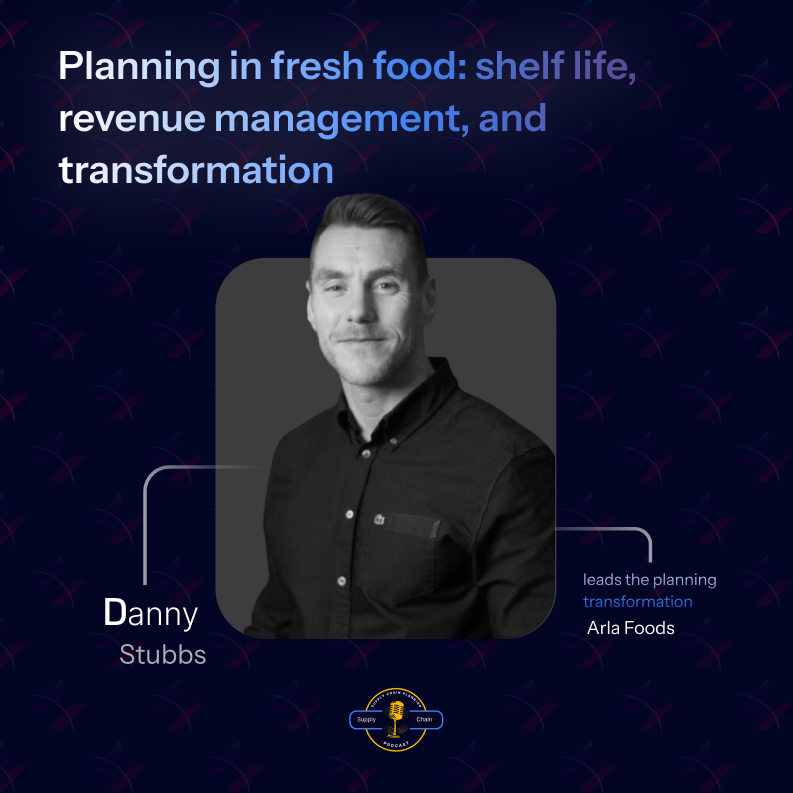
Fresh-food demand planning at Arla: milk on the shelf tomorrow, cheddar in three years, and 16,000 promotions in between

About Danny Stubbs
More than 20 years in planning at food manufacturers, the last decade at Arla Foods, where he now leads transformation across planning and service in Europe. He started on production lines, moved through site planning, scheduling, capacity and inventory roles, and then into demand planning and customer-facing roles. Before Arla he was at Associated British Foods. Listen to the episode.
The plan starts with supply you cannot switch off
Most demand planners forecast in one direction: what will we sell? At Arla, Danny Stubbs's teams forecast in two.
"The first thing we're doing is forecasting what we're going to get in from our farms," he says. Arla is a cooperative owned by around 8,000 farmers, the world's largest organic dairy company and the fourth largest overall. Milk arrives every day. "The cows don't stop for Christmas and holidays. And then our job is to say, where do we place this milk?"
Intake depends on farm economics, feed prices and growing conditions, peaks in spring and falls later in the year, so it never matches demand. Whatever retail, food service and existing contracts don't absorb goes to what Danny calls the milk wheel: powder, curd, butter for other manufacturers, or the global trade, "a bit like a stock exchange".
That is the first thing fresh food teaches: the plan starts with supply you cannot switch off. Here is the rest.
Segment by shelf life, then build the teams around the segments
Arla's range runs from one day to three years, and Danny's point is that no single planning approach survives that spread.
At one end is Milk24 in Denmark. "We guarantee that the milk that came off the farm today will be on the shelf tomorrow. The daily planning is super critical. Wastage is a big factor. You can't hold any stock." At the other end, extra mature cheddar. "We produce it today, but we can't sell it for three years. Cheddar will consume ten times the amount of milk as an equivalent bottle of milk." In between sit milk-based beverages such as iced coffee, which "behave more like a soft drink".
"What you can't do is just apply a one-size-fits-all. Hence the segmentation is really important. And having teams that are aligned to those categories." The skills differ too: one end is a logistics and production operation that has to be "super slick", the other is strategic and slower.
Demand sensing with the data you can actually get
For the short end, Arla runs a demand sensing engine fed by retailer point-of-sale and inventory data, where retailers provide it. "Take a market like Germany, it's much harder to get that kind of information. Say something like the UK, it's very commonplace for retailers to give you inventory, sales, various other metrics."
The work of the last couple of years has been to stop planners pulling that data in by hand. "How do we pull that into our data foundation so it's automatically part of our data, as opposed to having planners manually pull that in." On top of EPOS sit pricing, range, competitor activity, and cannibalisation inside Arla's own portfolio, which is split roughly evenly between brands and private label.
The daily profile is where the standard tooling gave up. "That daily profile is something we've had to put a lot of focus on because the off-the-shelf tools just don't handle that very well." Arla built its own machine learning for the daily profile of promotions and worked with its planning vendor on the sensing algorithms.
16,000 promotions a year, and a market that changes every week
"Just in Europe alone, we're handling circa 16,000 promotions per year," Danny says. Denmark is the extreme: retailers fighting for share with one-week, leaflet-driven promotions, so "you'll have categories that are 80-plus percent volume sold on deal". Plans change constantly, and the planning has to keep up.
Christmas is the same logic at full scale. "Something like a fresh cream would be an extreme, because you're going to sell 80-plus percent of your annual volume in probably a two-week period prior to Christmas." Nobody buys cream in November for a date after Christmas. Planning starts six months out with one question: which day is the peak day? "Does Christmas fall on a Thursday this year? When was the last time it fell on a Thursday?"
Then the logistics. A typical FMCG supplier delivers to six retailer depots; Arla delivers to stores. "We would have anywhere from 300 to 1,500 delivery points for a retailer. If you're a store manager and your milk delivery hasn't come, you've got shoppers shouting at you because you've got empty shelves."
New products: plan the trend, not just the launch
The long end of the spectrum is where Arla has moved its demand teams' attention. The case he gives is skyr: the category grew as expected, but one format, the one-kilo bucket, grew at "a real double-digit extreme" that nobody had planned for.
The response was organisational. "The way we structure our demand teams now is to make sure we've got people who are spending more of their time in that tactical horizon and beyond, to really anticipate. That's why your S&OP is so important: how do you anticipate rather than just react?"
Shrink the change
Arla has gone from APO to IBP on demand, is rebuilding supply planning, and is running a revenue management programme with o9, all while Danny's own role is transformation. His method for not losing people on the way has a name: shrink the change.
"If I said we're going to drive a thousand miles from Belgium to somewhere in Africa, it feels overwhelming. But if I say, step one, we're going to drive down to the port, and this is how. And then we reset and look at our next goal. You create increments to that change. Otherwise you end up with inaction, because people don't know where to start."
And the skills come before the tools. "If I'm buying a Ferrari but I don't know how to drive, it's going to sit in the garage. You have to equip people with the skills."
Your next steps
- If your raw material arrives whether you want it or not, forecast intake with the same rigour as demand, and plan where the surplus goes before it arrives.
- Segment the portfolio by shelf life and speed, and align planners to the segments. Don't run one-day and three-year products on the same process.
- Get retailer sell-out data into the data foundation automatically. A planner copying EPOS into a spreadsheet is a planner not planning.
- Treat the daily profile of a promotion as its own forecasting problem.
- For the next peak, start with the calendar: which day is the peak day, and when do the stores need the stock?
- Shrink the change. Set the next milestone, not the thousand miles.
Danny's last word is the same one Lora Cecere gave in her episode: "Think outside in. Don't lose that external perspective. Be curious to the outside of what's going on, and then step back and think how you can make an influence within your business."