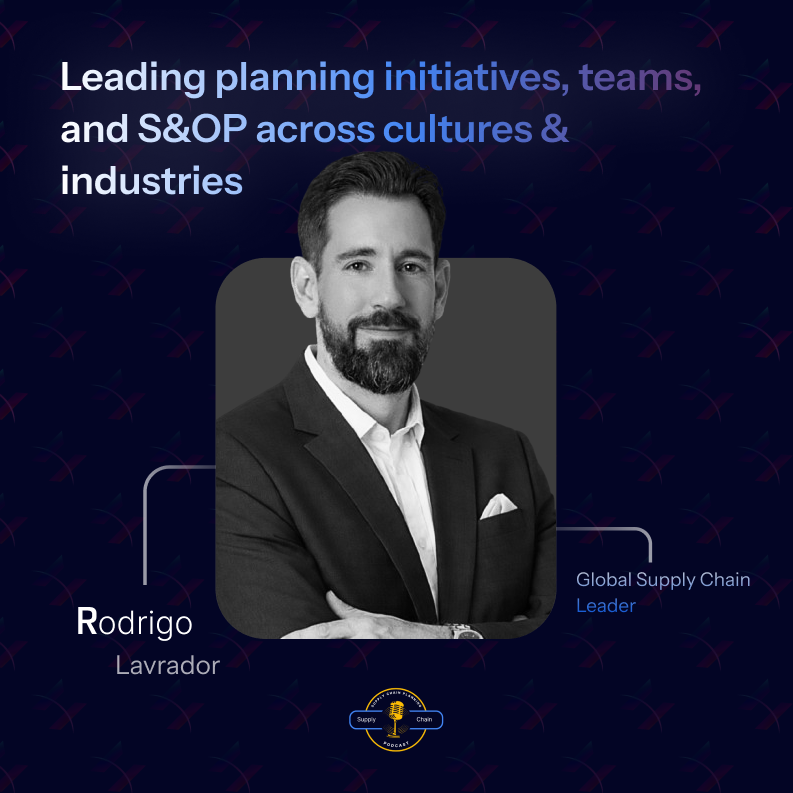
How to implement S&OP: data first, five meetings, and an inventory review in margin, with Rodrigo Lavrador

About Rodrigo Lavrador
Supply chain leader with more than 20 years across five industries and five company nationalities: Bosch in Brazil and South Africa, Avon, Genoma Lab, Givaudan in Brazil and Dubai, and now Daikin Middle East and Africa. He has built a supply chain department from scratch, implemented S&OP end to end, and led teams of up to 35 people. Listen to the episode.
Every chair in supply chain
Rodrigo Lavrador got into supply chain in 2003 because Bosch Brazil wanted a young candidate with international experience and he had just come back from six months in the US. "I started having no idea what supply chain was, or even logistics." Eight years at Bosch put him in "every single chair": customer service, demand planning, supply planning, international logistics, then three years in South Africa running continuous improvement and production levelling projects.
Avon gave him his first team, eight people, and the whole fragrance supply chain apart from distribution, in direct sales, "an amazing school". Genoma Lab asked him to build a department from nothing. Givaudan gave him the international move he wanted, first proving himself in Brazil, "a very hot chair, four supply chain managers in five or six years", then Dubai. Daikin followed. "German, American, Mexican, Swiss, Japanese. Five nationalities, five industries. Every day I'm learning how supply chain can be very different from company to company."
Building a department: people, then process, then system
Genoma Lab owns brands and formulas but no factories; production is contracted across South America. When the Brazilian market grew, the two-person import operation had to become a full supply chain and procurement function, and Rodrigo was its first hire. "You start with the people, the right people in the right position. Then you work the processes, demand planning, supply planning, inventory management. Then the systems." Some processes existed in Argentina and Mexico and only needed adapting to Brazilian rules. A facility near the port followed, and so did supplier partnerships: "Once you have a deal with Carrefour or a big pharmacy, you cannot fail. There is no space for failure."
Ben noted how rarely that order is followed. Rodrigo: "Many people want to put SAP in with the wrong process, and then it's trash in, trash out."
How to implement S&OP: data before meetings
Rodrigo implemented S&OP "from beginning to end" at Givaudan; at Daikin it is still in progress. His first rule is about credibility. "The priority is to have full control of your data to start. No one will be fully committed to meetings if the data appears inconsistent or incomplete. You don't want to risk your credibility with sales or your superiors due to missing or inaccurate data."
He has seen the alternative. "My first week in one company, I was observing an S&OP meeting. For the first 30 or 40 minutes it was the sales team asking about the numbers on the wall: I don't believe this number, where did you get it from, that's not what I'm seeing in the field. And the supply chain team was in Excel files trying to prove the number was correct. Getting control over your data from the supply chain side is crucial. Otherwise you will never have sales on board."
The second rule is to build the cycle step by step: data review, demand review, supply review, pre-S&OP, executive meeting. "By the time you get to the executive meeting, it's just a matter of making decisions. It's not a meeting to discuss numbers or whether something is right or wrong. It's sharing the situation, the business case, and getting the sign-off from top management."
Projects versus FMCG
The biggest difference between S&OP processes, in his experience, is the industry, not the tooling. Daikin Middle East and Africa earns most of its revenue from large-scale and mega projects; Givaudan is closer to FMCG. "Automation plays a role, especially for FMCG. But the nature of the business model changes a lot how S&OP is conducted."
The inventory review that spoke sales' language
Ben observed that sales feels a stock-out immediately but never feels excess stock. Rodrigo's answer was a sixth meeting. For more than a year at Givaudan, the cycle included an inventory review, with supply chain, production and the financial controller, to deal with obsolescence. "We were deep diving into the stock. We knew why the stock was there, since when, who was the key account manager who sold it, and the impact on his margin." The findings went into the next S&OP meeting with sales.
"Let's be fair, supply chain is complex. For the sales team, it is sometimes completely not understandable. So it's very important to translate supply chain language into sales language." Translated into margin, excess stock became something sales would help avoid, and in some cases help sell while it was still in date. "Everything can be an opportunity. It depends on the perspective."
A leadership method that works across cultures
Leading in Brazil, South Africa, the Middle East and now a Japanese company, Rodrigo built a three-pillar method. Transparent communication: "Every team member fully understands their role, how they contribute to the overall result, and what's expected. That works in any culture." Continuous improvement from the team: every member proposes one or two goals of their own for the year. "When I moved to Daikin, most of the team had been there 16 years. They know this industry much better than me, but I have to lead them. How, without their help? By inviting them to create their own objectives." And a transparent evaluation: he explains the nine-box grid, performance against potential, to everyone, "the only thing I cannot share is where they are located. Most employees don't know how they are measured or how the company chooses who is promoted. It's always a surprise. That's what I try to avoid."
The projects double as his potential test, because "a high performer is not necessarily a high potential". And he remembers a Givaudan director's line: "It doesn't matter if you give me the best results if, when I look back, I see blood on the walls."
Company DNA, he adds, sets the limits. Some companies have risk-taking ingrained; others need "a business case and then a second business case". Japanese companies rarely allow a fail-fast approach; at Givaudan he had the autonomy to go all in, with his director's backing "because if something goes wrong, sales come to you at the speed of light".
Tools, AI, and the moment you introduce them
On technology, Rodrigo's experience with AI has been "very insightful, particularly in how it can save time and reduce rework". The difficulty is elsewhere. "The main challenge is not the implementation, which can often be quick, but the environment into which the tool is introduced and the moment. Resistance from some team members, or pre-existing process flaws, are bigger obstacles."
The resistance has a logic. "Employees complain about overload. When you introduce a tool that will automate their process, they also complain: on top of my work I have to learn this and implement it. So you show that for a period we'll work a little more to save time and avoid rework in the longer run. It's like investing." He uses the team's natural early adopters to sell it to the rest, has hired two analytics profiles to help the others "cross data and get insights", and prefers to start with an MVP, "a Pareto 80/20", unless urgency demands going all in and failing fast.
Your next steps
- Before the first S&OP meeting, get control of your own data; a number sales can dispute costs you the process.
- Build the cycle in sequence, data review to executive meeting, so the executives only decide.
- If excess stock is your problem, add an inventory review with the controller and translate it into margin per account manager.
- When building a function from scratch: people first, then process, then system.
- Ask every team member for one or two improvement goals of their own, and use them to judge potential, not just performance.
Rodrigo's advice to young professionals comes in three parts. "Speak up and take informed risks. Learn a little about risk management and apply it personally and professionally; the more you do it, the better you do it." Then: "Master problem solving. Invest in root cause analysis, scenario planning and quickly evaluating alternatives. That will set you apart from 90% of managers today." And finally, develop your own leadership methodology: "If you're responsible for other people's professional lives, you have to know what you're doing. Don't rely solely on HR courses. If you do, the furthest you'll get is being one more among the crowd of managers that people want to escape from."