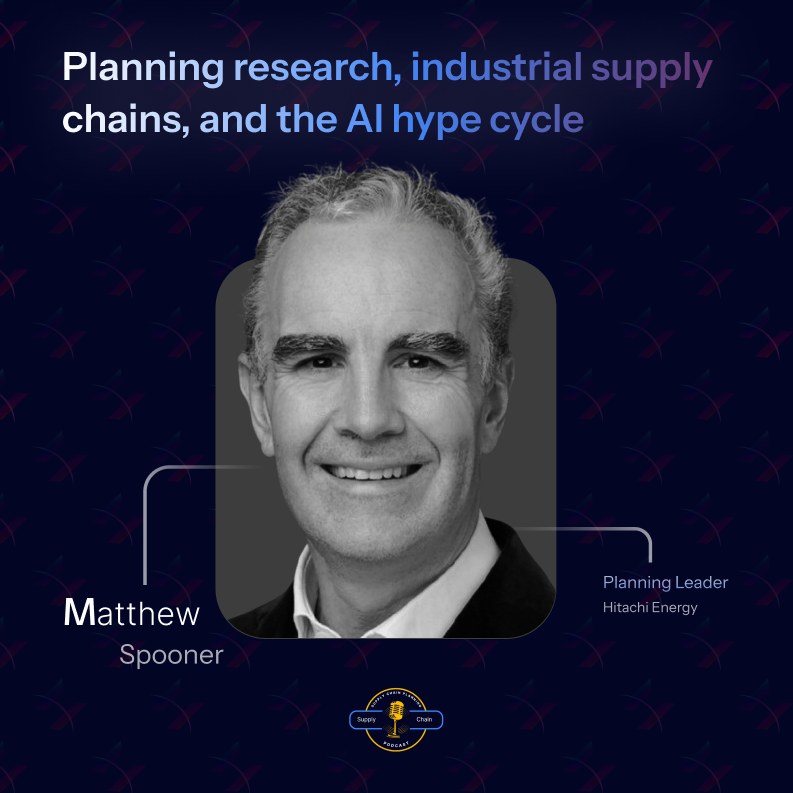
Industrial supply chain planning: BOM variability, tools built for consumer goods, and the AI hype cycle, with Matthew Spooner

About Matthew Spooner
Thirty years in planning from every side: operational supply chain leadership at Ericsson, ABB and Hitachi Energy, research director at Gartner from 2012 to 2017, strategy and thought leadership at Kinaxis, and consulting with life sciences and consumer companies before that. Former Royal Navy, computer science graduate. Listen to the episode.
Industrial and consumer supply chains: more alike than you think
Matthew Spooner got into planning because he was the only person in a shared office who could use Excel. The supply chain consultancy next door needed a summer analyst, sponsored the rest of his degree, and he has been in the field ever since: operations at Ericsson, ABB and Hitachi Energy, research at Gartner, strategy at Kinaxis.
Wim asked where industrial and consumer supply chains differ most. Matthew flipped the question. "We tend to think that our businesses are very unique. Actually, the problems that organisations are facing are very similar. When I went from Ericsson and joined Gartner, my first observation was, wow, these guys in Unilever are facing very similar problems to the ones I was facing."
The differences are real but specific. Industrial demand is project-driven, "lumpy, potentially very infrequent, not repeatable, because very often it's engineered to order. History doesn't tend to be as good an indicator of the future." And the shape of the network is inverted. "Industrial supply chains tend to be quite narrow, they don't have many distribution points, but they are very deep: very deep, complex BOMs that go down through multiple tiers. Consumer products distribute to hundreds or thousands of points, but the BOMs are not so complex."
BOM variability, not demand variability
The consequence for planning is where the uncertainty sits. Consumer companies live on statistical forecasting and outside-in drivers; ice cream and the weather. Industrial companies look at different drivers, buying intent on a big project, the financial health of the customer, and then face a second source of variation once the order lands.
"When an order is placed, it has to be engineered. You don't have so much demand variability. What you have is BOM variability. Very often you're buying parts for the first time, so you don't know what the lead time is going to be. At the quotation stage a part is maybe on a six-month lead time. When you place the order, you find out it's on a 15-month lead time." His summary: "Supply variability is a much bigger factor in industrial supply chains and demand variability is a much bigger factor in consumer products."
Collaborate with sales, and with engineering
Project demand is binary. "You're either going to win a project or not win a project. If you decide to procure material against a project that you don't win, very often you're not going to be able to reuse a lot of that material." So collaboration with sales is fundamental. But industrial planning adds a partner consumer planners rarely have: "a lot more collaboration with the engineering organisation to understand what the content of that project is going to be", because that content is where the variability lives.
Most planning tools were built for consumer goods
Ben asked whether the tools differ. Matthew's view is that most planning software carries a bias. "Many of those have been designed for consumer products and discrete, repetitive manufacturing, with a high focus on demand planning and improving the accuracy of your demand plan, because there's such a big incentive within those industries." Older Gartner research, he recalls, identified demand plan accuracy as one of the strongest indicators of supply chain performance, which reinforced the focus.
"When you look at industrial supply chains, a lot of those tools are not so appropriate, because demand variability is less important and supply planning is more important." Industrial technology tends to concentrate upstream, production planning, supply planning, supplier collaboration, while consumer technology concentrates downstream on demand planning and S&OP.
What Gartner is for now
Matthew spent five years as a Gartner research director and is candid about where the model is heading. "Ten years ago, they were the place that supply chain leaders used to come to understand best practices. Over the last 10 years you've seen Gartner focusing a lot more on peer connections, running more conferences, bringing supply chain leaders together."
The next shift is driven by generative AI. "The availability of information, with tools like Copilot and ChatGPT, we're almost overwhelmed. What we don't know is the quality of that information. Gartner will have a role in helping supply chain leaders filter the quality." That, he thinks, pushes the firm towards something it once resisted: "the rockstar analysts, who were actively discouraged in the past because they were trying to be more generic. That generic advice is now so widely available that what they need is those superstars with huge credibility."
Why the Magic Quadrant is less useful than it was
On the Magic Quadrants, Matthew is blunt, and historically minded. The supply chain planning quadrants were created more than a decade ago around "a core set of functionality that you needed to offer as a planning tool", and the scoring rewards breadth. "That tends to push the bigger tools up to the top right-hand quadrant."
The market has moved on. "What we're seeing now is a focus on systems of innovation, systems of differentiation, with a higher degree of interoperability. You might have a planning data layer and multiple different systems connected to it, very focused on delivering value in a specific functional area or a specific industry. They might have a much faster time to value, but because they don't have that breadth of functionality, they're never going to get into that top right-hand quadrant."
Which makes a common procurement rule a mistake. "A lot of organisations, when they create an RFQ for a new planning system, say we only want to include companies in the top right-hand quadrant. That's probably a bad decision." People who helped build the original quadrants, he says, "would probably say they are not as relevant as they used to be".
Transparency and the scoring machine
Ben raised the newer debate about how open analyst research is. Matthew contrasts two approaches. Lora Cecere's work on linking supply chain metrics to financial results, with Arizona State and now Georgia Tech, "is incredibly open and incredibly transparent: academic documents, all published". Gartner's evidence of value "is very much based on interviews with companies who've implemented those systems. By its nature it tends to be less transparent."
And there is a quieter distortion. "A lot of the companies who perform very well in the Magic Quadrants have a machine in their organisation focused on scoring highly. They know the methodology through years of working with Gartner. It's a marketing exercise. I don't think it's a conscious bias on the part of the analyst, but it's an unconscious bias."
AI is on the hype cycle like everything else
Matthew likes Gartner's hype cycles, and had an argument last year with a consulting partner who insisted AI would skip the trough of disillusionment. "Personally, I felt that he was completely delusional."
He also objects to the word. "AI and ML have been around for 50 years. Traditional AI and ML have probably gone through the trough and are coming up the other side. What you're talking about is the new forms, generative and agentic AI, which are going through the hype cycle at the moment. It's very clear that we're at the top. We're beginning to go down into the trough of disillusionment. A lot of the AI pilots are failing, and this is just a normal hype cycle. We're going to go through a pretty tough time for the AI market in the next couple of years." Ben's inference, that many of today's agentic start-ups won't be around in two years, Matthew called "the risk".
A reset on maturity
The deeper point is about maturity models. "Even the companies who are at stage four, stage five on a traditional maturity scale, when you start looking at the future, they're back at stage one, stage two. Almost every organisation has to reset." Many AI use cases, autonomous planning above all, "are talking about stage five levels of maturity. You've got companies who don't have a strong AI maturity trying to implement processes which are very mature, and they fail as a result."
His prescription: "What are our foundational processes for supply chain in the world of AI? Focus on those foundational use cases as opposed to the really shiny, sexy use cases and pilots, because those are almost bound to fail." Wim pressed on whether this lets laggards leapfrog. Not quite, Matthew says: "It levels the playing field. It's an opportunity for companies at a lower level of maturity to catch up, and companies at a high level also need to recognise that the processes and technology they've spent years implementing might not be the correct ones for the future." Wim's counter, that mature companies' data foundations will still let them move faster, he accepted as "a good point".
Agentic AI: rebranded RPA, and the end of spreadsheets
Has he seen real agents in planning? "There is so much marketing going on. A lot of the use cases I'm seeing, I look at and think, this is actually just an advanced form of RPA. We're seeing a rebranding of RPA into agentic AI."
Where it could matter is unglamorous. "Agentic AI will have the possibility of replacing a lot of the Excel spreadsheets, particularly the very repetitive ones where a supply chain analyst collects the same data from different systems every month, puts them into a spreadsheet and presses a button. The ones we turned into Power BI applications five years ago might be replaced by AI agents. It may not sound too exciting, but that would be revolutionary, because advanced planning systems have always promised that they would replace spreadsheets, and they never have."
Where the new technology could change planning
Matthew's own background is stochastic optimisation, which was theoretical in his student days because the computing power ran out on real problems. If AI can bound those problems, "suddenly you can start looking at optimisation in near real time, which would give you the ability to integrate network optimisation into your S&OP decisions. In the world of tariffs we're facing, changing all the time, there's huge benefit in being able to redesign my network in near real time."
His second idea inverts the data model. Instead of extracting everything from ERP and CRM into relational databases and processing all of it, "I just want to process a limited amount of data focused on answering the question I've got", with an agent autonomous enough to decide what the next piece of data should be. Ben pushed back that LLMs don't help with the optimisation itself. Matthew agreed: "LLMs don't help with your optimisation. Where they help is being able to ask supply chain questions in real time." In a traditional S&OP meeting the VP of sales asks what-if, it goes offline to an analyst by email, and comes back later. "The opportunity with LLMs is to cut that whole communication process and convert what the VP of sales said into a query the system understands, in near real time."
Your next steps
- If you run an industrial supply chain, measure supply and BOM variability as carefully as consumer companies measure forecast error, and plan buffers against lead-time surprises.
- Bring engineering into the planning cycle alongside sales, with a rule for when material is committed against an unwon project.
- Don't let "top right-hand quadrant only" write your RFQ; score tools on fit to your functional problem and time to value.
- Reset your maturity assessment for AI and pick foundational use cases before autonomous ones.
- List the monthly spreadsheets and Power BI reports an analyst rebuilds by hand; that is the first agent use case worth testing.
Matthew's own sources are peer networks and conferences, "the networking opportunities rather than the presentations", and a filtered LinkedIn: "There is some real gold amid the desert of AI-generated rubbish." For reading he recommends Richard Markoff's The Launch of the Century and his books with Ralf Seifert at IMD, and Lora Cecere's Supply Chain Metrics That Matter, "because that starts to describe how you quantify value in the supply chain".