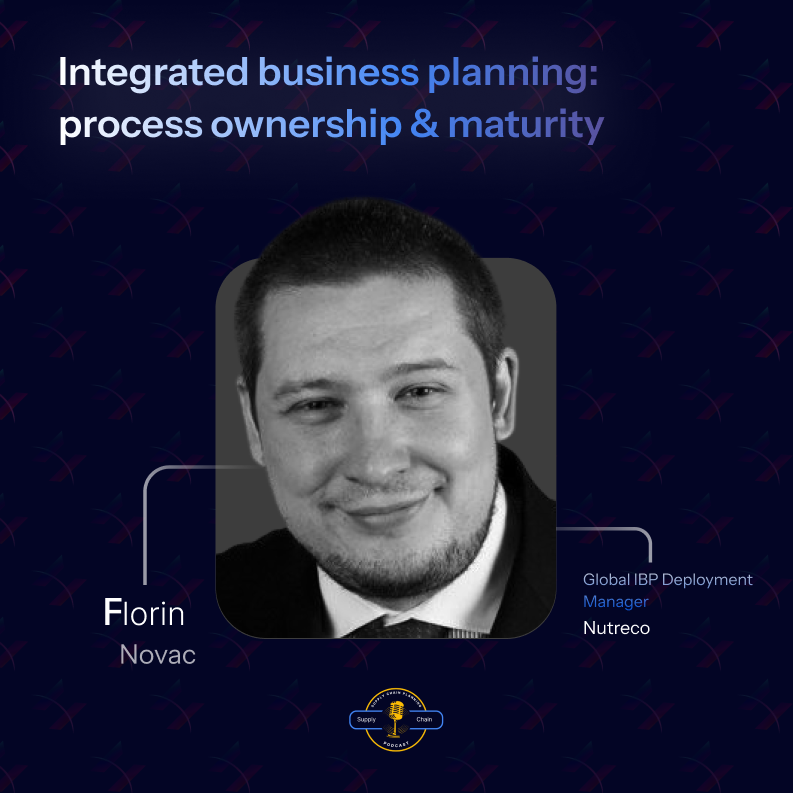
Integrated business planning: who should own IBP, and how to assess its maturity, with Florin Novac

About Florin Novac
Global IBP Deployment Manager at Nutreco, the animal nutrition company with around 99 factories worldwide. Before that: demand planning at GSK Consumer Healthcare in Belgium and Poland, project leadership at P&G's planning service centre in Warsaw, demand planning for APAC at Ansell, and demand planning process expert at Henkel. He started in marketing in Romania and found demand planning during an MBA at Vlerick. Listen to the episode.
From marketing to demand planning, by way of an MBA
Florin Novac spent six years in marketing for a medical devices distributor in Romania before an MBA at Vlerick introduced him to demand planning, "a really nice combination of analytical and commercial knowledge". GSK Consumer Healthcare took a chance on a planner with a commercial background, and the rest of his career has stayed close to that first love: SAP APO super user in Warsaw, a planning service centre at P&G, demand planning for APAC at Ansell, process expert and demand sensing at Henkel, and now IBP deployment at Nutreco, six countries and 13 years later.
On demand sensing, which he thinks is still overlooked, his definition is the strict one: an external partner improving the short-term forecast from orders, master data and customer sell-out. "Some companies say it's also using indexes and other data for the longer term. According to what I've seen, that's not demand sensing. It's focused on the short term."
Honest about where Nutreco is
Nutreco makes feed for livestock, pets and fish, and grew by acquisition, which left it "fully decentralised" in planning. The IBP programme started from scratch three years ago. Florin is candid about the label. "We call it IBP, but if you think of Gartner and their methodology, it's still S&OP. We're progressing towards IBP." What's missing is the finance link, portfolio management, and collaborative planning with suppliers and customers, "looking a bit more external than internal. That's a pure IBP, and we have some steps to take."
One thing the deployment taught them early: separate execution from the tactical cycle. "The S&OP started focusing on a very short term, so the tactical was not the focus anymore. We needed to decouple S&OE to discuss the short term and execution, and leave the S&OP for the tactical horizon." The textbook S&OE horizon is 12 weeks; with Nutreco's short lead times, "that's a bit too long" for some businesses.
Standardising a decentralised company
The good news was a single ERP and the same type of data, at different levels of maturity. The hard part was process. "We started three years ago with an IBP handbook, a single source of truth. That was the next journey in terms of standardising the processes." And it is still hard: "You're trying to change some very well-embedded, very decentralised ways of working."
IBP is a business process, not a supply chain process
Asked how he learned to move from demand planning to S&OP to IBP, Florin's answer is that the skill is connection. "IBP or S&OP is a business process, it's not a supply chain process. It's building up the business knowledge and the supply chain knowledge, and being able to connect those two parts."
Ben asked whether that means IBP belongs on the commercial side. "It's in the name: integrated business planning. Supply chain is part of it, definitely. Supply chain can also lead it. But business has to be accountable and, in the majority of cases, be leading the discussion." In practice he has mostly seen S&OP owned by supply chain, with one exception. "Glaxo did something very smart. They named their S&OP the core commercial cycle. By doing that, you get the involvement and engagement from the commercial leadership." The transition from S&OP to IBP, in his view, is precisely the transition to business ownership, and "business" means the leadership team of the whole business: "If the leadership team is not involved in sponsoring and supporting the whole process, it's not going to work."
Nutreco's programme started in supply chain, but the deployment toolkit includes the work of making leadership sponsor and own it. His advice for getting there: "Show quick results, show improvements." And choose the change approach case by case: "peer-to-peer influence, or a hybrid of top-down versus bottom-up. Nothing works for everybody the same way."
Should demand planning sit in marketing?
Florin had just read research from the Institute of Business Forecasting and Planning comparing forecast error by the function that owns forecasting. "The least amount of error was when the forecasting function was in marketing. And the most when it was in supply chain." Ben's guess had been that a standalone function with no agenda would do best. Florin's explanation: "Marketing has an open ear to the market and a natural inclination to include trends." He admits he hasn't seen it in real life, "not yet", and that as a former marketer he is biased. But asked whether he would put demand planning in marketing: "I would. People still link marketing to the creative guys who make the advertising, but are unaware of the amount of data analysis behind marketing."
Assessing maturity: self-assessment plus KPIs
At Henkel and Nutreco, Florin has run demand planning and IBP maturity assessments. The method is simple: grade each process step on a scale (one to five, or one to three), with questions covering the process, tool usage and the organisation. Both companies did it as a self-assessment; consultancies offer the same as an outside view.
The important part is reconciling the scores with performance. "If you have a self-assessed high score, but your KPIs tell a different story, then there's a question mark: where is the gap coming from? KPIs have to complement the self-assessment." The KPIs he uses: forecast accuracy and bias, OTIF and service level, financial alignment (how far apart the plans are, if they are separate), and inventory health, weighted by the company's strategy.
When people fall back to Excel
Has he seen maturity go backwards? "Definitely, when people fall back to Excels or to their own little tools." A session he attended the week before ranked the reasons for resistance to change; the top one was "lack of awareness of why are we doing this". His three steps, in order: "Reiterate why we are doing this and show the possible benefits. Then influence that person through someone more open, acting as an ambassador in the team. Then peer-to-peer: someone who already went through the change."
Nutreco runs change management as a programme, with a change champion per operating company, usually in HR, and the ADKAR model. Training sits at the knowledge step, "where we do the simulations, the hands-on. It's part of the change journey. You cannot skip that."
Certifications and networking
Florin has seen IBF and APICS certifications used two ways, as a reward for the few or as a broad programme. Nutreco chose the second, "a conscious decision to build a core mass of people speaking the same language and having the same level of knowledge", for people with the affinity for it. P&G, at its scale, built its own.
Conferences he treats as essential, with a condition. "You cannot just look inside and stay focused on your day-to-day. You need to be out there, understand what's happening, and try to get that back in. If you just go and nothing comes out of it, that's the budget spent. You have to stay relevant, but what you learn, you have to try to drive."
Your next steps
- Be honest about where your process is on the S&OP-to-IBP path: finance link, portfolio management, external collaboration. Name the gaps.
- Decouple S&OE from S&OP so the tactical meeting stops being hijacked by this month's fires, and set the horizon to your lead times, not the textbook.
- Rename or re-sponsor the process so the leadership team, not supply chain, owns it; Glaxo's "core commercial cycle" is the template.
- Run a maturity self-assessment per process step and reconcile it against accuracy, bias, OTIF, financial alignment and inventory health.
- Treat every Excel fallback as a change signal: repeat the why, recruit an ambassador, pair people with someone who has made the change.
Florin's own rule is one line: "Never settle. Be on the lookout for new challenges, don't become complacent. Learning new things, meeting new people, working with different cultures, it's really developing."