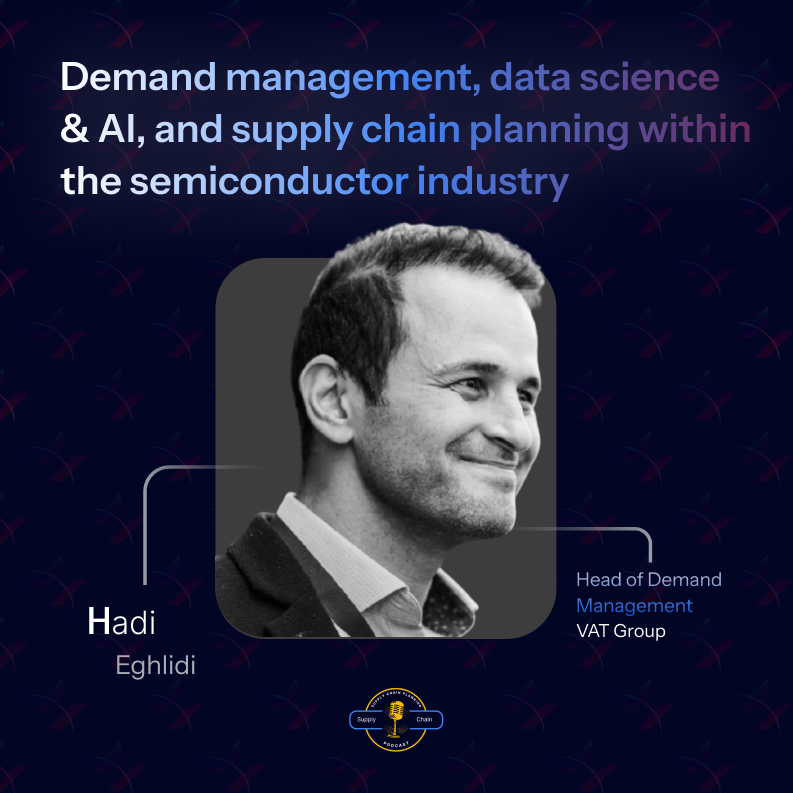
Semiconductor demand planning: the bullwhip, 3,500 indicators and dual-profile teams, with Hadi Eghlidi

About Hadi Eghlidi
Head of Demand Management at VAT Group, the Swiss manufacturer of vacuum valves for the semiconductor industry. A physicist and former university lecturer and research group leader, he led a smart-systems competence centre at VAT before moving into supply chain, after a data science degree at ETH whose thesis was a machine learning demand forecasting dashboard for the company. Listen to the episode.
From the lab to demand planning
Hadi Eghlidi's path into planning was not planned, but it was not random either. A physics background, an MBA with supply chain theory he never used, a data science degree at ETH, and a thesis he deliberately pointed at demand forecasting. "I developed a pretty complex dashboard where I analysed a good part of the supply chain, put some machine learning, some deep learning on top, and tried to forecast the future." When a planning role opened up, he took it.
The culture shock was language. "I was surrounded by people like me, very technical backgrounds. When I came to the supply chain part, I saw a lot of business people speaking a different language, thinking more strategically." He found his place as "the techie guy who also learned the business part", bringing the technical side into demand planning specifically.
Several layers from the end customer
VAT supplies vacuum valves to the equipment makers whose machines go into the fabs that make chips for the electronics brands. By Hadi's account the company holds close to 80% of its market in semiconductors. Being that far upstream has one dominant consequence. "Anything that happens in the supply chain, we see it with a higher amplitude than anybody else. Whenever there's a hiccup on the electronics market, it gets enhanced every layer you go in. By the time it reaches us, it might have an amplitude of 10 times." Double-digit growth one year, double-digit decline the next, is normal.
The chip shortage was a case study in the bullwhip. Shortage meant high fab utilisation, which meant capacity investment, which flowed to VAT as a supplier of critical subsystems. "However, at some point all these constraints are removed. When the constraints are removed, the companies start building up inventories, because they were scared of what happened in the past. As soon as demand slightly goes down, they stop building and start using their own inventories. That is the driver of the market going down."
A secretive industry, forecast from the outside in
Wim asked whether the beer game lesson, transparency between tiers, is possible in semiconductors. Not easily. "It's a secretive industry, driven by a few giant companies. It is not that they easily share information. Even when we talk to companies in other layers, they often complain that they don't have visibility."
Hadi's answer is indirect intelligence. His team has gathered close to 3,500 market indicators: equipment revenue by technology and end market (smartphones, PCs, data centres, 5G), equipment-maker revenues, estimates of inventories at each tier, data on specific chip technologies. Some comes from market intelligence firms and consultancies, paid for; some from public filings; some from the 70-plus salespeople in direct contact with customers. "Getting data is the major part of it. Then storytelling with that data is another major part. But that comes after getting high-quality, reliable data."
The North Star is an APS, but you still need hands-on capability
Ben asked how Hadi decides what to build in-house. His framing starts with humility about the job. "In supply chain you're not really the developer. Your main task by far is taking care of the business. Therefore the North Star for you should be having an advanced planning system that does all these things in a professional way."
Two things stop that being the whole answer. Reaching the maturity to run an APS takes steps. And "you have some applications where an APS cannot fulfil: KPI tracking, benchmarking, seeing where it could improve". For those, "you need a certain level of understanding and capability of doing it hands-on". Hence his team: "people that are business experts and people that are data science people, with a mutual understanding and collaboration, solving the problems one after the other".
Dual profiles: train both ways
Wim pushed on whether he would rather have two distinct roles or one hybrid person. Hadi's answer is to build the hybrid from both sides. "You cannot change people. You get people with a background in data science and people with a background in the business, and then you train them both. The data scientists should have an intensive time of really understanding the business, and the personality to go and talk to people about what they do. The business people should be open to learn the technical side, so that they can define the requirements for the data scientists."
Small companies may need this more, not less
Ben suggested that only the biggest companies can afford data science inside supply chain. Hadi reversed it. "If you're small, you might even need more of such people. When you're small, you cannot afford to jump on buying an advanced planning system, because you're just not mature enough to outsource all your tasks to a software. At the same time you're growing, a lot of needs pop up, and you cannot go and buy a software for every problem."
He sees a gap in the market there. "When you go to the space of planning, you see all these end-to-end advanced planning software companies, but you do not see much of the companies that could serve the companies that don't have much resources and cannot take the risk of switching to an APS right away. They have the needs. If there are companies that can position themselves to serve such needs, they are welcome. But if there are not, you better not stop yourself and develop these skills within the company."
And machine learning is not only forecasting. "Clustering, classification, anomaly detection, all of these have applications across the whole of supply chain planning." His example: finding, among hundreds of suppliers and dual sources, the ones charging too much. "A simple clustering technique could help you shortlist the ones where you could go and negotiate."
How the monthly cycle works with 70 salespeople
The demand process is sequential and monthly, with many short, single-agenda meetings. "We always start with the sales organisation, the customer forecasts, and any AI calculations we want to bring in. We make a baseline, some scenarios. Then it gets reviewed by the sales organisations, and together with the business units we come to an agreement and the final numbers." Product management and the supply chain managers who use the forecast are in the loop too, "a touch point with almost every stakeholder".
We are the experts, and numbers talk
On driving change, Hadi is unapologetic. "We are the experts. Not all opinions are equally important. We define the process, we define the improvements, we show it with numbers that such a thing could improve, and then we define the roadmap." Then it goes top-down: senior management sponsorship first, then the change.
The KPIs are ordinary: forecast accuracy, forecast value added, and efficiency, "the demand hours spent on forecasting". The credibility comes from the sequence. "For driving change you need that confidence, plus a bit of risk-taking. When we drive it by ourselves, we also take the risk of failures. One essential thing is having quick wins to show that things are going in the right direction, then in the mid-term show the KPIs. Then you get the momentum."
Literature review as a planning practice
Hadi runs his team the way he ran a research group. "We always start with research, with learning and questioning the status quo. I tell my team, I give you time to just go explore. Don't get your hands dirty right away. Go explore what the best practice is here." He sometimes asks for a literature review, "which might sound a bit weird in the setting we have", and reports that it works: "They often come back with very interesting suggestions that I learn from them."
Where planning teams are heading
Hadi reads the history as a series of revolutions: paper, MRP, ERP, advanced planning, then machine learning forecasting from around 2015. His bet for the next five years is that planning teams will build small applications themselves on cloud toolsets, "which are out there to democratise application development". With a caveat: "Business planning teams are not software development teams. They need partners, companies that come in and enable them, take care of the infrastructure, help with the technology." Or, he adds, companies that solve those small problems ready-made, so teams don't need the toolsets at all.
Your next steps
- If you sit several tiers from the end customer, assume the bullwhip and build a set of outside-in indicators for the tiers above you, starting with public filings and your own salespeople.
- Decide which planning tasks belong in an APS and which (KPI tracking, benchmarking, supplier analysis) need hands-on data capability in the team.
- Pair business planners with data scientists and train each in the other's language, with explicit time for it.
- Run change top-down with sponsorship, and sequence it: quick wins first, accuracy, forecast value added and planning hours as the mid-term proof.
- Give the team exploration time before implementation; ask for a short review of best practice before any new process.
Hadi's reading list is where his method comes from: The Goal by Eliyahu Goldratt, "written by a physicist turned business expert who thinks scientifically about root causes"; The Toyota Way by Jeffrey Liker; the Six Sigma literature; and, for anyone whose supply chain touches semiconductors, Chip War. "Then you understand the history, you understand how things are connected to each other, and that gives you the mindset to do this outside-in planning that I was advocating."