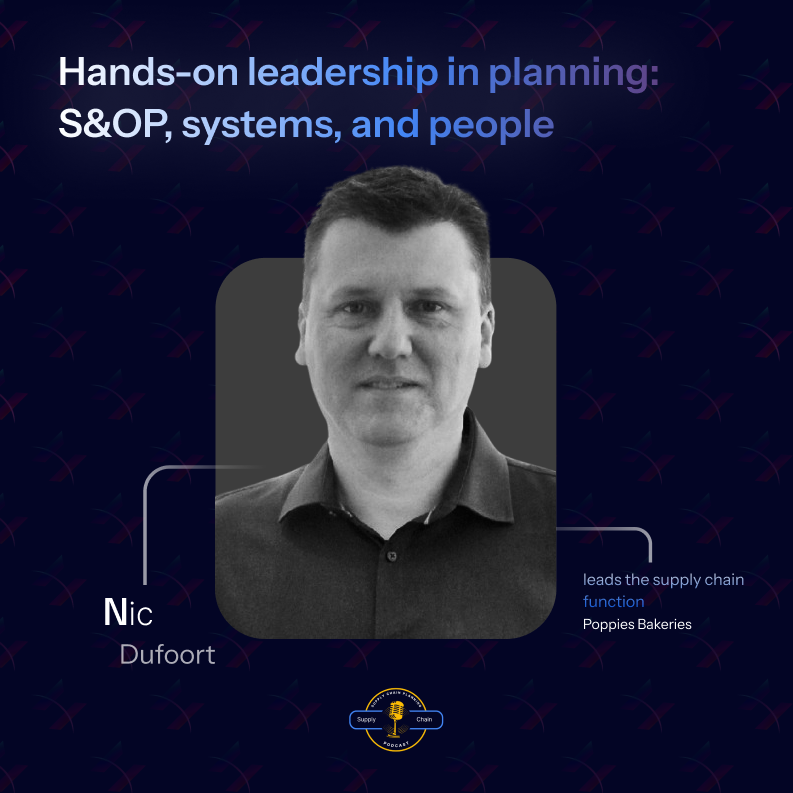
S&OP in an SME: from a failed meeting to Excel to a planning system, with Nic Dufoort of Poppies

About Nic Dufoort
Supply chain director at Poppies, the Belgian maker of frozen and ambient sweet desserts, with bakeries in four countries and customers in 70. Twenty-five years in industry before that: plant manager at machine builder Haco and furniture maker Decruy, click-furniture project lead, planning manager and supply chain manager at Unilin, SAP implementation lead at Delta Light, and supply chain manager at Jules Destrooper. Civil engineer from Leuven, MBA from Vlerick. Listen to the episode.
Why supply chain should not sit under operations
Nic Dufoort has run plants, led a product launch with a nine-month deadline set by a CEO who had already booked a hotel floor in Milan, and implemented SAP from partner selection to go-live. The first time he reported to an operations director instead of a CEO, at Jules Destrooper, he decided it was the wrong place for the function.
"Supply chain should not be under operations. Supply chain is a department in itself, and it should be in the management team." His reason is Bram Desmet's triangle. "You need to look at the service, the cost and the capital. If you are in operations, the focus is on the cost, and the other two parts of the triangle are not handled well enough. Sales looks at the service, finance at the working capital, operations at the cost. If you're in one of these departments, you don't look for a compromise, you look for optimisation of one side. The real job of supply chain is finding the right balance between these departments."
That is the deal he struck with Poppies' CEO two years ago: a supply chain team had existed for three years inside operations and "was not getting where we want to get". It became its own department, with Nic leading it. "We are seeking the balance between sales, operations and the finance guys, and we really see that we start to get impact."
Twenty-five years of maturity, and why food is harder
Nic has watched supply chain go from "a non-existing department 25 years ago" at a project-driven machine builder, through operational planning and inventory management at Unilin, where capacity was checked against the budget once a year, to Poppies, where balancing the triangle is "almost a daily process". Part of that is the discipline maturing; part is the industry. "If you have an MDF panel in stock after one year, it's still an MDF panel. If you have eclairs in stock, after six months it's an eclair, but you don't want to eat it anymore." Shelf life adds parameters, and inventory is getting more expensive everywhere.
What he found at Poppies was a demand-versus-shifts comparison that only raised the alarm one way. "They only talked about issues if there was too little capacity. If there was too much capacity, the easy solution was: the stock will go up. But a high inventory also means a big risk of obsolete stock in the food industry."
The turnaround at Decruy: 15% EBIT on paper, losses every year
Wim asked about Decruy, the furniture maker Nic helped turn around. "The big question was: how is it possible that every new product in pre-calculation has an EBIT of 15%, and every year we make a loss?" The pre-calculation was rudimentary, done by the sales director, blind to growing complexity, and benchmarked on competitors' prices rather than the company's strengths.
His method was not a theory. He picked three products, a 10-year-old office range, a three-year-old model and the newest one, and followed them through production with a notebook. "How many times does a panel go to the drilling machine? In pre-calculation, all drillings were made in one step, but maybe the panel goes three times." The old range was close to its calculation. The newest model, a designer piece, modern, 30% of turnover, everyone's favourite, "every bedroom we sold, we lost money".
Targets on paper, and three months on the floor
The fix had two sides: a new strategy built on customer intimacy, developed during his Vlerick MBA, and a hands-on cost project in operations. Every task sheet from the ERP got a time target, written by hand: two and a half hours for this, three for that. "Not to speed them up, but to say: if we want the margin we think we have, that's what we need to do."
The floor pushed back; the targets were unreal. So Nic took the jobs himself. "Every morning I went to the floor and said, today you get another job, I will do your job with my targets. Then I saw that sometimes you couldn't reach them, sometimes they were too easy. I did that for three months, in all places of the company." The mood changed. "It became a bit of a game. We will set the targets more realistic, in line with our calculation, and look together for solutions."
The same method in a planning team
Ben asked how that translates to a planning office. "It's completely the same." When Poppies moved from an old ERP to SAP, the logistics officers' jobs changed entirely, and the post-go-live complaints, "it was better before", are hard to judge from across a table. So Nic becomes the backup. "They teach me their job. In the Christmas holiday or the summer holiday, I do backup myself, one week. After one week you really understand the problems they face, the manual work."
And the micromanagement risk? "You have to say, I will do it for one week, then I understand it better, and then I will take distance. It's sometimes difficult. My team is good in that they understand why I'm doing it." It also helps with requirements, he adds, because you know what the work actually is.
S&OP: the meeting that failed, and the Excel that worked
The first attempt at S&OP at Poppies was the classic one. "We said, we are going to introduce S&OP. We have a bit of demand planning, we know a bit of our supply, we set a meeting within two months. You come into the meeting with no background, no data, and after 10 minutes you have more questions than answers. Everybody is doubting the data. Everybody says the forecast is not good and without a good forecast we cannot do anything. It's just nonsense. So we stopped that."
The second attempt started with a question, what do we want to compare and how do we calculate it in euros, and an Excel. "In the beginning the Excels changed every week. After some months, they were quite stable." Only then did he talk to Solventure, who supply Poppies' demand planning system, Arkieva, about supply planning. Their full module was a big project, and with an SAP implementation in flight, "if I come to the board with another IT-heavy business project, they will not do it". So they scoped only what the stable Excel did, implemented as close to standard as possible.
The Excel turned out to be the best specification. "If you put it in a Word document, you don't get what you want; the interpretation is always different. With Excel, there are formulas behind it, developers understand it, they see what you want to do." Scope delivered, budget slightly over. The result: "In our Excel, 80% of the time was gathering data and 20% was left for interpretation and decisions. Now the same data is live every morning, maybe 10% data gathering, and we can use all our time for interpretation."
How to justify replacing an Excel that already works
Wim raised the objection everyone hears: it works in Excel, why spend money? Nic has two answers. "If you have it in Excel, the people who could help you with other problems are stuck with data gathering." And robustness: "In periods where something happens, the feeling with the Excel is, we will skip it this month because we don't have time. Then your report is not up to date anymore and you cannot work with it. If it's in the daily automatic system, the data is still there."
Advice for a career in SMEs
As one of the podcast's few guests with a career mostly in small and mid-sized companies, Nic has firm advice for graduates. "Don't try to be the manager too quickly. I had students whose teacher says, you have to go for a supply chain manager role. Just don't believe this. Start within planning. If you're in planning, you're in the middle of the company. Start on the floor, take your safety shoes, feel it and learn."
And stay long enough to get good. "If you do a planning job for four months, don't believe you are the expert already. Ask yourself: I need eight hours a day for this job, what should change to do it in four? Then you really think about what you are doing. Your career takes more than 40 years. Take your time."
Your next steps
- Check where supply chain reports. If it sits under operations, expect cost to win over service and capital, and make the case for an independent seat.
- Make your capacity review raise the alarm both ways: too little capacity and too much, with the inventory and obsolescence cost of "the stock will go up".
- Before the first S&OP meeting, build the comparison in Excel, in euros, and run it until it stops changing.
- Use the stable Excel as the specification for the system build, and scope only what it does.
- Once a year, do a team member's job for a week; then step back.
Nic's reading is Bram Desmet's three books, "my Bible", which he handed to part of his team the week before the recording, and he recommends an MBA for two reasons: "You learn the basics of marketing, of finance, so you can talk with the marketing director and the finance director without not understanding them. And it creates a network. Even if you don't see them for years, they are always eager to help."