Supply chain project management and planning work: tools, habits and lessons from two practitioners

About the panellists
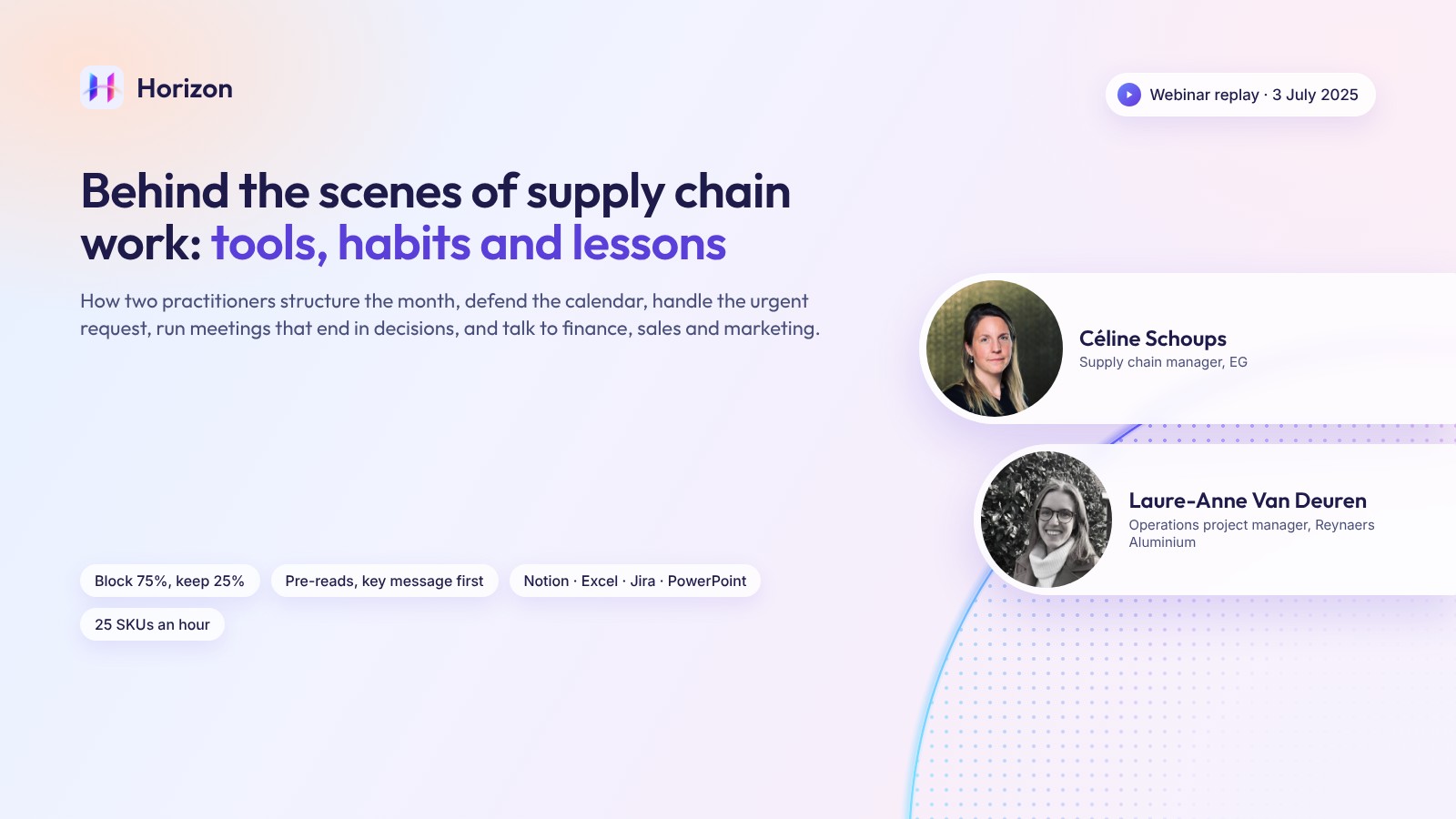
Céline Schoups is supply chain manager at EG, a generic pharmaceutical manufacturer, after roles at Danone, Mars and Deloitte. Laure-Anne Van Deuren is operations project manager at Reynaers Aluminium, previously at KPMG. Watch the webinar.
Supply chain project management has a literature of its own, mostly about methods. Very little of it describes what a supply chain manager or an operations project manager actually does on a Friday afternoon, or what happens to a carefully planned week when the general manager sends a question at eight in the morning. In a Horizon webinar, Céline Schoups, supply chain manager at EG, a generic pharmaceutical manufacturer, and Laure-Anne Van Deuren, operations project manager at Reynaers Aluminium, compared their working habits in detail. One runs the core of a supply chain with a monthly rhythm; the other runs cross-departmental projects where no two days look alike. Their habits overlap more than their jobs do. This article collects them, with the tools they named, so a planner or project manager can borrow what fits. The replay is on the webinar page.
Structure the month before the week
Schoups’ calendar is largely fixed months in advance. At the start of the month, the previous month’s actuals come in and the team manages by exception, adjusting the supply and purchasing plan. In the last week, the constrained supply forecast goes to finance for the group’s latest outlook. She already knows what the first and last weeks of November hold. The rule that makes the fixed calendar survive contact with reality is a cap: she blocks at most 70–75% of her time, so the ad hoc and urgent topics that arrive every day in a post-COVID supply chain have somewhere to go without pushing the planned work out.
Van Deuren plans the same horizon from a project angle. At the start of each month she lists what each project should have achieved by the end of it and puts blockers in her agenda per topic. Fixed meetings with the project teams are scheduled a few months ahead, at a frequency that follows the pace and phase of the project, so there are regular live touchpoints without filling the team’s agendas for months.
Both close the week the same way. Every evening they look at the next day; on Friday they restructure the coming week and decide what Monday starts with. Schoups does not work weekends and switches off completely, which is exactly why the Friday step matters: “If I don’t prepare it on Friday, I have no clue what I was doing last Friday.”
Make routine work a habit, and defend the blocks
In her previous role Van Deuren had daily inventory planning to do. Her approach was to schedule the recurring task at exactly the same time every day or week until it became a habit that no longer needed thought and did not get forgotten whatever else was urgent. Schoups does the same with recurring blocks, for a defensive reason: without them, “people are going to boycott my agenda, plan meetings in with me, and I don’t have control over my time any more.”
Decide what urgent means
Both have the same first question when a request lands: what is the value to the organisation? Schoups’ team asks whether it affects net sales, earnings or cash, looks at the bigger picture and reprioritises case by case; if it adds no value, why do it. She can run it that way because the team is experienced and largely self-steering, and she trusts their judgement, with a check-in when in doubt.
Van Deuren adds the second step that a project role needs. If the request is urgent and the re-plan still lands everything on time, nothing needs to be said. If it would delay this project or another one, she tells every stakeholder, because what looks minor to her can be blocking for another department, and she aligns with the sponsor on whether the timing shift is acceptable. Transparency about slippage is, in her words, the important part of the role.
And the leadership question at 8 a.m.? Both prioritise it. It is usually dealt with before most people are in the office, and if it is a bigger task, Van Deuren asks by when it is really needed before moving anything else.
Overload: write it out, then delegate
When the questions come from all sides, Van Deuren steps back, writes out every job, prioritises, reorganises the coming days and weeks, and communicates any delay. The lesson she values most from recent years is that she does not have to do everything herself. Involving the expert in the company saves her time, improves the quality of the work, adds to her own knowledge and gives a second opinion. Schoups sees the same lesson from the other side. Her team takes ownership to an extreme: they want to solve every problem and get on with life, including problems that belong to another department that has not realised it. “Our extreme ownership also becomes our pitfall.” Delegation, and the step back to ask whether this is really ours, is the correction.
Measure yourself
Van Deuren keeps a slide of what she wants to achieve next month and reviews it at month end, highlighting each item red, orange or green. A month with a lot of red means she took on too much, and the next month compensates. Schoups, who admits to cramming five things into the time for two, added a timer in her task tool to learn how long tasks really take, which has made her planning more realistic. Her team has a shared benchmark as well: when managing by exception in the demand planning analysis, 25 SKUs an hour. It is half a running joke and half a real measure of efficiency.
Run meetings that end in decisions
Supply chain touches every department, so Schoups does as much as possible face to face rather than in endless mail chains. She sends the invite herself, and the invite always states the desired outcome, because a vague title tells nobody what is expected of them and such meetings are rarely effective. If a decision has to be made, a pre-read goes out so that everyone arrives informed and the meeting can decide.
Van Deuren’s pre-reads follow a rule she learned along the way: show the key message and the topics to discuss, and put every detail in the appendix. Those who want the figures can find them; the meeting is for discussion, not for going through numbers. After the meeting her team writes a summary in a standard status-update template, what was done, what happens in the coming weeks, who does it, and which risks or decisions are coming, and sends it by email. The email is information, not a trigger for new discussion; the discussion happened in the session, and the next session reviews what was done. Documents live in Teams so everyone works from the latest version, and recurring requests come in through SharePoint forms with flows that route them to the right person.
On notes, both are firm. Schoups’ company does not allow AI note takers, so she takes notes herself during any meeting she has initiated, because without shared notes everyone leaves with a different version of what was agreed and the chaos gets worse. Van Deuren’s meetings are recorded and transcribed by the standard tools, with notes made together during the meeting.
Finance wants numbers, sales and marketing want the story
Finance speaks the same language as supply chain: facts and figures, no translation needed. Sales and marketing often have KPIs that conflict with supply chain’s, so the conversation has to explain the bigger picture and what is in it for them, in simple language, with the constraints stated and the technical detail left out. Schoups puts it plainly: with finance you keep to the figures, with marketing and sales you build the story around them to get the point across. Van Deuren tailors the message to the person in front of her and keeps all the detail available, so anyone who wants to know what it means for their client can find it and nothing is hidden. The same logic applies upward. For a general manager the conversation is sales, cash and earnings; for a pharmaceutical affairs director it is supply chain detail and the regulatory agenda; for anyone senior with limited time, the pre-read goes out first and the meeting is short.
Both split their week by location: focus work at home, meetings at the office, and a meeting either fully live or fully online, because the hybrid version works less well than either.
The toolkit, in one place
For tasks and projects: Schoups runs her work from a planner page in Notion, free version, on desktop and phone, with a label per topic (follow up, to do, monitor), a due date and tags for the team members involved. Before a one-to-one she filters on the person’s name; a separate private page records each team member’s wins and the feedback given, so mid-year and year-end reviews are prepared in minutes with concrete examples. Van Deuren uses the company’s Excel templates for project timelines and action logs per person, Jira for larger cross-departmental projects where each person follows up their own items, and her agenda, with blockers per topic, for her own tasks.
For visualising: Excel for the detailed Gantt chart, PowerPoint for the roadmap and for anything communicated to the wider company, Visio for as-is and to-be process flows at the start of a project when every department has its own picture of the process, Lucidchart’s free version for the same job, Office Timeline for simple timelines, and Excel for anything quick and dirty.
For learning: Lean Six Sigma Green Belt training, for thinking from the customer’s perspective and for focusing on the topics that solve the problem rather than on everything; Dale Carnegie’s How to Win Friends and Influence People, as a reminder of common sense about other people’s interests; Liz Wiseman’s Multipliers, on the behaviours that grow or diminish the people around you; Steven Van Belleghem on customer centricity; two line managers at Mars who taught business acumen; being the most observant person in the room and writing down what you see; and asking for feedback in a culture that does not give it easily.
Where inventory planning should live
An audience question asked about planning inventory in Excel against the ERP. Schoups knows companies that implemented an ERP and still plan in Excel beside it. She is a strong advocate of planning in the ERP, provided it is set up correctly and the process flow in the system matches what is done in practice, because the alerts and the logic are far more advanced. Where the ERP does not show everything, EG connects it to a data warehouse and manages by exception from reporting on top. Reynaers took the other route for inventory: a separate demand-driven inventory system sets the stock levels and parameters and sends the purchase orders to a very specific ERP. Her view is that for their system it was the best solution, without claiming it is the general one.
Horizon’s answer to that question is the same one both panellists gave in their own way: the plan should live where the alerts, the exceptions and the data are in one place, with the ERP as the source and the destination. Horizon connects to all major ERPs, including SAP, Oracle and Microsoft Dynamics 365, or works from Excel or CSV, and approved decisions flow straight into the plan and the ERP, with owner and reasoning logged. Which is a long way of saying what Schoups’ team measures in SKUs per hour: managing by exception only works when the exceptions come to you. Watch the full replay.