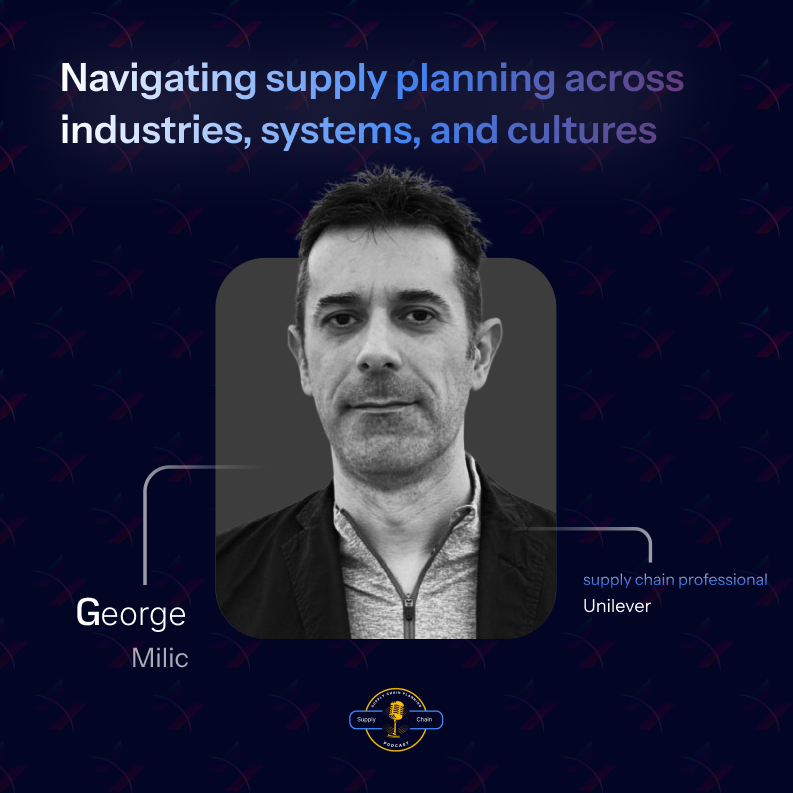
Supply planning across industries: what IKEA, Apple, Zoetis and Unilever taught George Milic

About George Milic
Associate demand planning manager at Unilever, for the nutrition portfolio in US retail. Twenty years in planning before that: Dollar General, IKEA in North America and Switzerland, an S&OP build at a skincare start-up, global lead supply planner for an iPhone model at Apple, and financial forecasting on the marketing side at Zoetis. An economics graduate who expected to go into banking. Listen to the episode.
Six companies, one discipline
George Milic's first supply chain job had a misleading title. Global sourcing coordinator at Dollar General was "predominantly an operational role, entry level": demand forecasting for the portfolio, replenishment of the company's warehouses across the US, and allocating inbound purchase orders across the DC network. He had studied economics expecting finance or banking. Twenty years later he is still in planning.
The companies in between could hardly differ more: furniture, phones, animal health, a start-up with 50 people, and now Unilever. What this conversation draws out is what changed from one to the next, and what didn't.
IKEA: availability first, then the move into process
At IKEA's North American regional office, George monitored warehouse stock supporting the stores and made sure supplier orders matched the business, with customer availability as "the most important KPI driving the work". Demand forecasting sat in Sweden.
His second IKEA role, in the regional support office near Basel, was his first step away from daily operations. He trained 50 to 60 planners on JDA's fulfilment and distribution systems, handled change requests and worked with IT on enhancements. Ben asked how he avoided becoming "the central ivory tower person who comes up with processes that look nice on paper". George admits he struggled at first. His fix: "I recruited and led focus groups of planners. One focus group would be committed to improving the process for new product launches in the EU market, with three or four planners who were working operationally in the business."
A start-up S&OP built on spreadsheets
Back in the US, George set up S&OP from nothing at a beauty and skincare start-up of around 50 people. "There was no S&OP process in place. You had to go about the work in a very scrappy way. Limited IT solutions; the work was heavily reliant on Excel spreadsheets." The lesson he took is about data rather than process design. "In achieving a successful S&OP process, data management and data exchange is very, very crucial. To have the right information available and refreshed in a timely manner off a spreadsheet-driven process was challenging. It did drive some hiccups."
Apple: weekly planning, air freight, and laser focus on the expensive parts
At Apple, as a contract consultant in the AppleCare iPhone planning team, George was global lead supply planner for an iPhone model, reviewing the regional planners' work and accountable for how many new purchase orders were placed. Wim asked how it compared to IKEA.
Speed, first. "Planning for consumer electronics was essentially a weekly process. Very fast-paced. Air freight is used for everything. You place a PO, you're receiving it four to six weeks later." Then value, and with it priority. "When you're planning iPhones you have very key service level targets for the higher-value items: a whole unit phone, or components like screens and motherboards, which are very expensive. The priority from a day-to-day perspective was really on those. In IKEA it was more flat; whether you were planning a bookcase or anything else, everything was treated more equally."
Which was easier? The focused version. "When you're meeting with the management team to review your plans, there would be laser focus on those higher-priority SKUs. You're basically given the unilateral discretion to act independently in planning those."
Zoetis: two forecasts, one in dollars and one in units
At Zoetis, the animal health company spun out of Pfizer, George took his only job outside supply chain, in the marketing team, improving the financial forecasting process for the brand portfolios and making sure it fed S&OP. "We improved the financial forecasting process to incorporate customer insights, to ensure we had appropriate net revenue projections versus the company's budget. Those plans were compared with the volume forecast the demand planning team was delivering."
So there were two forecasts: marketing's financial projection in Anaplan, and supply chain's volume forecast in SAP, exported and compared in presentations. The reconciliation was directional: "Assuming no change in price, is year-over-year growth in revenue reasonably aligned to year-over-year growth in volume?"
Ben asked whether the split made sense. George's view is that it doesn't have to exist. "From an S&OP process perspective, in my opinion, you don't need two separate inputs. You can utilise the demand forecast the supply chain team is producing, and that demand forecast would be communicated to your S&OP team in both volume and net revenue. Everybody collaborates on one input that feeds into what should ultimately be the consensus for the business. That's definitely the way it's done in some companies."
Unilever: demand planning with supply in view
Today George plans demand for Unilever's nutrition portfolio in US retail, and does not run supply planning day to day. But he watches it. "If there are service issues or stock-outs, or potential capacity constraints that could affect the company's sales performance, those inputs would need to be recognised in ensuring you have an appropriate demand forecast, and a narrative to explain the forecast performance."
On systems: fundamentally similar, and less Excel than before
George has used JDA, Kinaxis, Anaplan and SAP. His conclusion is unfashionable in a market where job adverts ask for specific tools. "On a very general level, all the systems are fundamentally very similar. They're all good solutions to have versus having nothing at all to support day-to-day planning." Every company he worked for "just naturally happened to adopt systems for different reasons".
What has changed is the share of work that stays inside them. Fifteen years ago, "there was a lot of data that needed to be exported and managed in Excel to carry out day-to-day planning". Now, from what he sees of Unilever's supply planners, "they're able to do more of their work in the systems and not be reliant on exporting as much information and doing work outside the system". Machine learning and AI he finds "very helpful" for baseline forecasting in particular, and sees development on both the demand and supply sides.
How to train planners on a planning system
Wim asked what worked when George was IKEA's JDA solution expert. "It's very important to develop close relationships with the planners who are carrying out the day-to-day work in the solutions. Stay close to your team, see what their questions are, learn what works well for them, where they have problems, where there are opportunities for change requests." On top of that, periodic training sessions, at least twice a year, with content he built himself: PowerPoint, screenshots, a description of every module and screen.
He was the intermediary between the vendor and the planners, trained by the provider and translating for the team. Web-based click-through training had its place for onboarding from the ground up, "but I still found it important to provide in-person, more customised trainings".
US and Europe: results versus relationships
As the podcast's first US-based guest, George was asked about culture. "In American culture there's probably a heavier emphasis on results, on KPIs. In Europe, KPIs were still important, but there was more interest in people getting to know each other on a personal level." His example: IKEA flew every North American planner to Sweden once a year to meet the global teams, review priorities and spend time together. "That was new for me." On knowledge and capability, he saw no difference: "I don't think one side had any kind of advantage over the other."
Your next steps
- If you move into a central process or systems role, form focus groups of working planners around each improvement so the process is built with the people who run it.
- Before building S&OP in a small company, decide how data will be refreshed and exchanged; the process will fail on that before it fails on design.
- Segment by value and give planners discretion on the items that matter most, rather than treating every SKU the same.
- Where marketing and supply chain keep separate forecasts, aim for one demand forecast expressed in both volume and revenue.
- If you own a planning system for a team, pair close contact with twice-yearly customised training, and route change requests through what you hear.
George's advice for people early in a planning career is to keep learning formally. "I strongly advocate pursuing trainings, whether via an external provider or internally. I attended an S&OP training with Oliver Wight once and found it very beneficial." And to use LinkedIn deliberately: "Join supply chain focus groups and discover the people you're most interested to follow and connect with." He names Nicolas Vandeput as one he reads.