
Get full value from your APS: add Deep Sensing on top
Most manufacturers and distributors we talk to already run an advanced planning system (APS). Years of investment, a multi-year contract and a team trained on it. And still, demand planning and S&OP are where they feel the gap: the forecast needs heavy manual correction, and what sales, customers and the market already tell you never reaches the plan.
The usual answer is "replace it". Often that isn't timely or practical. There's a better first question: how do you get full value from the system you already have? Our answer: AI demand planning on top of your APS.
Why replacing your APS is rarely the first move
A replacement takes years to decide and deliver, and it puts everything that already works at risk.
In most companies the gap is much narrower than the whole system. It sits in demand planning and S&OP, and in the information that feeds them.
Why demand planning and S&OP are the hard part
Demand planning and S&OP are usually the hardest part to get right in a planning system. They need two things most systems weren't built for: far more information than the system holds, and more advanced modelling than it runs.
That shows up as three gaps.
What's missing in most demand planning and S&OP processes
1. The information isn't in the system
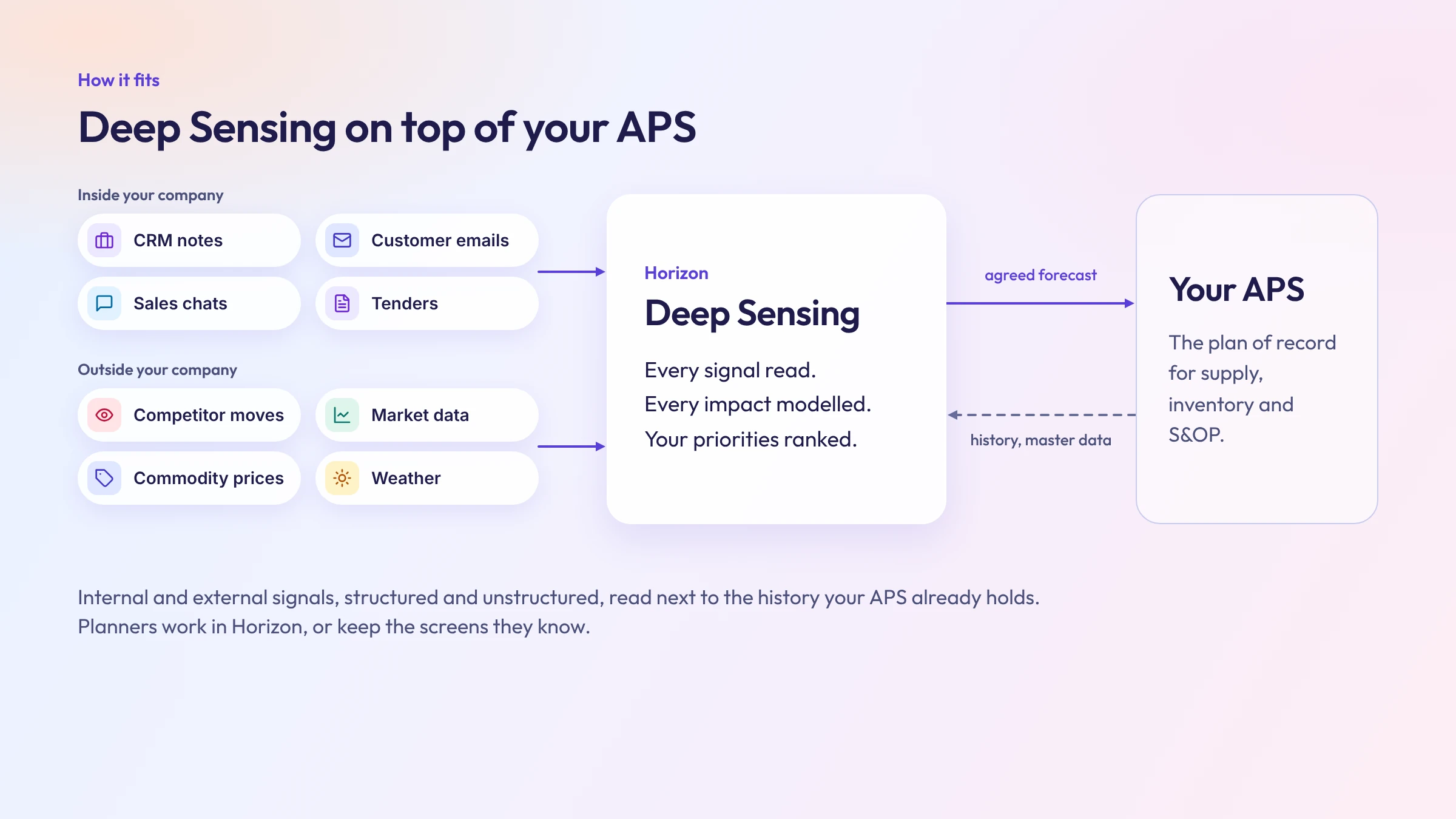
The forecast runs on sales history, orders and a few fixed inputs. But what moves demand sits somewhere else. Inside the company: CRM notes, customer emails and Excels, sales chats, call transcripts, tenders. Outside it: competitor moves, market data, commodity prices, weather.
Bringing one new signal into the system is a data project. So most of it stays in people's heads and inboxes. It reaches the plan late, as a manual adjustment or a remark in the S&OP meeting.
2. The impact isn't modelled
Even when a signal is known, nobody calculates what it means per item, per customer and per period. It becomes an override, or a debate.
The models are part of the reason. Many planning systems still forecast mostly with classical statistics. Where machine learning is available, it has to be configured, fed with prepared data and tuned, so it often stays unused. Deep learning, foundation models and causal models for drivers such as prices and launches are rarer still.
3. Planners don't see the key priorities
Fixed screens and long exception lists treat every item the same. Planners work through all of it, and the few changes that really matter are easy to miss.
The same happens in S&OP. The meeting goes to reconciling numbers, when it should go to the few decisions that need the people in the room.
How Deep Sensing sits on top of your APS
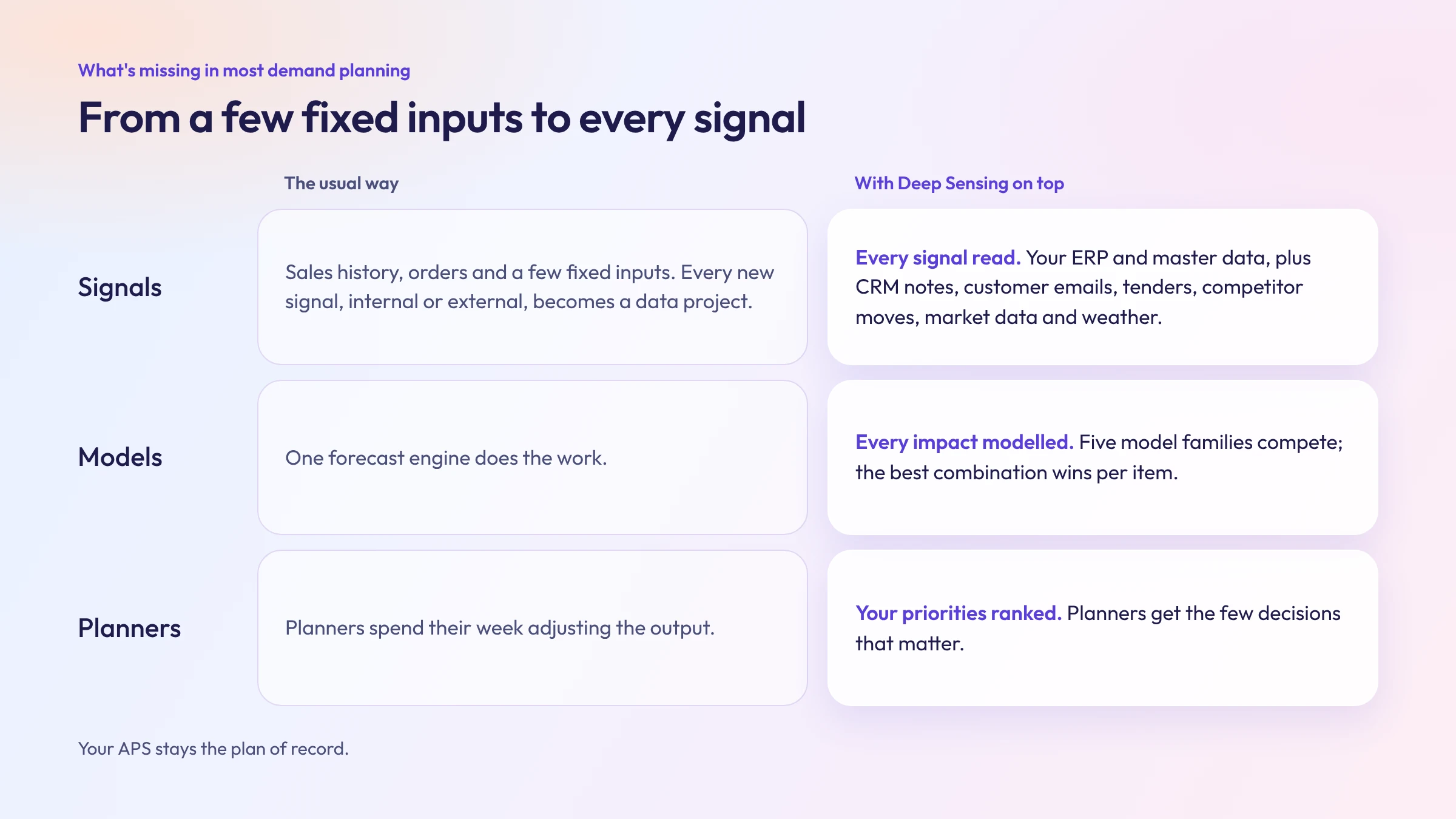
Deep Sensing reads everything that moves your demand, models the impact, and hands your planners only the decisions that matter. On top of an APS, it closes the three gaps.
Every signal read. Horizon takes the history and master data you already have, and adds the signals your APS doesn't see: internal and external, structured and unstructured. A customer email about a launch that moves. A competitor that runs out of stock. A commodity index that jumps. Adding a source is a connection, not a data project.
Every impact modelled. Five model families compete, and the best combination wins per item, chosen by backtest: statistical, machine learning, deep learning, foundation models and causal models. HZN-1 is deterministic: same data, same answer. Language models read. Engines decide the numbers.
Your priorities ranked. Planners see the few decisions that matter on the impact map, with the reasoning behind each one, in flexible views that fit their role. The agreed forecast flows back into your APS, which stays the plan of record.
Planners can work in Horizon, or keep the screens they know.
What changes in your S&OP
The cycle stays the same. The input gets better. The demand review starts from what changed and what it means, not from last month's numbers. Drivers and assumptions are visible, so the meeting can go to the few decisions that matter.
What we've seen on three systems
SAP IBP, in pharma. Horizon on top of SAP IBP: 10-20% lower forecast error than the existing baseline, with the result written back into IBP. Read more: Get more value from SAP IBP.
OMP, in project-driven businesses. Where demand is lumpy and hard to forecast, a stronger baseline than the existing one in our comparisons.
Kinaxis, in distribution. A stronger baseline than the existing one in our comparisons, plus the extra signals and the collaboration with sales.
Across our customers, we see 18-45% lower forecast error than traditional systems.
What it takes
Data. Start with the data you have: the history and master data already in your APS or ERP.
IT. A way to read that data and a way to return the forecast. Your APS set-up stays as it is.
Time. Start with Horizon Instant: up and running in less than 24 hours, so you see the accuracy on your own numbers. Add Deep Sensing and Ori when you're ready.
Questions we often get
Do we need to replace our APS? No. Your APS stays the plan of record. Deep Sensing adds what demand planning and S&OP are missing.
Our APS already has machine learning. Why add this? Machine learning on history is one piece. Deep Sensing adds the information your system doesn't hold, five model families that compete per item, and the priorities for each planner.
How is this different from demand sensing? Demand sensing sharpens the short term with recent orders, point-of-sale data and sometimes weather. Deep Sensing reads all relevant information, internal and external, structured and unstructured, and models its impact across the horizon.
Where do planners work? In Horizon, or in the APS screens they know.
Does it change our S&OP process? No. The cycle stays the same. The input gets better.
Which systems does this work with? Today we have experience with SAP IBP, OMP and Kinaxis. More will follow.
You don't have to choose between the system you have and the AI you want. Get full value from your APS: add Deep Sensing on top.
Start with Horizon Instant, or book a demo.
SAP and SAP IBP are trademarks or registered trademarks of SAP SE. OMP and Kinaxis are trademarks of their respective owners. Horizon Solutions is not affiliated with, sponsored by or a partner of these companies.
