
Get more value from SAP IBP: add Deep Sensing on top
SAP IBP is the planning backbone at many companies: one integrated plan across demand, supply and inventory, tied closely to the ERP. Nobody replaces that lightly, and most shouldn't.
But many IBP teams tell us the same thing about demand planning and S&OP. The statistical forecast needs a lot of manual correction, and what sales, customers and the market already tell you arrives too late, or not at all.
Why demand planning is the hard part in SAP IBP
Demand planning and S&OP are usually the hardest part to get right in any planning system, and IBP is no exception. They need far more information than the system holds, and more advanced modelling than most teams run in it.
That shows up as three gaps.
What's missing in SAP IBP demand planning
1. The information isn't in IBP
IBP forecasts from structured data: orders, shipments, sales history and the drivers you load into it. Its demand sensing sharpens the short term with the most recent of that data. That's useful, but it's only one input.
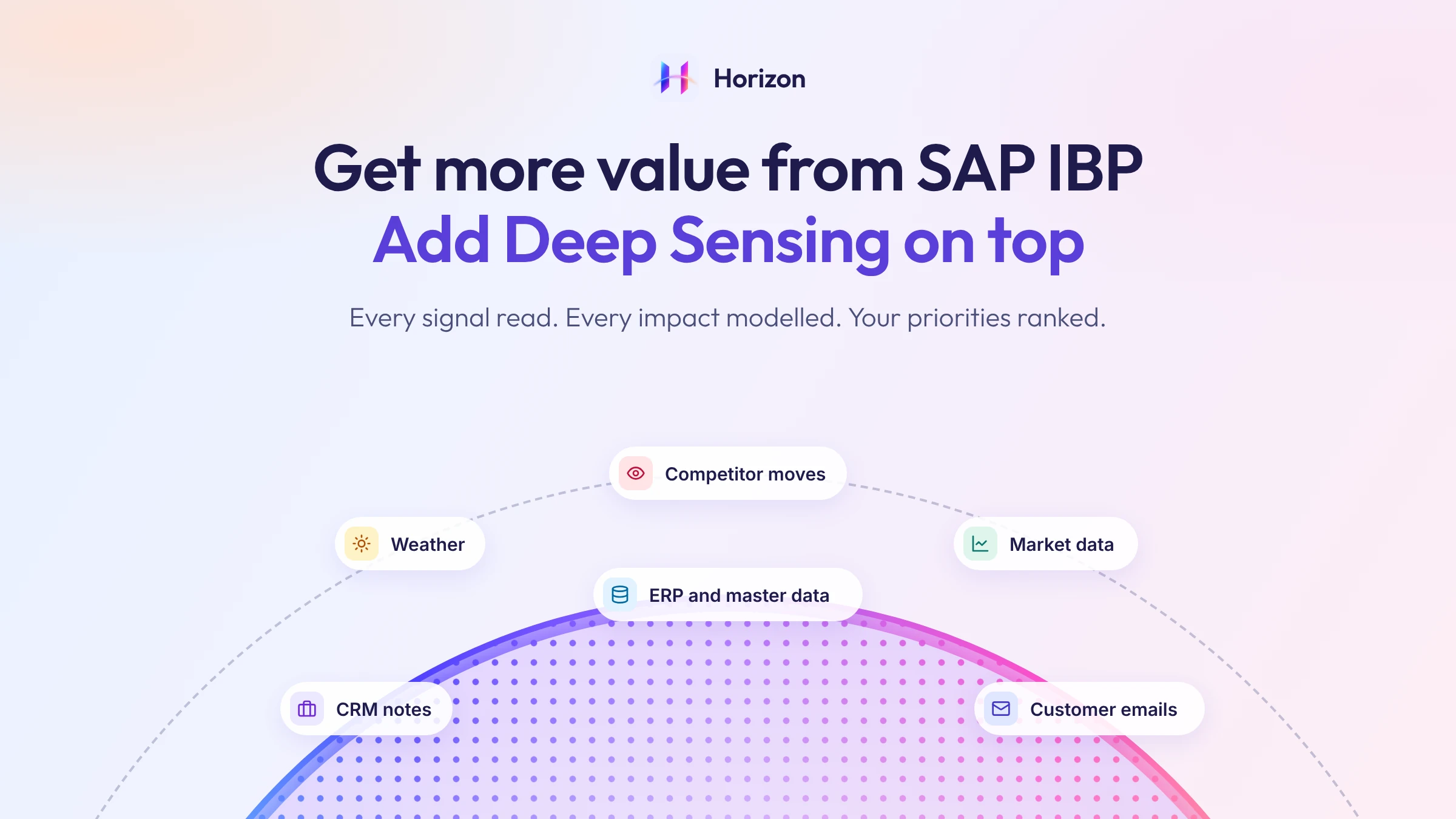
What moves demand often sits somewhere else. Inside the company: CRM notes, customer emails and Excels, sales chats, tenders. Outside it: competitor moves, market data, commodity prices, weather. Bringing each of those into IBP is a project. So planners carry them in their heads and adjust the numbers by hand.
2. The impact isn't modelled
IBP comes with a range of forecasting algorithms, including machine learning. In practice, each one has to be configured, fed with prepared drivers and tuned. Many teams we meet run a handful of statistical models and correct the output by hand.
Other model families that work better for some items, such as deep learning and foundation models, usually mean building and integrating your own. And a forecast model in IBP works with structured key figures. A customer email or a tender document isn't something it reads.
3. Planners don't see the key priorities
Planning views and alerts show a lot of numbers. What they rarely show is which few items need a decision today, and why. In S&OP, the time goes to reconciling numbers, when it should go to the decisions that need the people in the room.
How Horizon sits on top of SAP IBP
1. Read. Horizon takes the history and master data you already have in IBP and the ERP.
2. Add the signals. It reads the information IBP doesn't see: internal and external, structured and unstructured. Adding a source is a connection, not a data project.
3. Model the impact. Five model families compete, and the best combination wins per item, chosen by backtest: statistical, machine learning, deep learning, foundation models and causal models. HZN-1 is deterministic: same data, same answer.
4. Return. Planners see the few items that need a decision on the impact map, with the reasoning behind each one, in flexible views that fit their role. The agreed forecast is written back into IBP, which stays the plan of record.

What we've seen in pharma
Horizon on top of SAP IBP, in pharma: 10-20% lower forecast error than the existing SAP IBP baseline.
For each item, planners see how the number was built: the baseline, each signal with its own impact, and the forecast that goes back into IBP. They work in Horizon on the items that need a decision. Supply planning and S&OP carry on in IBP as before, on a better demand plan.

What changes for planners and for S&OP
Less time correcting statistical output. More time on the few decisions that move the plan. Planners become key planners, the first to see what's beyond the horizon.
In S&OP, the cycle stays the same and the input gets better. The demand review starts from what changed and what it means. Drivers and assumptions are visible, so the meeting can go to the decisions.
Questions we often get
Do we keep SAP IBP? Yes. IBP stays the plan of record. Horizon adds what demand planning and S&OP are missing.
IBP already has demand sensing and machine learning. Why add this? They work on the structured data inside IBP. Horizon adds the information IBP doesn't hold, five model families that compete per item, and the priorities for each planner.
How does the data flow? Horizon reads history and master data, and returns the agreed forecast to IBP.
Does it change our S&OP process? No. The cycle stays the same. The input gets better.
How fast can we see results? Start with Horizon Instant: up and running in less than 24 hours, so you see the accuracy on your own numbers.
Running another planning system? Read the full story: Get full value from your APS.
Start with Horizon Instant, or book a demo.
SAP and SAP IBP are trademarks or registered trademarks of SAP SE. Horizon Solutions is not affiliated with, sponsored by or a partner of SAP.
