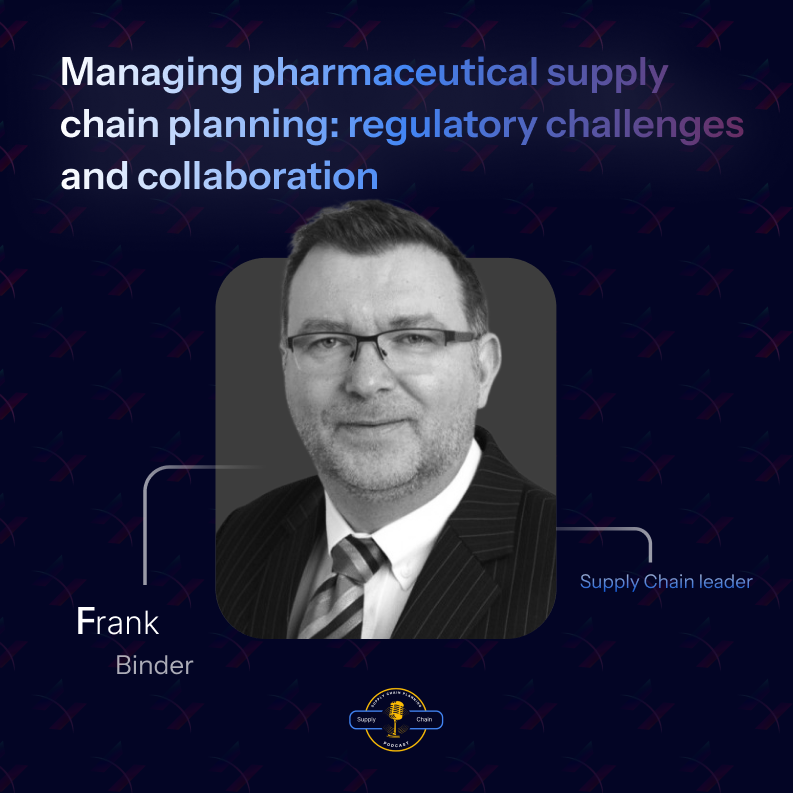
Pharmaceutical supply chain planning: regulation, IBP in money, and what to centralise, with Frank Binder

About Frank Binder
Supply chain leader in pharmaceuticals for more than 20 years: production chemist at Roche, supply chain consultant at Accenture, then operational and global supply chain roles at Novartis, Celgene and Santen. A physical chemist by training, with a PhD. Listen to the episode.
Why pharmaceutical planning is different
Frank Binder's route into planning ran through the lab and the shop floor: a PhD in physical chemistry, API manufacturing "by the tons" at Roche, consulting at Accenture, and then an operational role at Novartis that turned into a career in global supply chain. What he learned on the way is that in pharmaceuticals the plan is only as good as its regulatory footing.
"Where a product is manufactured and how it is manufactured and what ingredients are used, this is all registered with the relevant authorities. We must make sure in our planning that we actually plan the right SKUs. We have to be sure which SKUs we are allowed to bring on the market in Malaysia or in France." Two SKUs can come off the same line to different recipes. The leaflet and the box text are approved per country. And changes, moving a product between sites for instance, have to be approved, many of them before they take effect. "It just adds a dimension of complexity. On one hand, a very granular set-up. On the other hand, difficult changeovers."
You lose aggregation unless you design for it
Wim asked whether that granularity removes the usual benefit of forecasting at an aggregate level. Frank's answer is that it does, unless the supply chain is built to get it back. "We really have to consider the planning from making the actual semi-finished goods to the finished goods specific to one SKU. We do not have aggregation in many cases, but if we plan for it correctly, we can set up aggregation situations." That means producing generic, non-localised semi-finished goods and postponing packaging, printing and labelling to a second step. "It has to be really set up as such."
Two consequences for planners. "You cannot demand plan in isolation and just look at numbers. You need to know how your whole supply chain actually looks and how the production process looks." And you need to know where there is a second source, because substitution is not an option: "It is really important that we never have any mix-up between our products."
Structured collaboration, or it gets chaotic
The commercial teams hold information the planner needs, so Frank has built integrated business planning wherever he has worked. "We have discussions on the demand plan where we really sit together and understand each other's assumptions. Then, when we fully understand the demand plan and where the upsides are, we go about the supply plan, which then needs to reflect the regulatory set-up." The structure matters because the cycle repeats. "This basically repeats every month. If we do it in a more informal way, it gets chaotic quite quickly."
At Novartis the process already existed. At Celgene, "much more of a start-up situation, a rapid growth situation", he had to put it in. At Santen an S&OP process existed and was reshaped into IBP with finance far more involved.
Money as the common language
Finance is in the room so that trade-offs can be made in value, not volume. "It is very difficult to talk about replacing X million bottles of product A with Y million bottles of product B if you don't understand what is actually the contribution of that product, what is the gross margin. Together with finance, we value the demand and the supply plan and compare them in terms of value. Do we have any gaps between what we want to achieve from a budget perspective and what we can actually support? We are trying to have money as the common language within the company."
The hard part is price. Pharmaceutical pricing varies by market and comes with rebate schemes for some customer groups and not others. "We worked a lot with finance to get something we can use as an average sales price that reflects quite closely what is actually going to happen, without becoming too complex."
Regulatory in the process, distribution in the control tower
Regulatory affairs is not a standing IBP participant, but it joins whenever change is on the table: a registration update, a site transfer. "When we have major projects, they come in and give us updates on where we stand and what we can do and what we cannot do."
Distribution issues, by contrast, rarely belong in a six-to-24-month process. They surface in the short-term control tower, which Frank describes without mystique: Power BI reports over the next three months, "where do we have risks of inventory shortages or even out-of-stocks, what plant production can be accelerated", plus forwarder data where useful. "It's still a work in progress to have a really efficient kind of cockpit with the minimum amount of generating reports. But it's very important."
Systems: no pilots, backfill your best people
Frank was on the business side of Novartis's global SAP R/3 programme, two dozen rollouts over several years, and implemented Oracle at Celgene. Ben asked whether pharma can trial a planning system in one market first. "The effort is enormous. You want to try something out and you still have to go through a complete design project. I haven't seen that done in pharmaceuticals. There's a selection of one system, the system is configured in a global template, and then you just go one by one."
His staffing rule is firm. "You need to put some good people from your organisation into the project from the business side. It's really worthwhile to have some really good people building the system; the efficiency gain is paid back multiple times. What we typically do is backfill these roles in the standing organisation, because we just cannot afford not to." Consultants earn their place where they bridge the two sides: "consultants who are able to understand and translate business requirements".
The business case for data management
Data management and data science, Frank argues, are now as fundamental as planning or logistics capability, and have to be in-house. "You cannot implement advanced systems without having some really advanced data management in place." The problem is selling it. "Data management is quite abstract. In some instances it can even be quite boring to explain what it is, but the value is enormous."
His argument runs on both sides. The downside: "If we do not have good enough data management in-house, the data quality will degrade quickly to a point where you cannot operate an ERP system anymore, or not gainfully." The upside: "What kind of analysis could we do that would benefit the commercial team? If you can provide data that enables the commercial team to do a better job, that is always a selling argument." He has won that case, and he has been sent back to the drawing board.
Supply chain is not an order-taker
Ben asked how supply chain is regarded inside pharmaceutical companies. Frank has seen both models. "There are companies where the commercial team says, I want this, I am your internal customer, so you have to do it. That is normally not fruitful, because as supply chain professionals we have something really unique to contribute: an understanding of the operational effort and the cost to do specific things."
The contribution is cost-to-serve. "We can challenge some markets where there is a lot of effort and very little sales and even less profit. Teaming up with finance and commercial on marginal markets, products in the long tail, cost-to-serve analysis, that's where supply chain has unique insights. But it doesn't work if we just wait for others to give us orders."
A network redesign that outlived the company
The project Frank is proudest of is Celgene's European distribution network. Every country had its own logistics provider for in-market distribution. With finance, commercial and QA, "we came up with a radically simplified model with one single location in Europe, with one multilingual customer service team, delivering next day to hospitals across Europe. Out of Germany, to hospitals in the UK, in France, in Italy."
The savings were large, the hospitals gave good feedback, and the proof came later. "Bristol Myers acquired Celgene, and instead of just moving everything to their standard distribution set-up, they decided to keep it and even to expand it. What we did more than 10 years ago is still being used by the company that acquired Celgene."
What to centralise, and what not to
Maturity varies inside pharma companies as much as anywhere: "one team that's very mature and in another region a team that is doing quite basic things". Frank's rule is to centralise the processes that have to synchronise and leave the rest regional.
Demand planning has to run the same way everywhere: "the same approach, the same granularity, the same frequency of data collection, the same frequency of discussion, because otherwise we are just not able to maintain a regular global process" synchronised to a working day in the month. The data has to mean the same thing, "if I have a demand from Malaysia, I need to be sure that is equivalent to a demand for France". Supply planning needs the same system and the same methodology, or planners in regions that supply each other "cannot even have a meaningful conversation". That means a central playbook and central accountability, "otherwise you can centralise a process and the very next day it starts to diverge again".
Plant scheduling and distribution stay local. "There is no point in making sure that the distribution in Malaysia works the same way as the distribution in France." And for regions still on spreadsheets, the IBP minimum is the same: "It doesn't matter if a region still has to use Excel sheets. In the end, the templates are the same."
Recruiting planners: tell me a story
Frank thinks planner is "one of the most difficult kinds of jobs to recruit". The profile is analytical and comfortable with systems, but also persuasive, "a negotiation situation, influencing colleagues without having any reporting line", open to change when a new system arrives, and resilient, because "every day you will have different messages and different things have happened". There is no standard career path into it, and the gap between average and good is "a multiple in terms of productivity and creativity".
So he interviews for stories. "Tell me about a situation where you were faced with the potential out-of-stock of an extreme product. How did you manage it? What did you achieve?" Real stories show experience, "but also how they think, how they process things, and whether they can give you a coherent and succinct story", and several interviewers look from different functional angles.
Leadership: not a micromanager, and keep the one-to-ones
Frank credits mentors, Kurt Reber at Novartis and Michael Morrissey at Celgene, and tries to pass it on, formally and informally. On his own style: "Being a micromanager is in a way ridiculous and it's also dangerous for the organisation. I try to empower people, giving them some guidance, but in the end it is about enabling people to do things by themselves." The skill he still works on is patience.
On the fashion for cancelling one-to-ones when there is nothing to discuss, he is clear. "Regular one-on-ones have nothing to do with micromanagement. It's really about an agenda that is quite open. It's about understanding how the other is doing, what the key activities are, whether they are stressed out or severely overworked. If you just get a status report and say, everything is green, let's move on, that's not leadership as I imagine it."
Your next steps
- Map which SKUs are registered where, and design postponement into the supply chain so you can aggregate before localisation.
- Put finance in the IBP cycle and agree an average sales price, rebates included, so trade-offs are made in money.
- Decide which planning processes must be standard worldwide (demand, supply) and which stay regional (scheduling, distribution), and give the central ones an owner.
- Before the next system project, name the business people who will build it and backfill their roles.
- Interview planners for concrete stories, with several interviewers from different functions.
Frank's advice for anyone aiming at a planning career is a recognised certification such as APICS CPIM, "something that is portable", plus literacy in finance and the commercial side. "You need to understand a bit what the products are that you are planning. That gives you more credibility with the commercial team. Supply chain professionals, and especially planners, have the chance to really understand a bit beyond the narrow task."