Postponement in the pharma and medtech supply chain: ready to use, not ready to sell
About Zoltán Sólyom
Supply chain director at Coloplast. Roughly eight years at Teva and eight at Coloplast, across market supply chain, new product introductions, portfolio management and end-to-end operations in pharma and medtech. Watch the webinar.
Where pharma and medtech planning is ordinary, and where it isn't
Most of the planning in a pharma or medtech company looks like planning anywhere else. “Wherever sales is happening with normal, decent fluctuation and volatility, the normal models are working,” says Zoltán Sólyom, supply chain director at Coloplast. Set a service level, derive the target stock and the safety stock, and run. His example: a 95% service level on a given item translates into about 3.6 weeks of inventory held on the market, continuously.
The difference starts at the edges. A launch has no history. A stockout reaches a patient, not just a customer. A product is reimbursed by governments and registered country by country, so the version sold in one market cannot simply be sent to another. And a change as small as a print tape has to be documented before production can use it. Those four facts shape everything below, and the lever that answers most of them is postponement.
Launch forecasts: who owns the number
In Zoltán's experience, the forecast for a new product or a new market sits firmly with sales and marketing. Someone responsible for that business decides how much they expect to sell, and how they arrive at the number is “a super complex task”. Both errors are expensive. Overestimate, and operations produces volumes the country cannot sell, which sooner or later are scrapped. Underestimate, and the launch misses the financial targets it was built on.
Supply chain's role is not to claim a better number. “If I say I know better how much they can sell of a product we have never produced, they could also challenge me on why I can only produce that quantity.” What works is a sanity check from the operational side: the competitors on the market, the capacity available, whether the ambition is beyond what the machinery can make. That depends on trust, and trust on a track record of collaborating well.
Existing products are different. Once a product has history, supply chain can bring knowledge to the forecast, and it has grounds to push back when the numbers are plainly off: a forecast that has sold 10% of plan for half a year is a conversation. Marketing, Zoltán notes, is under pressure from finance to deliver targets and tends to the optimistic; operations tends to the pragmatic.
Forecast accuracy settles the argument
The KPI that makes that conversation possible is forecast accuracy, comparing the forecast made one, two or three months earlier with actual sales. What matters is how the company uses it. As a hard KPI for marketing, it changes behaviour on its own. As a soft one, it becomes the reason to ask for a forecast to be reconsidered, backed by data: the raw materials on hand, the volumes already produced, the shelf life left, and what will expire based on what the system shows.
The planning systems Zoltán has used can also measure two accuracies at once: the forecast with marketing's manual adjustments, and the one the statistics would have produced untouched. “It's always funny to see which version is going to win at the end of the month.” His finding is that adjustments backed by real knowledge win, because statistics only see the past, and a promotion, a competitor's stockout or a price change does not appear in the statistical forecast at all. That is also where competitor data comes in: market data providers that report sales volumes monthly, weekly or daily, and the field teams that hear about a competitor's stockout and channel it back.
Service levels when the customer is a patient
The inventory models hold until volatility arrives, and in pharma and medtech it arrives often: a competitor's problem sends demand your way, a raw material becomes unavailable. “Getting prepared for unexpected situations, my experience is that these models tend to fail.” Then it is a company decision, and the decision Zoltán has seen is almost always to be more secure: strategic stock in raw materials and finished goods, higher than the model suggests, because a stockout in this industry has a much stronger effect than a cost line. The result is higher inventories than elsewhere, by choice.
Shelf life, country versions and the ten-year pallet
A medicine's shelf life is typically between one and five years, two to three on average. That sounds generous until the volume is small: produce a full pallet of a slow-moving item and the pallet may be enough for ten years. The second driver of write-offs is change. When a product has to reach the market with different information, packaging or labelling, the existing inventory cannot be used, the product is remade and the rest is scrapped.
Country versions multiply the problem. Because medicines and devices are reimbursed by governments, countries set their own requirements for how a product looks, and switching between country versions is not easy. Under the EU's medical device regulation, Zoltán's company ran two versions of a product for years, the MDR version for countries where registration was quick and the old one where it was still pending, and counted that as the good outcome: two versions rather than one per country.
Postponement: ready to use, not ready to sell
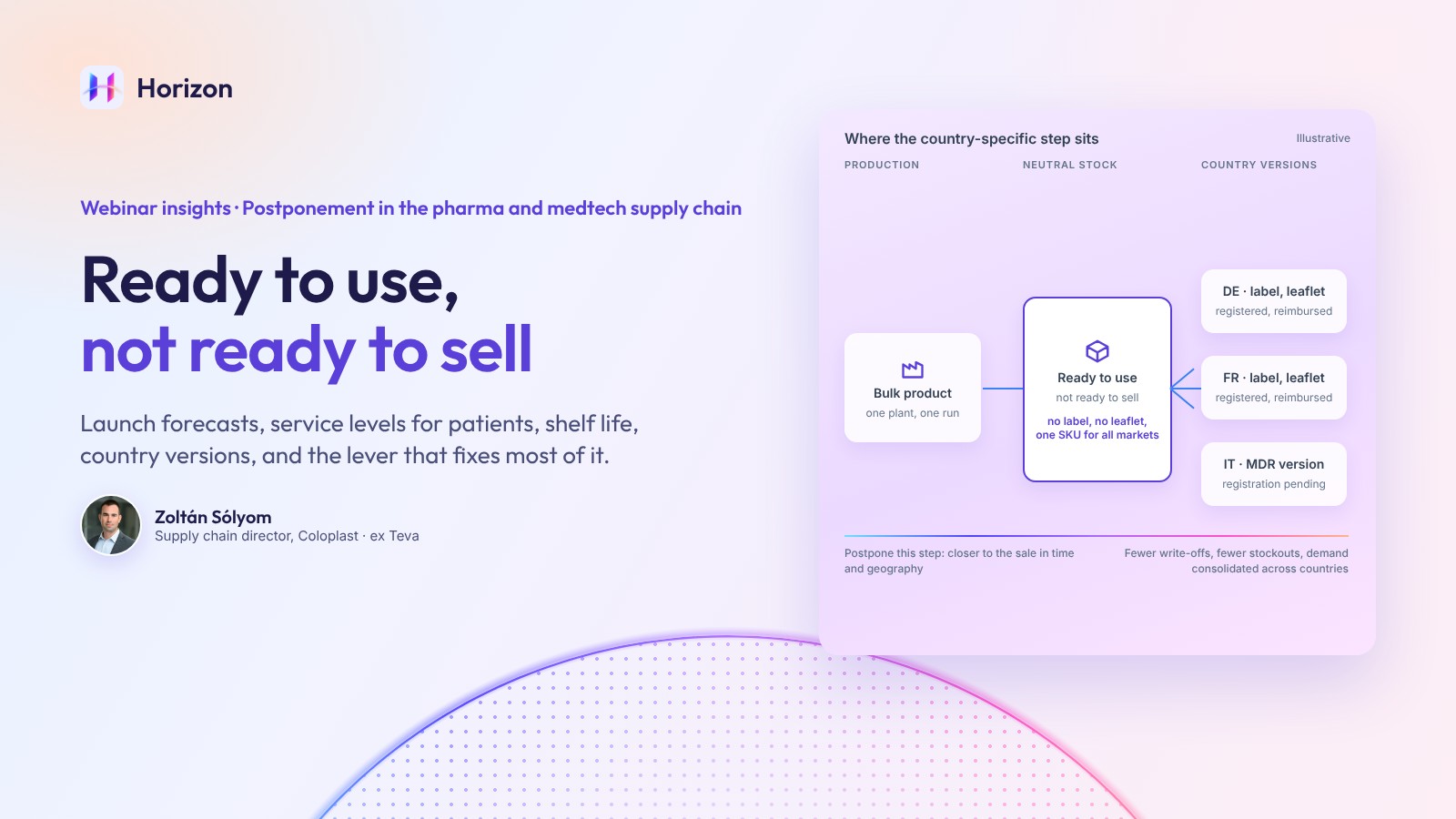
This is the lever. Hold inventory in a neutral version, “ready to use but not ready to sell”, without the country-specific characteristics, and delay the final step until closer to the sale, in time and in geography. “Then you have a better chance of having the right amount of inventory on the market, a shorter lead time to answer market needs, and you can consolidate the demand from several countries at the same time. You save yourself from write-offs and from stockouts as well.”
Planners rarely own this decision; it belongs to the people who design the network and the production flow. The two questions are where the cut-off sits, the point at which a product becomes ready to sell, and where the ready-to-use stock is held and for which regions. Write-off provisions are managed the same way: with the forecast and current inventories, the team identifies what will expire a year or two out and starts the conversation with marketing early, or finds another use for the raw materials, so the provision shrinks instead of turning into a write-off.
IBP, Excel and the planner
In Zoltán's current role, IBP earns its keep on the long term: when to invest in new machinery for specific items, how many square metres of capacity are needed three years out. Capacity is the key, because these products cannot be bought from someone else if the company does not make them.
Excel has not gone away, and he does not expect it to. The planning system produces the ideal plan, what the market needs and what would be good to produce. Excel is the fine-tuning layer for what the system cannot characterise, and regulation is why there is so much of it. The print tape example makes the point: the tape that prints the label is itself a registered item, so a shortage of it cannot be fixed by swapping in an identical tape with a different item code. The change has to be registered and documented, and the plan has to be adjusted, order by order. “Until the plan is only in the system, it is just on paper. As soon as it goes down to operations, it has a very tough impact if they are not able to produce.” For a large portfolio there are many such changes, and a final check before the plan reaches the line is non-negotiable.
On AI, Zoltán sees a lot of performance to gain inside the planning system, and no replacement for the planner. The job is experience: the problems met before and how they were solved, “and that seems to be quite human”.
Your next steps
Agree who owns the launch forecast and what supply chain's sanity check covers, then make forecast accuracy visible, with the adjusted and untouched versions side by side. Decide the service-level policy for volatility explicitly, so that higher inventory is a choice rather than an accident. Map the products where a neutral, ready-to-use version is possible and where the country-specific step could move later, and decide where that stock would sit. Run the expiry exposure off the forecast every cycle and take it to marketing early. And keep a final, documented check between the plan and the production line, because in a regulated plant the plan is not the hard part; executing it is.
Zoltán's own summary is the one to keep: ready to use, not ready to sell. Everything else in the session follows from deciding where that line is drawn.