SKU rationalisation and make-to-order vs make-to-stock: planning in project-driven industries
About the panellists
Guilherme Pereira led global IBP processes and technology implementation at Knauf, after global supply chain and planning roles at Nordex, Allnex and Baker Hughes, and has since moved to a new role. Jogy Babu is general manager of sales and operations at RAK Ceramics, overseeing demand, supply and fulfilment planning, with more than 25 years in production and supply chain. Watch the webinar.
Demand that moves with interest rates
Gypsum boards and ceramic tiles are sold into construction, and construction moves with the economy. “We used to use a lot of causal factors,” says Guilherme Pereira, who led global IBP at Knauf. Interest rates, government incentives, the news from the Fed and the dollar for the US market: in all, 50 to 60 drivers in the demand model, alongside seasonality. Much of the data is public. The country-specific pieces, such as Italy's renovation incentives, are not, and come from third-party providers that Guilherme describes as reliable and not expensive. The data science runs first and the output is then checked by hand against the bigger plan.
Jogy Babu, who runs sales and operations at RAK Ceramics, draws the horizon line. Incentives, trade barriers and interest rates matter most for the long term and for capacity: which markets to go into, and what the plants should be able to make. Short-term planning is governed by seasonality, and seasonality is regional: renovation season in European and American summers, Ramadan in the GCC, Chinese New Year in Asia, low summer demand in southern Europe. Historical patterns carry most of that, with experience layered on top for the holidays that shift from year to year.
SKU rationalisation before the forecast
Tiles are a lifestyle product. “The preference you select is not my preference,” Jogy says, and every market wants its own colours and designs, so the SKU count grows unless someone stops it. RAK Ceramics stops it at product design. When one market asks for a product, the team looks for two or three markets that could take it, proposes alternatives where only one is interested, and leans on the fact that most buyers choose beige, white and grey anyway. Sales will always ask for their own variants; given a clear value argument, in Jogy's experience they accept the discipline, because the company moves better with fewer SKUs.
Underneath that sits master data. Jogy manages it personally and rebuilt the whole structure so that every new SKU follows the same parameters for its item code and attributes, which is what makes the data complete enough to plan on. Guilherme's experience at Knauf is the mirror image: within one country, the same product existed as different variants purely because of package size, and forecasting at the lowest level on messy master data was “always really tricky”. Moving stock between countries to optimise inventory ran into the same wall, with different SKU numbers and packaging for the same raw material, and customers who did not want the other size. “If you have messy master data, you're going to have messy IBP in the end.”
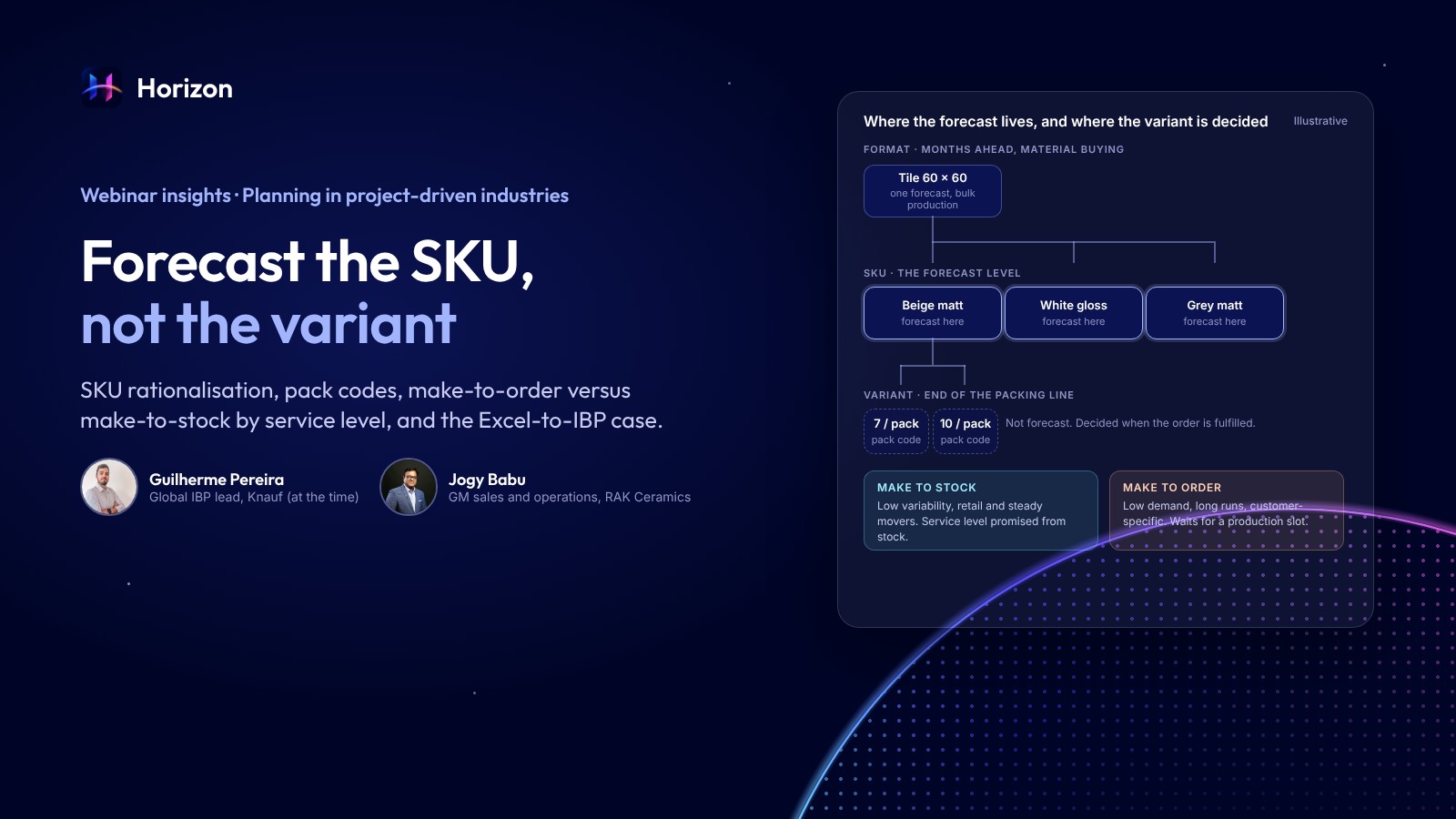
Two practices come out of it. Forecast at the level of the product hierarchy where the forecast is reliable, and let the variant be decided as late as possible. At RAK, that means pack codes: “We don't forecast the variants, we forecast the SKU. The packing is managed at the end of the packing line.” Seven pieces or ten pieces per pack is a packing decision, not a forecasting one. For months-ahead material buying, plan at the family or format level, 60 by 60 or 120 by 120; differentiate size, design and package only when the order has to be fulfilled.
Make-to-order vs make-to-stock, by service level
Long production runs and long transport lead times, 45 to 60 days to some export markets, make the stocking decision the central one. RAK Ceramics segments products into make-to-stock and make-to-order. Products with low forecast variability and steady movement go to stock; low-demand products with long production runs go to order, unless the market has to be served immediately, in which case they are stocked anyway. Buffer stock covers the long-lead-time customers. The deciding variable is the service level promised, and the promise is made explicit: products sit in different catalogues, each with its own service level, so sales and customers know whether something ships from stock or waits for a production slot.
Channel enters the same decision. RAK serves projects, contractors, B2B traders, OEMs and retailers, and retail SKUs are always make-to-stock. Guilherme's summary is that “everything is around the service level”: set it, then derive the MTO/MTS strategy and the rest of the decisions from it. Customer-specific exceptions exist, but the segmentation is done at product level first, and ideally at the start of the year when the product line is designed.
Planning across the network
Unlike pharma, where a country-labelled product cannot cross a border, building materials can move, and both panellists plan at network level. Labels and cartons still differ between Europe and the Americas, which pushes the most customer-specific items to make-to-order, but stock, transit and on-the-ground inventory are managed as one system. Jogy assigns cost of ownership: one person is responsible for what should be in transit, another for what is on the ground, each with targets.
Guilherme's example is from an earlier role: aged inventory sat in plants across the globe, so the team created two distribution hubs, in Dubai and Rotterdam, shipped the most expensive aged stock there, and transferred it to whichever plant or customer needed it. The saving was almost $10 million. The logic generalises: before producing more of something, check whether the capital is already sitting somewhere else, whether the logistics make sense, and whether the customer's requirement is met; if all three hold, transfer rather than make. CO2 and energy constraints, for the record, show up as regional capacity limits in European plants and as pallet and container load design in logistics, not yet as drivers in the demand plan.
From Excel to IBP: people first, master data first
Asked what improved when Knauf moved from Excel to IBP and what got harder, Guilherme names the constraint before the benefit: “It's always the human being.” A planner who has done the job for twenty years in his own spreadsheet, with his VLOOKUPs and formulas, has to be convinced that the spreadsheet is no longer needed and that the new tool, slower at first while he learns where to click, will do the same work. Implementation is never easy and needs a strong team, but the top priority is master data: know exactly what the tool will do with each field and attribute before it is loaded. The gain shows in the data afterwards, forecast accuracy before and after.
Jogy, who is at the start of the same journey, sees the case in the silos. A central demand planner in Excel cannot see everything happening in the market and the company, and the missed chances show up in revenue, working capital and service. Excel forces a choice between a statistical forecast and a collaborative one; a system combines them. The hard part is the same on both sides: convincing management that IBP is needed, and convincing users to move.
The business case
Guilherme's structure is a five-step executive story: define the problem; quantify the impact, working capital and inventory first; describe the IBP solution and the tool; estimate the measurable benefits, forecast accuracy, inventory, manual planning hours; and compare the cost of software, implementation and change management with the expected savings. He avoids rolling everything into one headline number and sticks to the three measurable items. Jogy builds from the data the company already has: working capital, and the gap between CRM pipeline and converted sales orders, because sales are lost to service failures, not only to price. Add the lead times promised per channel and the complexity of serving retailers, projects, OEMs and B2B at different service levels, and the case for one integrated plan writes itself.
AI, as used today
Both are past the slide-deck stage. At Knauf, Guilherme worked on agents for the manufacturing sites, including a shared knowledge base so that a problem solved in Brazil years ago is found by a plant in Indonesia today, with guardrails against hallucination, and most recently on a demand planner agent that automates the small daily decisions and manual work. His view is that most companies already have the data; the work is putting it in a shape an AI can read. Jogy's first use case is collaboration: real-time exchange with customers and stakeholders, with the system showing a customer that their forecast and their orders do not match. Which tools a company can use depends on its platform; both are building on the enterprise stacks their companies allow, and both describe themselves as early in the adoption.
Your next steps
Start with master data, because every later step depends on it. List the causal factors that actually move your demand and find out which are public and which need a provider. Decide the hierarchy level at which you forecast and the point at which variants are set, and push variant handling to the end of the line where you can. Segment make-to-stock and make-to-order by variability, channel and promised service level, and publish the promise. Look for aged inventory across the network before adding capacity. And build the IBP business case on three measurable numbers rather than one big one.
The panellists' own advice is the same from both sides of the table. Jogy: forecast the SKU, not the variant. Guilherme: get the master data right first, then take the people with you, because the tool is the easy part.