
The bullwhip effect: four causes, one root cause, and what's realistic to fix

Most supply chain leaders could explain the bullwhip effect in their sleep. Small changes in consumer demand turn into bigger and bigger swings in orders the further you move up the chain. Procter & Gamble's logistics team saw it in nappy orders: babies use nappies at a steady rate, yet orders swung widely.
Jay Forrester described the mechanism around 1960, and the beer game has taught it to students ever since. It's still in most supply chains. Not because people don't understand it, but because many textbook fixes are hard to put into practice. So this article keeps the theory short and focuses on what's feasible, and what isn't.
The bullwhip effect in one picture
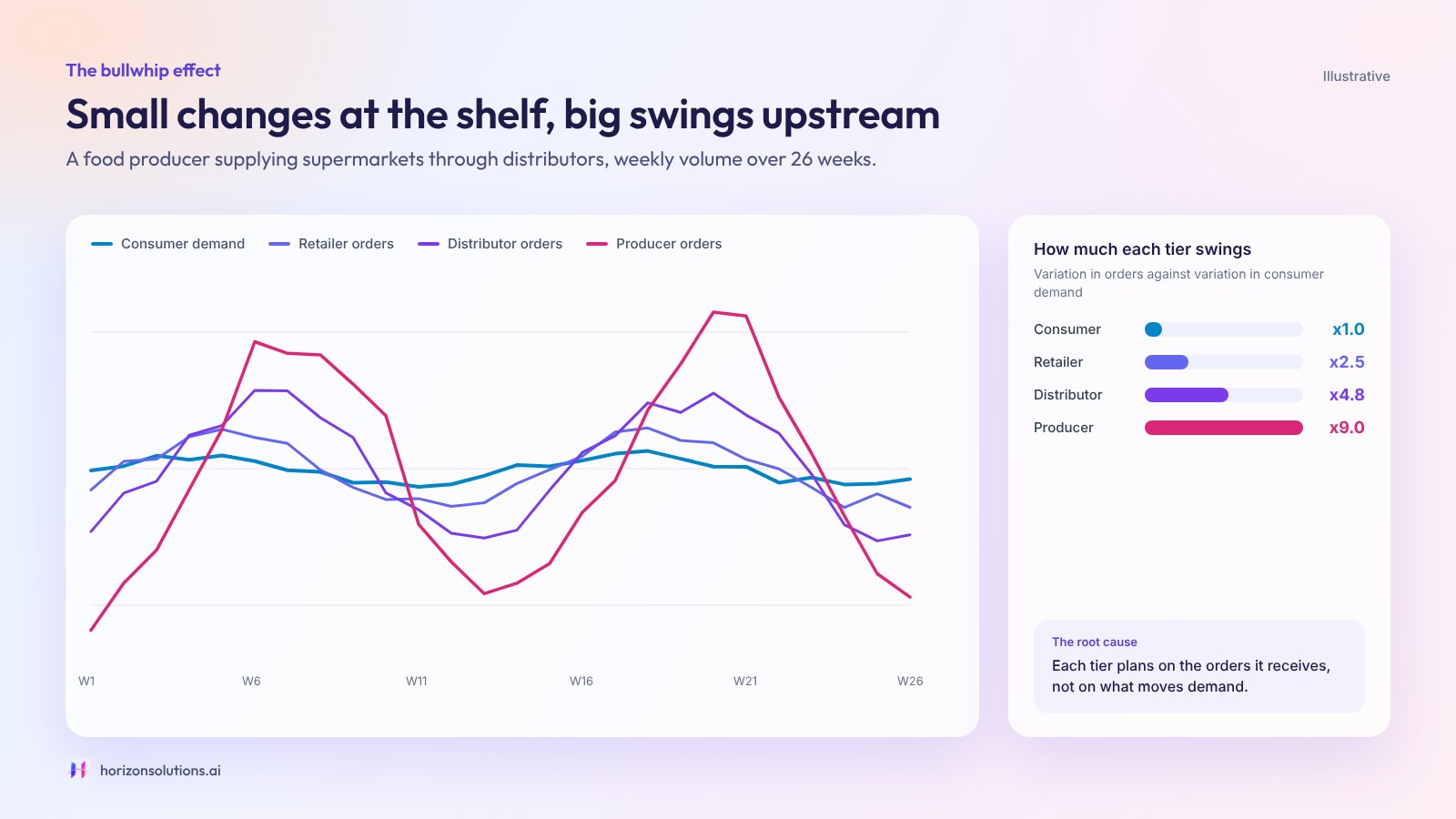
Take a food producer that supplies supermarkets through distributors (an illustrative example). Consumer demand for one of its products moves a few percent from week to week.
The supermarket orders in weekly batches and adds safety stock when sales pick up, so its orders swing more than its sales. The distributor sees those orders, not the shelf, and does the same. By the time the signal reaches the producer, a 5% change at the shelf can look like a 30-40% change in orders. Production, raw materials and suppliers swing with it.
The four classic causes
In 1997, Hau Lee, V. Padmanabhan and Seungjin Whang named four causes:
- Demand signal processing. Each tier forecasts from the orders it receives and adds safety stock on top, so every update is amplified.
- Order batching. Orders go out weekly or per full truck, not as demand happens, so a steady flow becomes a series of spikes.
- Price fluctuations. Promotions and price changes make customers buy ahead, then stop buying.
- Rationing and shortage gaming. When supply is short, customers order more than they need to get a bigger share, then cancel when supply returns.
The root cause underneath
All four share one thing: each tier plans on the orders it receives, not on what's moving demand. Orders are a delayed, filtered and often inflated version of demand. The further a company sits from the end customer, the more of its plan is built on noise.
That's why the fixes that work all come down to the same idea: get closer to real demand, and react to it earlier and less. Lora Cecere calls the delay demand latency, and it's the part most companies can shorten.
How big is yours?
Compare how much the orders you receive vary with how much the underlying demand varies, over the same periods. A ratio well above 1 means amplification. Then do the same for the orders you send to your suppliers.
Measure it per customer and per product group. The effect is rarely spread evenly: a handful of customers or groups usually cause most of it, and that's where to start.
What's feasible
- Use the downstream signals you already get. Customer forecasts and releases, sell-out data where a customer shares it, listings and store openings announced by email, promotion calendars. Most companies receive more of this than they use, in Excels, portals and EDI. Using it needs no new partnership, only a way to read it and link it to the right items.
- Plan on demand, then derive orders. Forecast what end customers will buy, then work out what each customer will order, rather than forecasting orders directly. Treat forward buying around promotions as a known effect, not as new demand.
- Calm your own replenishment rules. Rules that chase every change pass the swing upstream. Smoothed order rules and stable safety stock settings pass on less.
- Smaller orders where the economics allow. Combining several items per truck keeps transport efficient while cutting the batch size per item.
- Allocate on history, not on today's orders. In shortages, base allocation on past sales or contracts. Inflated orders then stop paying off, which removes the reason for shortage gaming.
- Watch competitors. When a competitor runs out of stock, demand shifts suddenly. Seeing it early avoids over-reacting on the way up and on the way down.
What's unrealistic
- Full visibility across every tier. Seeing your customers' customers and your suppliers' suppliers in real time is the textbook ideal. Few companies get it beyond one tier, and waiting for it delays everything else.
- Perfect customer forecasts. Customers won't share perfect forecasts, and theirs carry their own bias. The realistic aim is to use what they share, weighed by how reliable it has been.
- Stopping promotions. Everyday low pricing removes forward buying, but few commercial teams will give up promotions. Model their effect instead.
- Full collaboration programmes with every customer. Shared planning and vendor-managed inventory work with a few large partners and rarely scale to the whole customer base. More in CPFR in practice.
- Zero lead times. Shorter lead times help. Zero isn't on offer.
Where to start
- Measure the amplification per customer and product group.
- Pick the three to five customers or groups that cause most of it.
- List the signals you already receive from them, and start using them.
- Fix the replenishment and allocation rules for those first.
For how this plays out in practice, see Hadi Eghlidi on the bullwhip in semiconductors, George Milic on supply planning across industries and Knut Alicke on the basics to fix first.
How Horizon does it
Horizon starts where the bullwhip starts: in the gap between orders and demand. Deep Sensing reads the downstream signals in customer emails and Excels, CRM notes and sales chats, links them to the affected items and models the impact before it shows up in orders. Adding a source is a connection, not a data project.
On the supply side, Horizon sets stock with multi-echelon inventory optimisation. In shortages, it proposes allocation actions based on configurable priority rules, with planner approval and an audit trail. See Supply Planning.
Start with Horizon Instant: demand planning on your own data, up and running in less than 24 hours. Or book a demo.
