The demand planning process in luxury and FMCG: what changes and what stays the same
About the panellists
Francesco Calore has held planning and managerial roles at ASSOS, Tiffany & Co., SVP Worldwide and LG Electronics. Simone Rossano has twenty years in planning lead roles at Bulgari, Godiva, Ferrero, Reckitt and Zespri. Watch the webinar.
Most descriptions of the demand planning process assume a certain kind of company: thousands of SKUs, promotions, retailers, a statistical baseline with sales uplifts on top. That is the FMCG version. Luxury and premium companies run the same process with different weights on almost every step, and planners who have moved between the two worlds notice it immediately. In a Horizon webinar, Francesco Calore (ASSOS, Tiffany & Co., SVP Worldwide, LG Electronics) and Simone Rossano (Bulgari, Godiva, Ferrero, Reckitt, Zespri) walked through those differences step by step. This article follows the demand planning process from volumes to systems and marks, at each step, what changes between luxury and FMCG and what stays the same. The replay is on the webinar page.
Step one: decide what you are planning, units or value
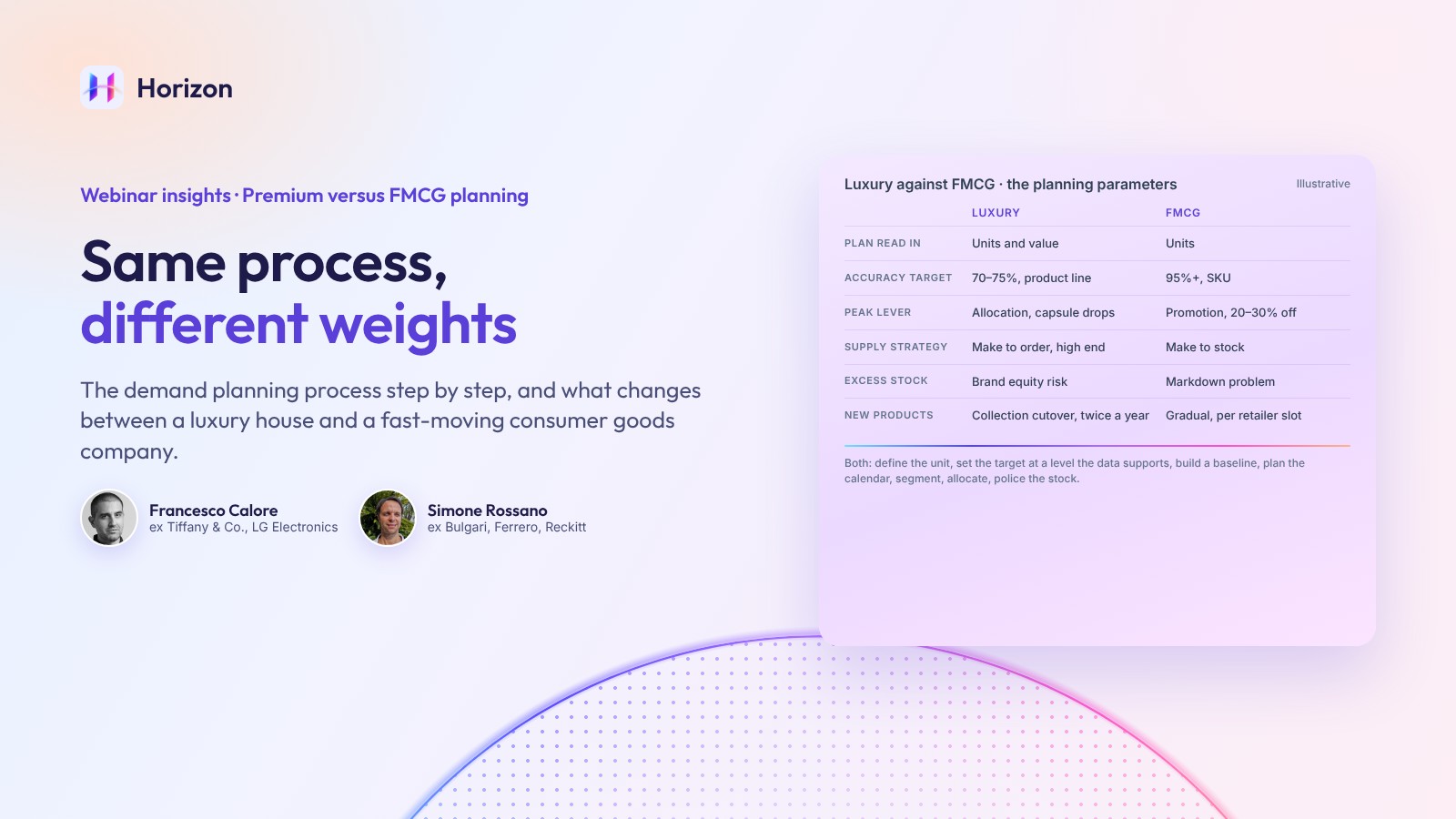
In FMCG the plan is in units, and value is a report. In luxury the plan has to be read through two lenses at once. Volumes are low and unit values are very high, so a small change in units is a large change in revenue, and a single order of one unit, if it is a high-end watch, has to be fulfilled even if that means moving the piece from one store to another at considerable logistics cost. Rossano gives three reasons the two lenses never separate: inventory of valuable goods has to be watched in both, the margins are high and controlled in both, and the one-unit order exists. Calore’s consequence is value-weighted KPIs: a single high miss can hurt more than several wins, so the forecast error that matters is the value-weighted one.
Step two: set the accuracy target, and the level you measure it at
The panellists’ benchmarks are worth writing down because they are so rarely stated. In luxury, an acceptable value-weighted accuracy sits around 70–75%, measured at product group or family level over a three- to four-month horizon, with sell-through watched alongside it. On entry segments such as accessories, 80–85% is reachable. Consumer electronics on stable SKUs with strong history and seasonality reaches well above 75% even on longer horizons, with product lifecycle and obsolescence as the risk instead. FMCG targets run far higher, 95% and up in Rossano’s experience.
The level matters as much as the number. Luxury measures at product line level because many SKUs, high-end jewellery or watches, sell a handful of units a year and cannot be judged individually. FMCG measures at SKU level because the volumes support it. Benchmarking across the two is, in Calore’s words, a pain in the neck even within the same industry, which is why the measurement convention has to be fixed before the target is debated. The Horizon article on accuracy, bias and forecast value add covers how to do that.
Step three: build the baseline
In FMCG the baseline is statistical, and the uplift on top is defined by the key account managers: promotions are the lifeblood, with price ladders, bundles and retail media producing predictable spikes. In luxury the portfolio splits. The carry-over products and entry segments, eyewear, ties, silk, wallets, belts, are the revenue makers with an almost constant demand and are forecast statistically, with spikes planned from sales input around the peak periods. The high-end watches, jewellery and accessories are made to order and, in Rossano’s words, “very, very, very difficult” to forecast at all.
Step four: collaborate, but with whom
Supply chain is central in both worlds; the partners differ. In luxury the collaboration is strategic and tight with finance, the gatekeeper of margin and open-to-buy, and with merchandising and brand marketing on the collection’s intent and story. The planner’s job, as Calore describes it, is to translate the brand narrative into SKU depth and delivery waves: which boutiques, which windows, which client lists. Sales exists, but reaches out when it needs something rather than in a structured cycle. In FMCG the centre of gravity moves to the sales team, because retailer contracts, trade marketing and slotting calendars drive the plan, and finance and marketing set the targets. The tension between marketing, which wants the widest assortment, and supply chain, which wants a rationalised one, exists in both, and Rossano calls it a productive tension: the forum where assortment and quantities get agreed.
Step five: plan new products and phase-outs
Here the calendars diverge completely. A luxury house has a collection cutover twice a year, spring-summer and autumn-winter, with a long development lead time and a strict calendar set by marketing in which every department has a role. New product introduction runs as a separate track inside S&OP, reviewing desirability and feasibility in parallel with expert panels doing the numbers, and the phase-in and phase-out windows follow themes and brand moments as much as the calendar. Miss the cutover and there is no second chance. In FMCG, phase-in and phase-out are gradual and negotiated with retailers: miss one shelf slot and another appears three or four months later. Consumer electronics sits in between, with an engineering-driven product roadmap in which a legacy product is planned out as its successor comes in.
Step six: plan the peaks
Both worlds have the same peaks: Christmas, Easter, Valentine’s Day, Mother’s and Father’s Day, Chinese New Year, Golden Week, Black Friday. FMCG plans them with promotions, discounting 20–30% to capture volume, and the uplift can be estimated from previous years’ price sensitivity. Luxury does not touch the price. Its levers are allocation and clienteling, limited and capsule collections, curated drops and planned scarcity; at Tiffany the word promotion, in the sense of price, “sounded like a bad word”. That makes the uplift harder to estimate: a brand moment driven by social media or a partner never lands in the same place twice, and the Blue Book event moved in timing and location every year while being worth several hundred thousand dollars in watches alone.
Step seven: decide make-to-order or make-to-stock
FMCG, apparel and consumer electronics are make-to-stock throughout, with forecasting and line balancing driving efficiency. Luxury segments its supply chain to mirror its marketing segmentation. Rossano describes the project at Bulgari that drew the line: the blockbuster products, pushed, made to stock, allowed a little safety stock; the high-end segments made to order, because an excess of pieces in gold and diamonds that may leave the collection is a nightmare to manage. Calore adds assemble-to-order to shorten lead times on bespoke watches, small and frequent batches, and pre-allocation to boutiques or clients to justify a production run. For the general logic of that decision, see SKU rationalisation and make-to-order versus make-to-stock.
Luxury production carries three constraints that FMCG does not. Scarce materials: exotic leather, gold, diamonds, materials that cannot be stocked in bulk and that cap batch sizes. Artisans: the value is in the manual work of highly skilled people who are hard to find, so capacity is a natural cap and scheduling is nothing like a line that runs several hundred thousand units. And the target margin agreed with finance, which is checked down to the single unit. The scarcity is real, and it is also a narrative: it raises desirability and supports periodic price increases, which the planner has to understand from both sides.
Step eight: allocate when supply is short
The whole luxury business runs on an imbalance between demand and supply, so allocation follows strict strategic rules. Distribution is selected, flagship stores come before secondary stores in the same country, home stores get most of the product during the cruising phase, and the outlets and agreed phase-out customers take what is left at the end of the collection. In FMCG a shortage is operational: a priority list agreed with sales and marketing, and the business does not revolve around scarcity. The appetite for risk follows: luxury customers know premium takes time and are willing to wait, so when forced to choose the planner is cautious and protects margin and stock; FMCG protects the shelf, because an empty shelf sends the consumer to the competitor.
Step nine: live with the inventory policy
Calore’s summary of the luxury policy is three words: few, right and visible. Curated depth, the right pieces exposed where it matters. A stockout risks disappointing a client; an excess risks brand equity erosion. In consumer electronics and apparel, excess and obsolete inventory is a markdown problem, costly but manageable; in FMCG, in the worst case, you rent another warehouse and run a promotion. Luxury has no such room, and works at unit level with family-and-friends events as the only outlet for excess.
Step ten: the systems and the people
Rossano rates FMCG a five out of five for planning maturity: standardised systems covering forecasting, supply, replenishment and distribution end to end, and a supply chain excellence or business process owner function to develop them. Consumer electronics, in Calore’s experience, is a four, with heavy integration and Excel used for bridges and to mimic features the packages did not yet have. Luxury he rates a three: an ERP with satellite systems, a replenishment system from headquarters, legacy custom tools and spreadsheets for fine-tuning, simulation and allocation, with Excel as the glue. He has never seen a supply chain excellence function in a luxury house, because the artisanal stages do not fit the standard system models.
The people differ too. Luxury has a stronger culture than average: craftsmanship, heritage, pride in multi-decade careers at the same house. That energy fuels continuous improvement and can become resistance when a system or process change looks like a compromise on quality. The winning planning profile there is a mix of analytics literacy and product knowledge, including how a client walks into a boutique. In both worlds supply chain is strategic, for different reasons: in luxury because it sits in the collection from design through acceptance and has to get the piece to the boutique; in FMCG because it has to be fast and keep the shelf full.
What stays the same
Strip out the weights and the process is the same list in both worlds: define the unit of planning, set an accuracy target at a level the data supports, build a baseline, collaborate with the functions that hold information, plan introductions and phase-outs on a calendar, plan the peaks, segment make-to-order from make-to-stock, allocate when short, and police the inventory policy. What luxury teaches FMCG is to look at value and not only units, and to segment the portfolio before forecasting it. What FMCG teaches luxury is that standardised systems free planners for the work that needs judgement. Horizon forecasts across the hierarchy, from total to product group to item, item × location and item × customer, so the luxury planner can read the plan at product line level and in value while the FMCG planner works at SKU, on the same engine. The full replay has the detail on each step.