
What does a demand planner do? The job today, and the job that's coming
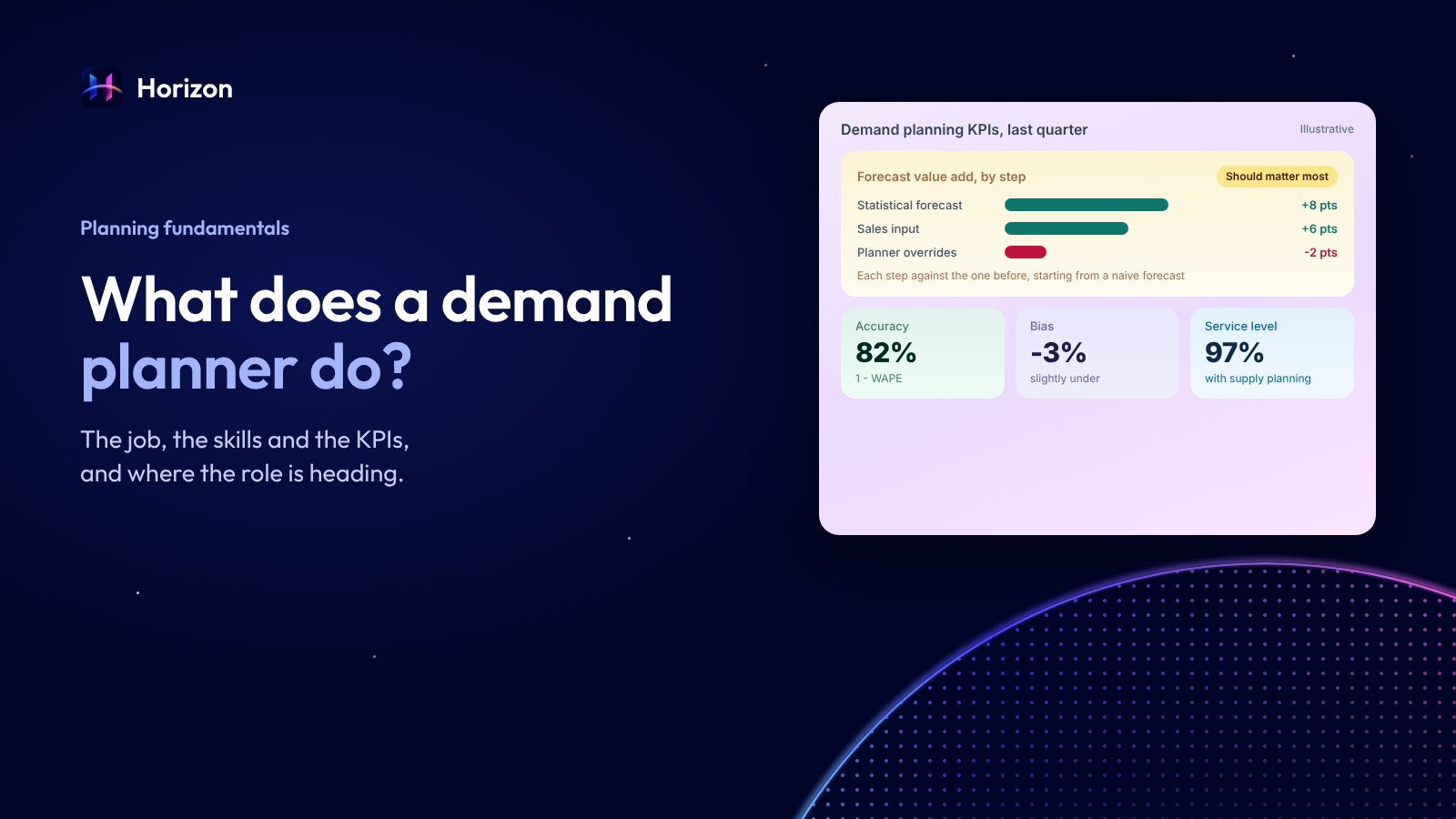
A demand planner forecasts how much of each product customers will buy, and turns that forecast into one number the rest of the company plans on. They combine a statistical forecast with input from sales, marketing and customers, check it against what actually happened, and present it in the demand review of the S&OP cycle. Supply, inventory and finance then work from the same number.
This guide covers the responsibilities, skills and KPIs of the role, the usual career path, where the week actually goes, and how the job is changing.
What a demand planner is responsible for
- The baseline forecast. Generating and maintaining the statistical forecast per item, customer and location, and cleaning the history of outliers and stock-outs.
- Market input. Collecting and challenging input from sales, key account managers, marketing and customers: promotions, launches, listings, tenders.
- The demand review. Presenting the forecast, what changed, and the risks and opportunities in the S&OP cycle.
- Performance. Measuring accuracy and bias, and learning from the misses.
- Portfolio changes. Planning launches and phase-outs together with product management.
- Exceptions. Following up where demand deviates, and working with supply planning on shortages and allocation.
The skills that matter
- Analysis. Enough statistics to judge a model, and fluency in spreadsheets and the planning system.
- Business sense. Knowing customers, products and the market well enough to see when a number is wrong.
- Business partnering. Asking sales the right questions and challenging without alienating. Jessica Seurinck of Inve Aquaculture, speaking in a Horizon roundtable, called working with sales on S&OP "an educating role".
- Judgement. Knowing when to override the model, and when to leave it alone.
- Communication. Telling the story behind the number in the demand review.
The KPIs a demand planner is measured on
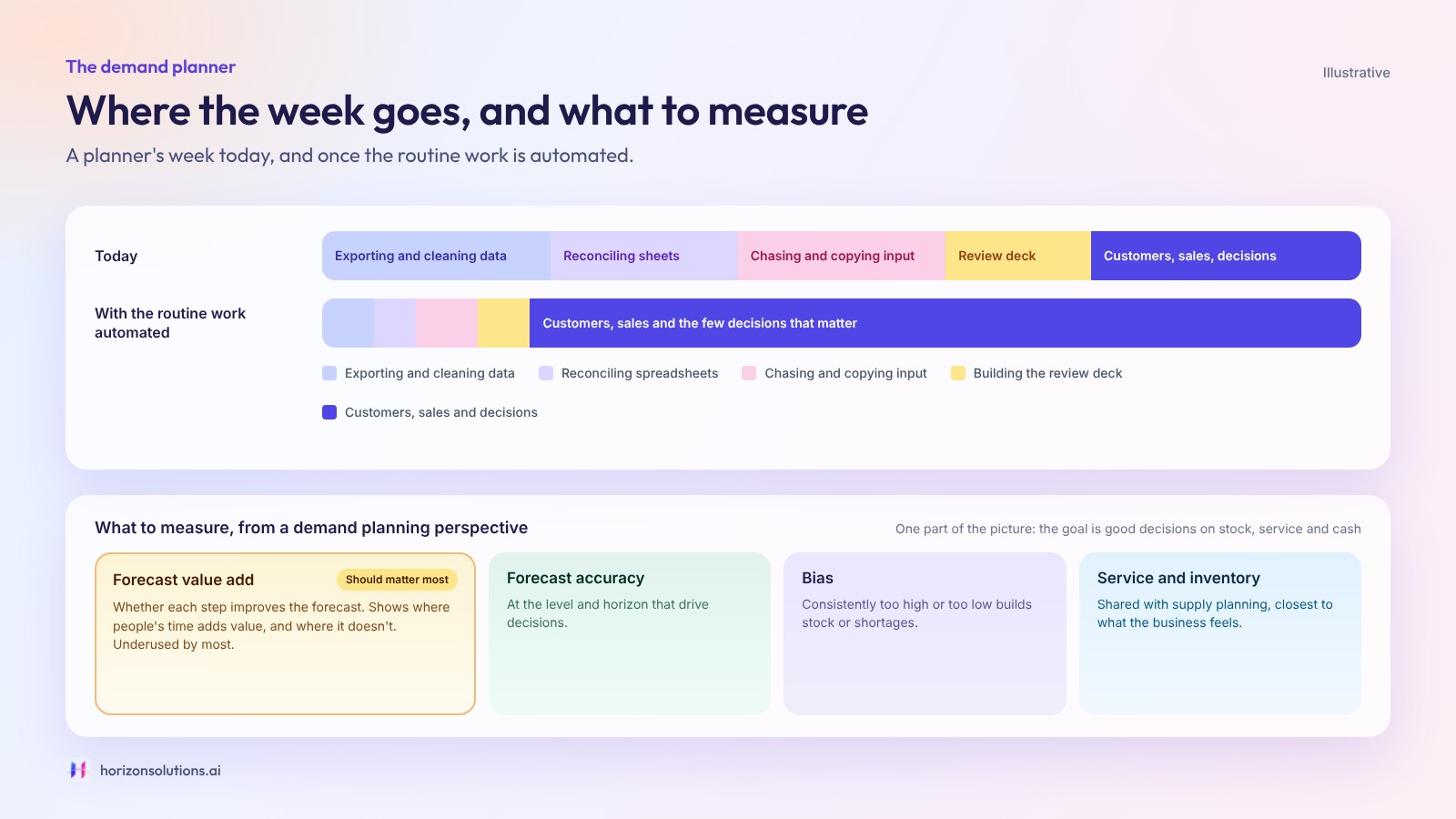
A word of perspective first. Forecast accuracy and the other demand planning KPIs are only one part of the picture. What the business needs is good decisions: the right stock in the right place, customers served, cash not tied up. A better forecast helps, but it doesn't guarantee any of that. It still makes sense to track these numbers from a demand planning perspective, because they show where the forecast, and the process behind it, can improve.
- Forecast value add. The one that should matter most, and the one most companies underuse. It measures whether each step in the process, such as sales input or a planner's override, makes the forecast better or worse than the step before, starting from a simple statistical forecast. It shows where people's time adds value and where it doesn't. Teams that measure it often stop touching items where overrides make things worse, and spend that time where input really helps. More in forecast accuracy, bias and forecast value add.
- Forecast accuracy. Usually one minus the weighted absolute percentage error, measured at the level and horizon that drive decisions, such as item and location at the replenishment lead time.
- Bias. Whether the forecast is consistently too high or too low. Bias often does more damage than random error, because it builds up stock or shortages over time.
- Service level and inventory. Owned with supply planning, but shaped by the forecast, and the closest to what the business actually feels.
Career path
Most demand planners come from supply chain, business, economics, engineering or data roles. A typical path runs from demand planning analyst to demand planner, senior planner, demand planning manager, and on to head of planning or S&OP lead. Many move sideways into supply planning, category management or commercial roles, where the market knowledge carries over.
Certifications such as ASCM's CPIM or the IBF's Certified Professional Forecaster help early on. For what companies look for higher up, see Radu Palamariu on chief supply chain officer skills.
Where the week actually goes
Ask demand planners about their week and a familiar picture comes up. A large part goes to work that isn't planning: exporting data from the ERP, cleaning it, reconciling versions of spreadsheets, chasing sales for input, copying customer forecasts from emails and portals into the plan, and building the slides for the demand review.
What's left goes to the questions that matter: which changes are real, what they mean for supply, and what to decide. Planners don't choose this split. It follows from data, inputs and systems that are scattered.
The job that's coming
Planning systems are taking over the mechanical part: the baseline, the data preparation and the routine reconciliation. That doesn't make planners less important. It changes where their time goes.
At the 2026 Gartner Supply Chain Planning Summit, one session described the end-to-end planner. The customer collaboration planner is a good example: once building the baseline by hand has no point, the time goes to working with customers and sales on what's really coming. Roles become value-focused instead of task-based, as covered in our Gartner 2026 takeaways.
What that asks of planners:
- More time with customers, sales and product management, and less with spreadsheets.
- Judging the system's recommendations rather than building the numbers: knowing when to trust them and when to challenge them.
- Owning a few decisions with real impact, rather than reviewing every item.
- Curiosity. Gartner also flagged the risk that some planners lean in while others switch off, which is why companies need to tell planners clearly how the role will change.
For planners, it's good news: the most interesting part of the job is the part that's growing. For more on how planning teams are shifting, see Hadi Eghlidi on dual-profile teams and Maurice Shneor on demand planning when sales does the forecast.
How Horizon does it
Horizon is built for planners. HZN-1 builds and tunes the baseline per item. Deep Sensing reads the customer emails and Excels, CRM notes and sales chats a planner would otherwise copy by hand, and links each signal to the affected items. Planners see the few decisions that matter, in flexible views that fit their role.
Up to 90% of planning time back. Trusted by 120+ planners. Become the first to see what's beyond the horizon.
Start with Horizon Instant: demand planning on your own data, up and running in less than 24 hours. Or book a demo.
