

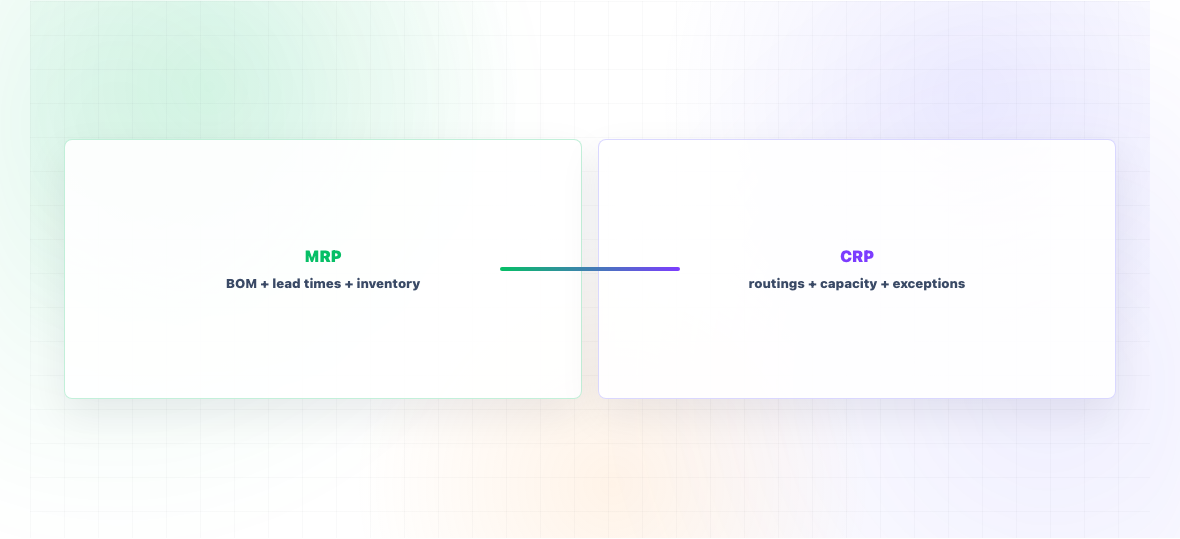
Material Requirements Planning (MRP) computes what raw materials and components need to be purchased or produced to support the master production schedule. It traverses bills of materials (BOMs), applies lead times, and produces purchase orders and production work orders timed to meet the production plan.
Capacity Requirements Planning (CRP) validates whether the production plan is feasible against the available capacity of machines, labor, and other constrained resources. It identifies periods where the plan exceeds available capacity and flags them for resolution.
MRP and CRP work as a pair. MRP assumes capacity exists and computes material need; CRP checks whether that capacity actually exists. If CRP shows the plan is infeasible, the MPS must be adjusted and MRP re-run. This is the classic ERP planning cycle that most manufacturers have run for decades.
This page covers how each function works, where they're still useful, and the limitations that drove the development of more advanced planning methods (finite capacity scheduling, multi-echelon optimization, advanced planning systems).
Author :
Chinmay Narwane
Detailed scheduling is the shortest-horizon production planning function: it sequences specific work orders on specific resources at specific times, typically over a horizon of hours to weeks. It produces the executable schedule that operators and supervisors follow on the shop floor.
Detailed scheduling sits at the bottom of the planning hierarchy. Above it is master production scheduling (MPS), which decides what to make in each period at a more aggregated level. Above that is rough-cut capacity planning (RCCP), which validates the MPS against high-level capacity. Above that sits the operational plan from supply planning, and above that the strategic plan from S&OP/IBP.
This page explains where detailed scheduling fits in the hierarchy, what it computes, the constraints it handles, and how it differs from the planning layers above it.

Author :
Chinmay Narwane
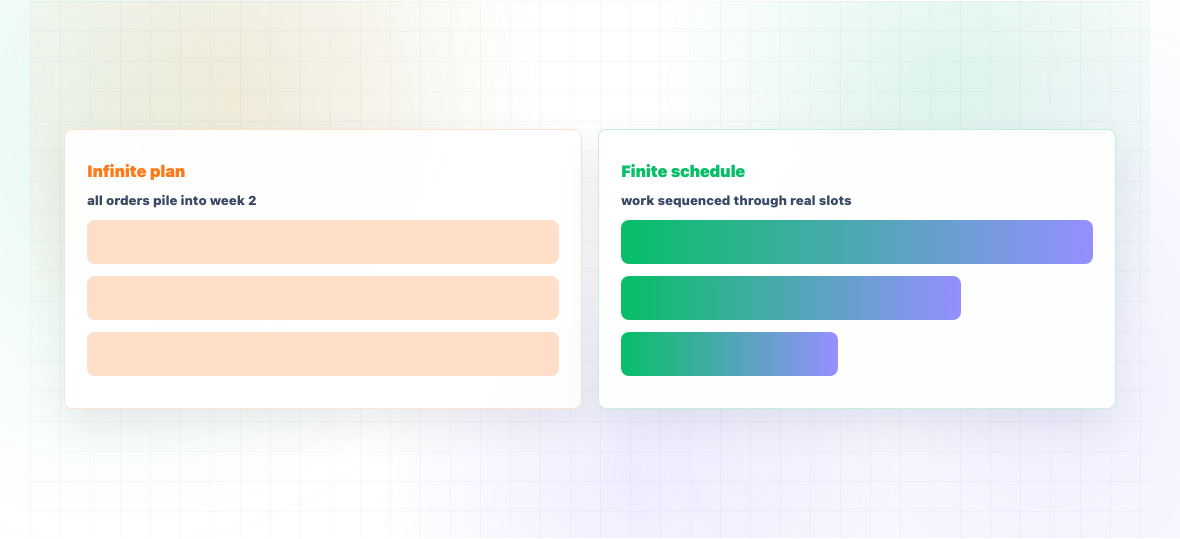
Finite capacity scheduling (FCS) produces production schedules that respect the actual capacity of machines, labor, materials, and tools rather than assuming infinite capacity is available at every resource. The schedule it produces is feasible: work orders are sequenced on specific resources at specific times, accounting for setups, parallel resources, calendars, and constraints.
The alternative infinite capacity scheduling, which is how most ERP MRP runs work produces a plan that assumes any quantity can be made in any period. The plan looks feasible on paper but typically isn't executable on the shop floor without significant manual adjustment. Schedulers and supervisors spend their day reconciling the MRP output with what the plant can actually do.
This page covers how FCS works mathematically, where it pays back versus where it's overkill, and what implementation actually involves.
Author :
Chinmay Narwane
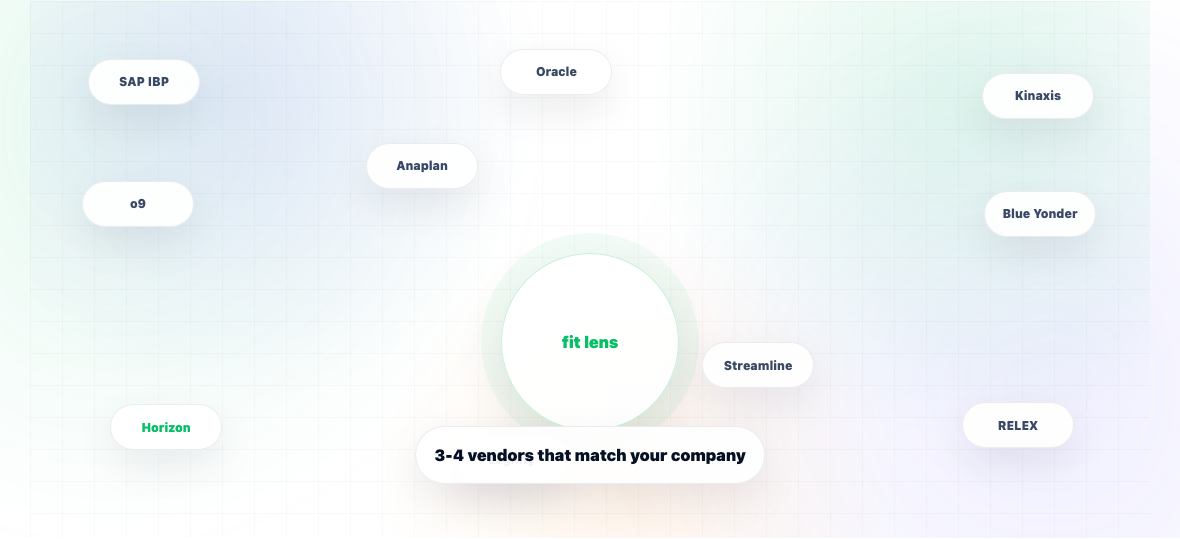
This is not a leaderboard ranking the "top 10" platforms. Vendor rankings produced by analysts or content sites are mostly marketing artefacts they conflate companies of wildly different scope, size, and target market. The useful question isn't "which platform is best" but "which platform is best for our specific situation."
This page categorizes supply chain planning platforms by who they're built for, what they're strong at, and where they struggle. The goal is to help a manufacturer narrow a shortlist from "everyone in the category" to "3-4 platforms that genuinely fit our profile." The platforms named are the ones most manufacturers will encounter in evaluation the list isn't exhaustive but covers the meaningful comparisons.
Author :
Chinmay Narwane
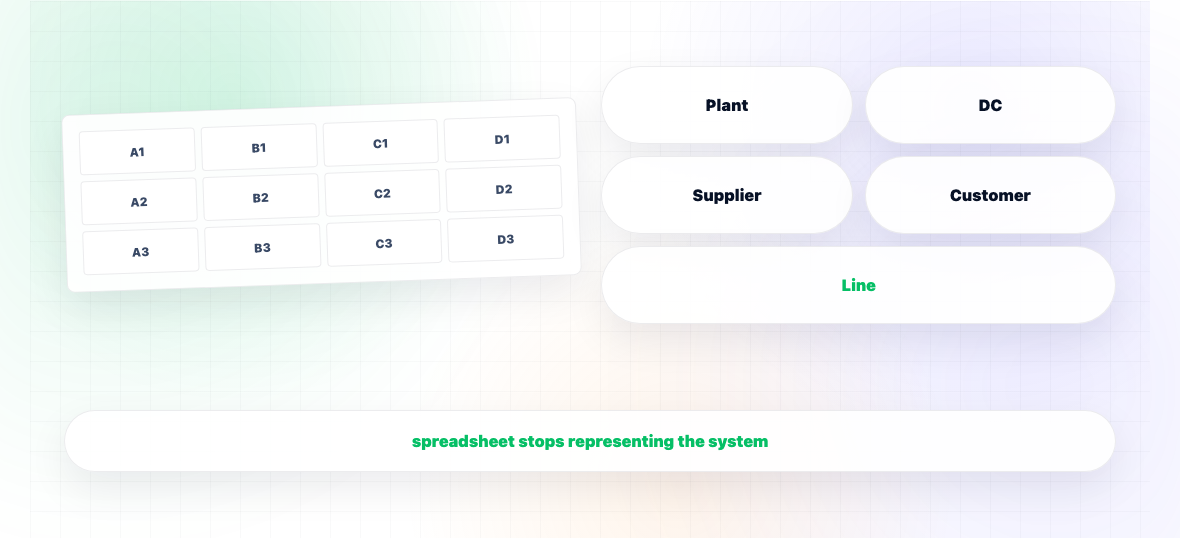
Excel can run supply chain planning. Many small and mid-size manufacturers do this for years, sometimes successfully. The question isn't whether Excel is theoretically capable it's whether the specific complexity of your supply chain has exceeded what Excel can handle without losing significant money to the limitations.
This page compares Excel and dedicated supply chain planning (SCP) software across the dimensions where they actually diverge: multi-echelon math, capacity-aware scheduling, multi-user collaboration, scenario analysis, and integration with execution systems. It then describes the specific scale and complexity thresholds where Excel typically breaks down.
Unlike the demand-planning-specific Excel comparison, this page is about the full scope of supply chain planning production scheduling, inventory across echelons, distribution planning, supply-demand balancing. The thresholds are different from demand planning alone.
Author :
Chinmay Narwane
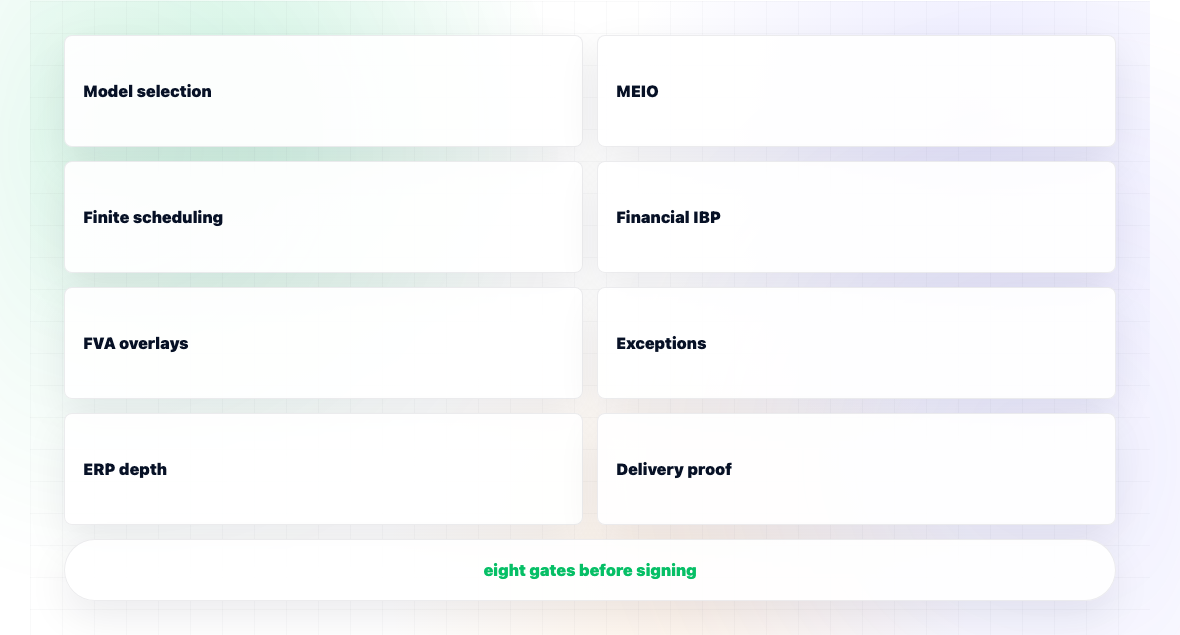
This page is for a supply chain leader at a manufacturing company evaluating planning software for the first time, or replacing a tool that has stopped paying back. Most evaluation guides list 30+ features and produce decision paralysis. This one focuses on the eight capabilities that genuinely separate platforms that work from platforms that don't, plus the red flags worth catching early.
The guide assumes you've already concluded that Excel or your ERP's planning module isn't sufficient if that decision is still open, the move-from-Excel decision is a separate conversation. From here on, the question is: what makes one planning platform better than another for a manufacturer?
Author :
Chinmay Narwane
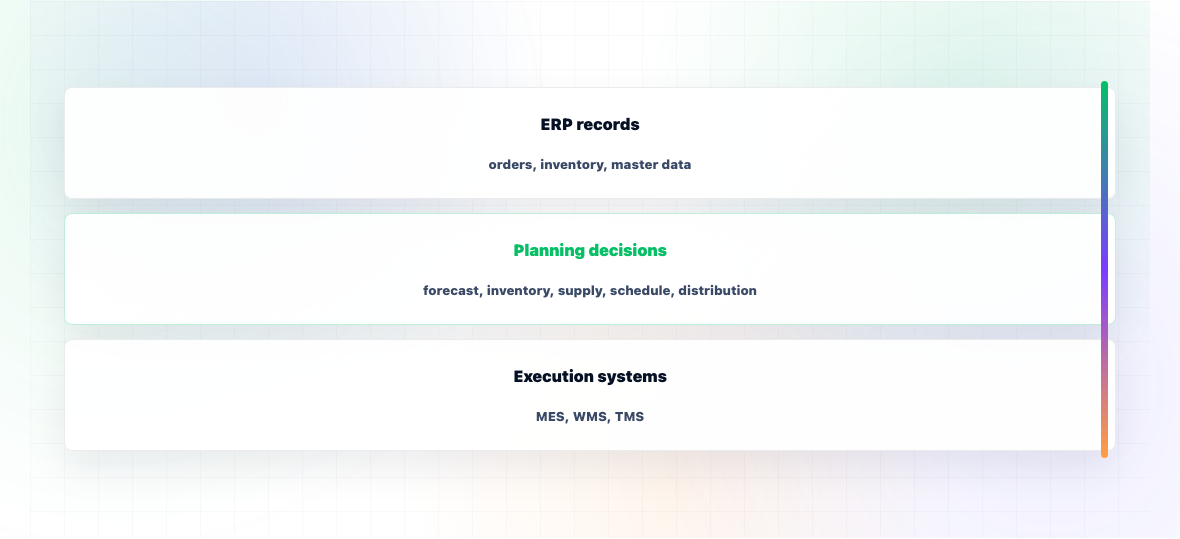
Supply chain planning software is a category of applications that decides what to make, when to make it, how much inventory to hold, and how to move product through the network across a planning horizon ranging from days (production scheduling) to years (capacity and strategic planning). It is the decision layer that sits between transactional systems (ERP, MES) and execution.
The category is broader than any single function. It covers demand planning, inventory optimization, supply and production planning, distribution planning, and the S&OP/IBP rhythm that ties them together. Modern platforms cover all of these in one workspace; older approaches used separate tools per function with integration between them.
This page explains what each of the five core modules does, how supply chain planning software differs from ERP and execution systems, and how to think about whether to buy an integrated platform or best-of-breed tools.
Author :
Chinmay Narwane
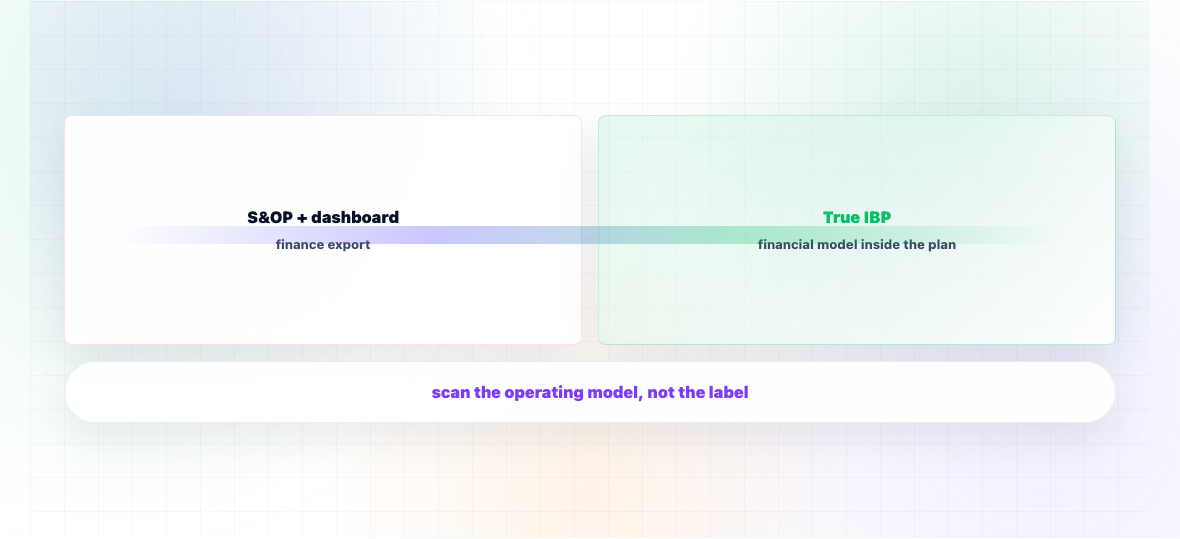
IBP software is one of the most over-marketed categories in supply chain technology. Nearly every planning platform now claims to support IBP but the gap between platforms that genuinely enable Integrated Business Planning and those that are S&OP tools with a finance dashboard is large. The buying decision matters because it's typically a 5-10 year platform commitment and the wrong choice forces either expensive workarounds or a painful migration.
This guide is for the executive buying committee typically a COO or CEO, CFO, and Head of Supply Chain at a company moving from S&OP to true IBP. It covers the seven capabilities that genuinely matter, the four red flags that distinguish marketing from substance, what implementation actually looks like, and the questions to ask in a vendor demo that reveal whether the product supports IBP or just claims to.
Author :
Chinmay Narwane
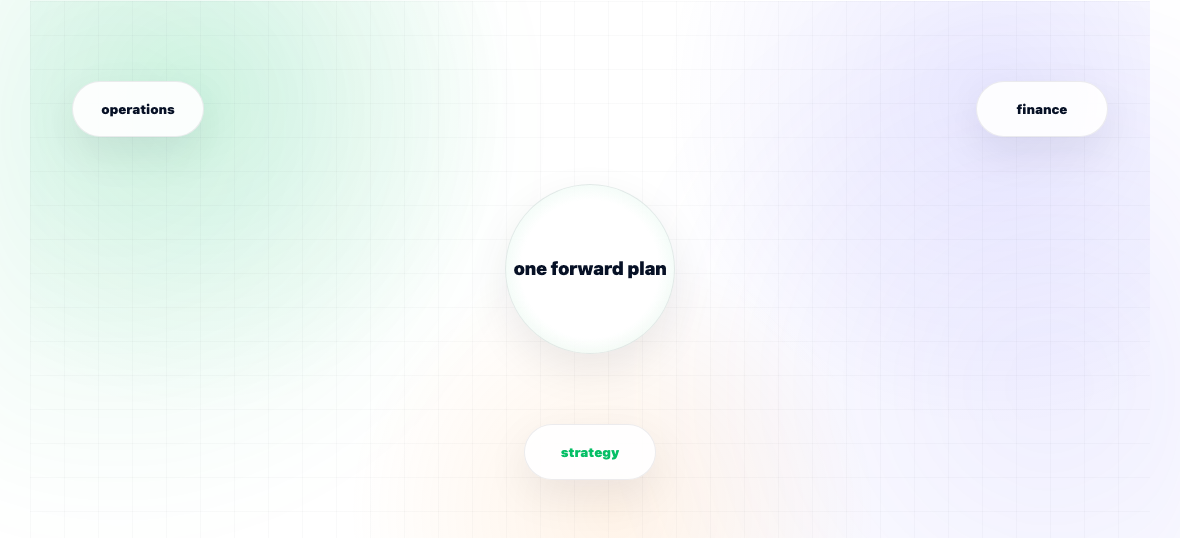
Integrated Business Planning (IBP) is a monthly executive rhythm that aligns operations, finance, and strategy on a single forward plan covering the next 24-36 months. It produces a feasible operational plan that has been reconciled to financial targets and strategic commitments so the volume plan, the revenue plan, and the strategic plan are all the same plan.
IBP evolved from S&OP (Sales and Operations Planning) by extending the scope. S&OP balances demand and supply in volume terms. IBP extends that to balance volume and value including margin, working capital, and strategic initiatives. The participants change accordingly: where S&OP is typically run by supply chain, IBP is owned by the COO or CEO with finance as a peer participant.
This page covers the five-step process most mature IBP rhythms follow, what each step actually produces, and the difference between IBP done well and IBP that's just S&OP with finance in the room.
Author :
Chinmay Narwane
Demand segmentation is the practice of grouping SKUs by their demand characteristics typically volume and variability so each group can be forecasted, reviewed, and managed with the right approach. A 5,000-SKU portfolio is not one forecasting problem; it's several problems mixed together, and treating them uniformly is what causes most accuracy and inventory issues.
The most common framework is ABC/XYZ, which crosses volume importance (A, B, C) with demand variability (X, Y, Z) to produce nine segments each with different forecasting methods, review cadences, safety stock policies, and management attention.
This page covers the standard ABC/XYZ framework, how to compute each axis, what segments mean in practice, and how segmentation drives different decisions across forecasting, inventory, and review processes.
Author :
Chinmay Narwane

