

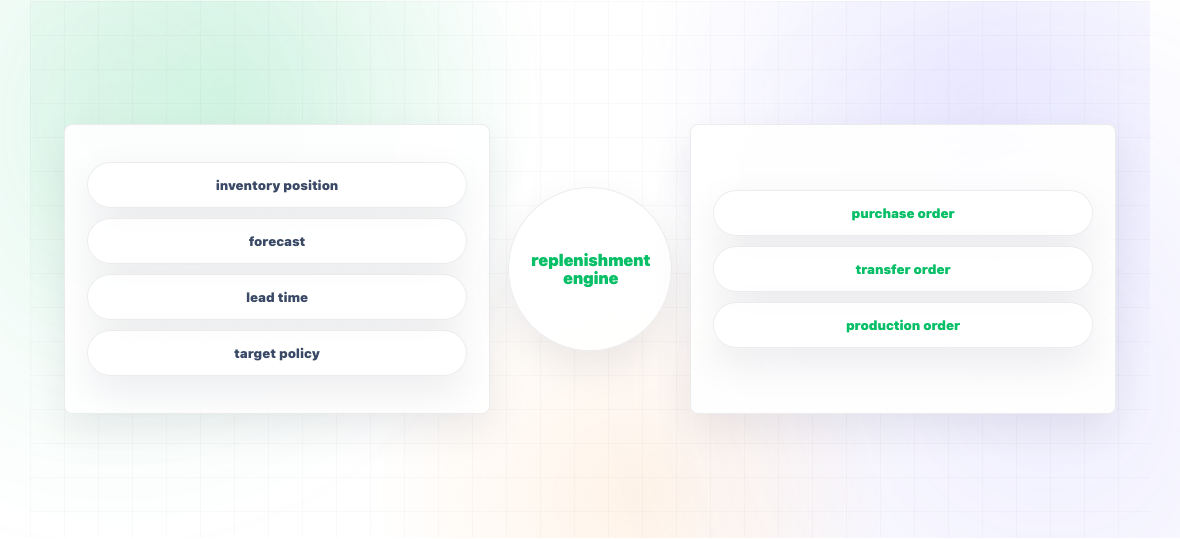
Replenishment planning software automates the decision of when to reorder and how much, based on inventory levels, demand forecasts, lead times, and target stocking policies. It generates purchase orders for raw materials, transfer orders for moving stock between locations, and production orders for items produced in-house all timed to maintain inventory within optimized policy bounds.
The category overlaps with adjacent functions. MRP also generates orders, but works from production schedules rather than inventory policies. Inventory optimization sets the policies, but doesn't execute them. Replenishment planning sits between optimization (policy) and execution (purchase orders, transfers), automating the decisions that turn policy into action.
This page covers what replenishment planning software actually does, how it differs from MRP and inventory optimization, and where it's most valuable.
Author :
Chinmay Narwane
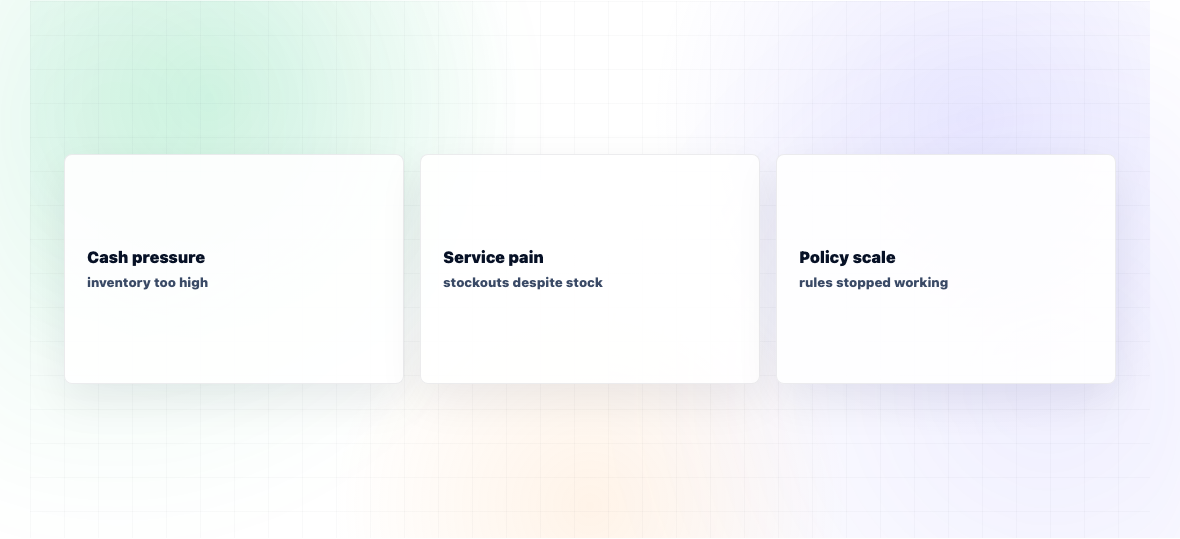
This guide is for a supply chain leader, CFO, or operations leader evaluating inventory optimization software. The buying decision usually starts with one of three triggers: working capital pressure (inventory is too high), service problems (chronic stockouts despite high inventory), or a recognition that rule-of-thumb policies have stopped scaling.
The inventory optimization category is broader than many buyers realize. Some tools are pure optimization engines that produce safety stock recommendations to be implemented elsewhere. Others are full platforms that include the operational execution of the policies. The distinction affects evaluation, implementation, and ROI substantially.
This page covers the seven capabilities that genuinely matter, the four red flags worth catching early, and realistic expectations for ROI and implementation.
Author :
Chinmay Narwane
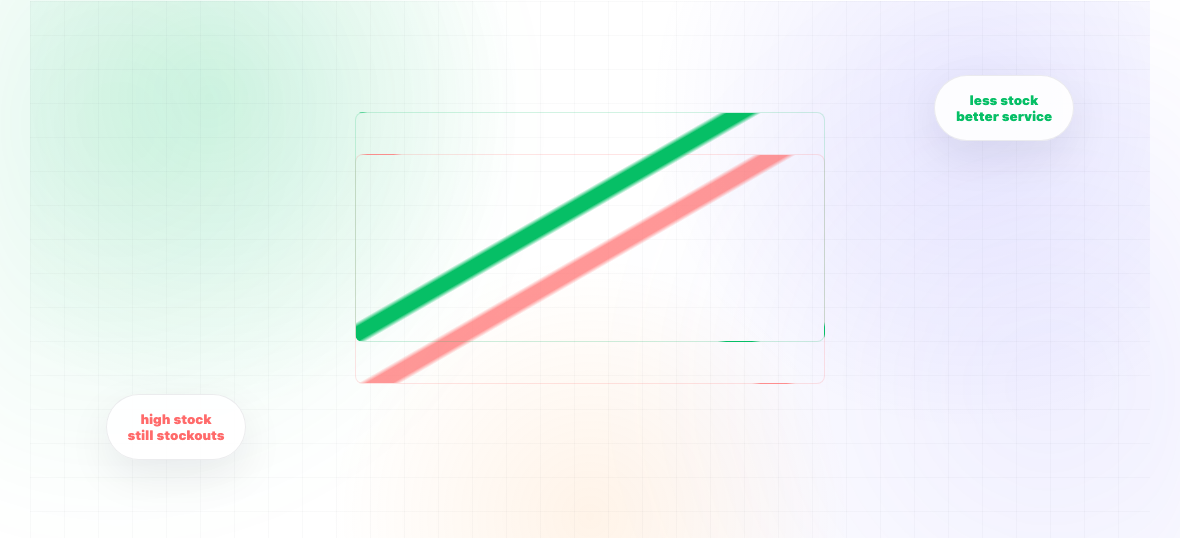
Reducing inventory without causing stockouts is mathematically possible inventory and service levels are related, but they're not on a fixed 1-to-1 trade-off. Companies can reduce inventory and improve service simultaneously by addressing the structural causes of both excess and stockouts, which usually overlap. The same SKUs that cause stockouts often hold excess inventory at the wrong time; the same SKUs with chronic excess often face occasional stockouts.
This page covers six specific methods that, in our experience, deliver real working capital release without service degradation. They're ordered roughly by impact and by sequence earlier methods unlock the later ones. A realistic expectation: companies starting from rule-of-thumb inventory policies typically see 15-25% inventory reduction over 12-18 months while maintaining or improving service. The methods compound; no single method delivers the full gain.
Author :
Chinmay Narwane
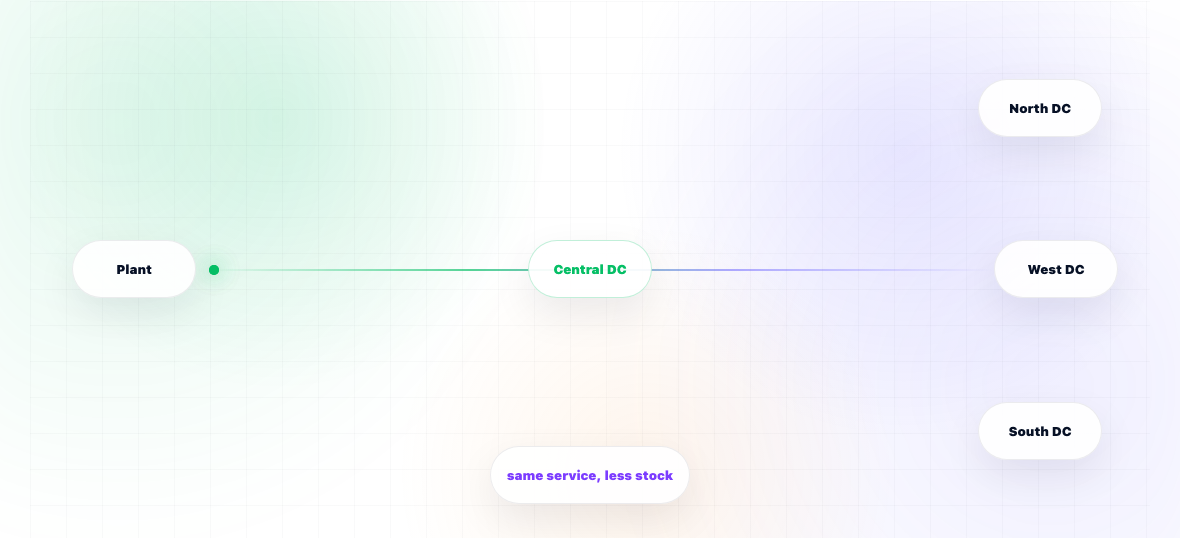
Multi-echelon inventory optimization (MEIO) is a mathematical method for setting inventory levels across a supply chain network multiple plants, central distribution centers, regional DCs, customer-facing stocking locations by optimizing across the entire network rather than each location independently. The defining capability is risk pooling: holding some safety stock at upstream nodes that can be deployed to any downstream location, which reduces the total inventory required across the network.
The alternative single-echelon optimization, which treats each location independently produces safe inventory levels per location but ignores the risk-pooling opportunity. The math difference is significant: a typical multi-location network running single-echelon methods holds 15-25% more total inventory than MEIO would recommend, at the same service levels.
This page covers the math of MEIO, how risk pooling actually works, the data requirements, and where the method delivers real value versus where it adds complexity without proportional benefit.
Author :
Chinmay Narwane
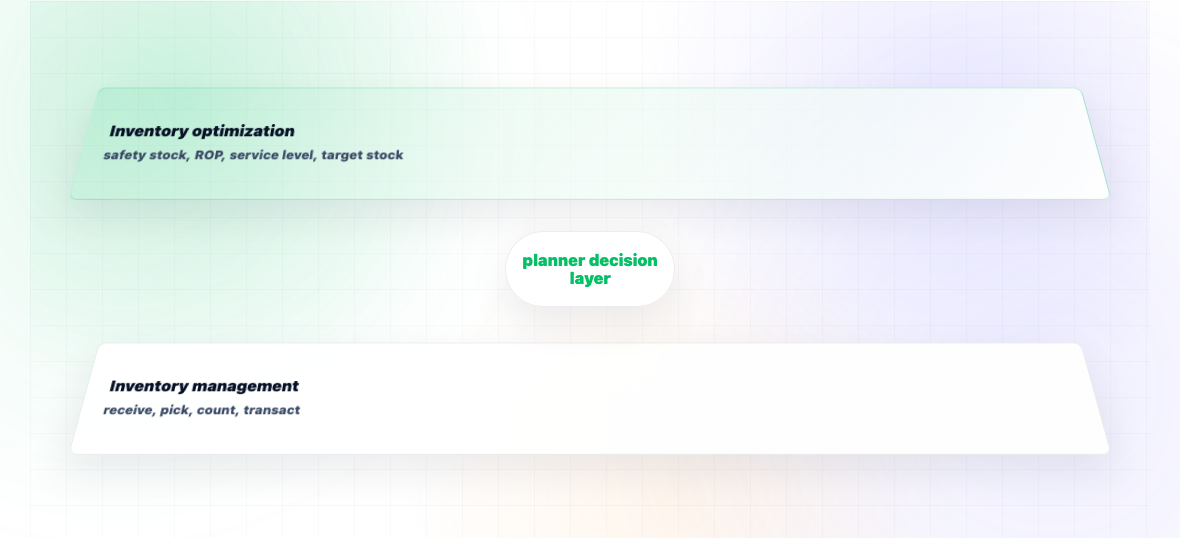
Inventory optimization is the discipline of setting safety stock levels, reorder points, and replenishment policies using mathematical optimization rather than rule-of-thumb methods minimizing total working capital tied up in inventory while meeting defined service level targets. It's the analytical layer above traditional inventory management, which focuses on transaction control (receiving, putaway, picking) rather than the math of how much to hold.
The distinction matters because inventory management can be done well without optimization, and inventory optimization can be done badly without management. The two are complementary: management handles execution, optimization handles policy. A warehouse with excellent management running on rule-of-thumb inventory policies typically carries 20-35% more inventory than necessary.
This page covers how inventory optimization actually works mathematically, the methods used at different levels of sophistication, where it pays back, and how it integrates with demand planning and supply planning.
Author :
Chinmay Narwane
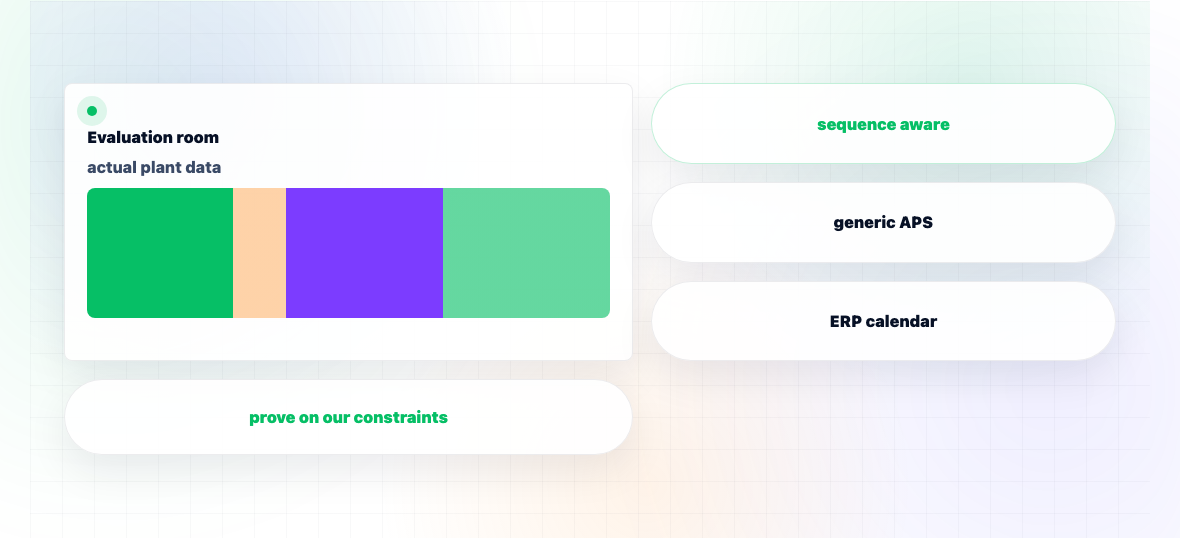
This guide is for a manufacturing operations leader evaluating production scheduling software for the first time or replacing a tool that's stopped paying back. The guide assumes you've already concluded that ERP-based scheduling and manual methods aren't sufficient if that conclusion is still open, the move-from-manual decision is a separate conversation.
The category contains tools with wildly different scope, target customer, and underlying math. A scheduling tool built for discrete assembly is very different from one built for process manufacturing, and both differ from tools built for continuous operations. Many evaluation projects fail because they compare tools from different categories without recognizing the differences.
This guide covers the eight capabilities that genuinely matter, the four red flags worth catching early, and how to evaluate fit for your specific manufacturing mode.
Author :
Chinmay Narwane
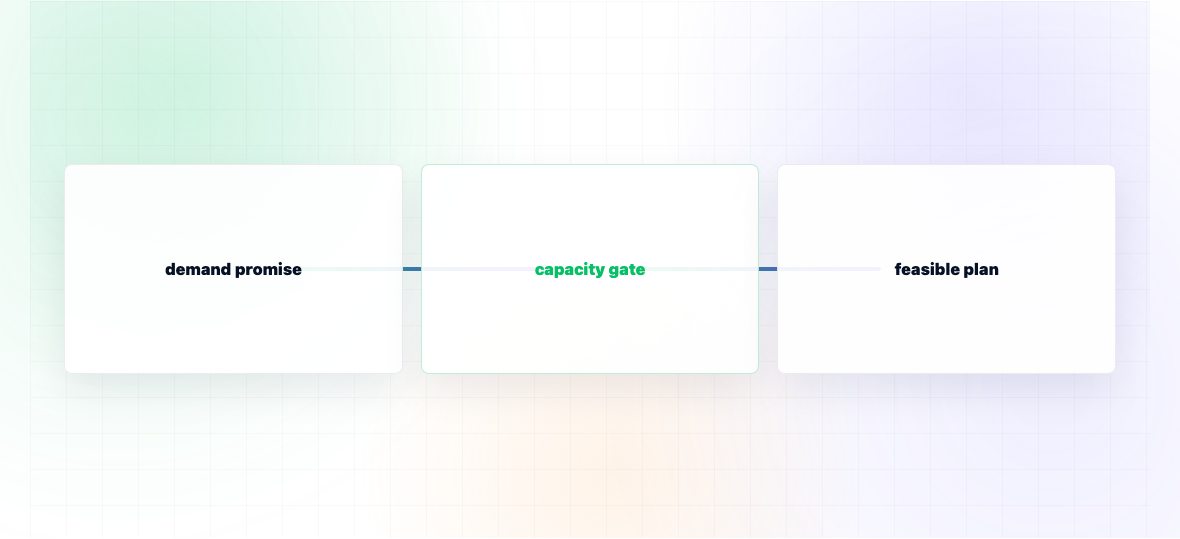
Capacity planning in manufacturing is the discipline of determining whether the plant's production resources machines, labor, materials, tools can meet expected demand, and what to do when capacity falls short or exceeds need. It runs at multiple horizons, from strategic capacity investment decisions made over 3-5 years to detailed daily decisions about which work orders to expedite.
The discipline operates at four distinct levels, each making different decisions with different data and different tools. Confusing the levels is one of the most common manufacturing planning mistakes treating strategic capacity questions with operational tools, or operational capacity questions with strategic models.
This page covers the four levels of capacity planning, the questions each level answers, the tools used at each level, and how the levels integrate into a coherent capacity management discipline.
Author :
Chinmay Narwane
Production optimization software applies mathematical optimization methods to production planning and scheduling decisions finding the combination of which products to make, when to make them, on which resources, and in what sequence that maximizes a defined objective (throughput, margin, on-time delivery) subject to operational constraints. It overlaps with production scheduling software but extends the scope beyond schedule generation to broader production-system decisions.
The category is broader than scheduling alone. Production optimization can cover product mix decisions (which orders to accept given limited capacity), campaign planning (how to group products into manufacturing campaigns), resource allocation (which machines to dedicate to which products), and yield optimization (how to operate within process parameters to maximize throughput). Scheduling is one application of optimization; production optimization is the broader discipline.
This page covers what production optimization actually does, the mathematical methods involved, where it pays back, and how it relates to but extends beyond production scheduling.

Author :
Chinmay Narwane
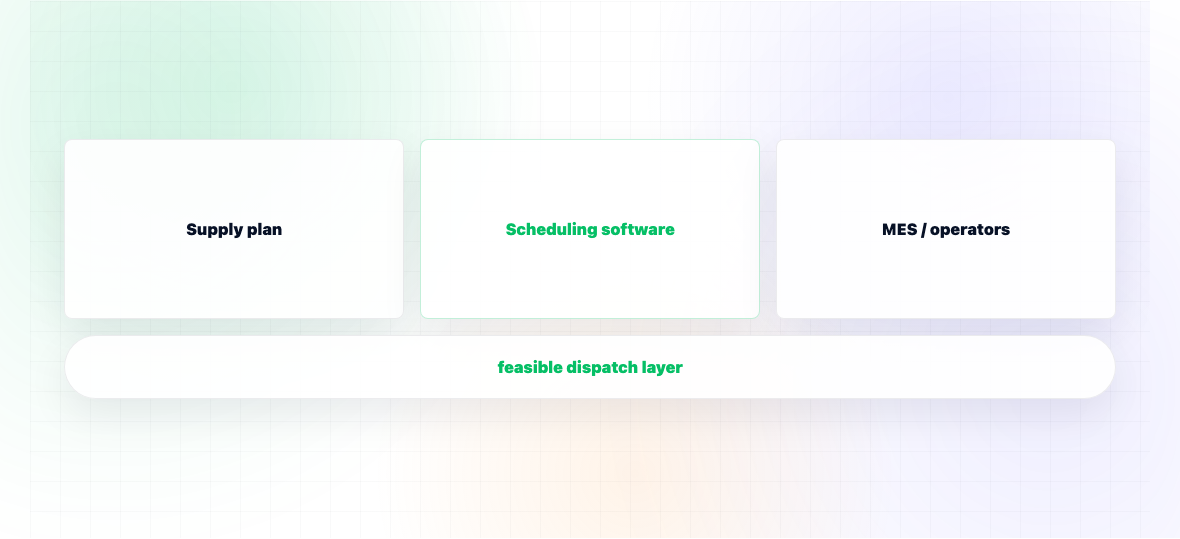
Production scheduling software generates feasible shop-floor schedules sequencing specific work orders on specific resources at specific times accounting for capacity, sequence-dependent setups, material availability, labor, and customer due dates. It's the planning layer that sits between supply planning (which decides what to make in each period) and execution (MES, operators, and shop-floor systems).
The category encompasses both standalone production scheduling tools (often called APS Advanced Planning and Scheduling) and the scheduling modules within integrated supply chain planning platforms. Both serve the same function; the difference is whether scheduling is bought as a point solution or as part of a broader platform.
This page covers what production scheduling software actually does, the six capabilities that distinguish good tools from limited ones, and how the category integrates with ERP and MES.
Author :
Chinmay Narwane
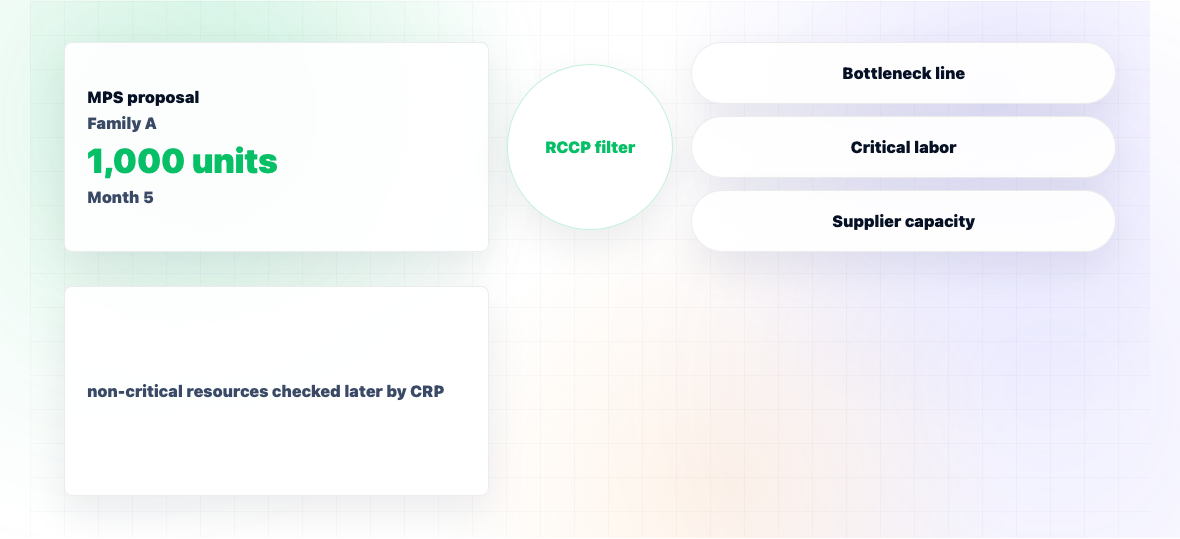
Rough-Cut Capacity Planning (RCCP) is a higher-level capacity check that validates whether the master production schedule (MPS) is broadly feasible against the company's critical resources typically bottleneck machines, key labor categories, and constrained suppliers. It runs before MRP and detailed scheduling, catching infeasibility early when it's cheaper to fix.
RCCP differs from CRP (Capacity Requirements Planning) by scope and timing. CRP runs after MRP, checks every resource in the routing, and operates at a detailed level. RCCP runs before MRP, checks only critical resources, and operates at an aggregated level. Both have their place RCCP for fast directional feedback during MPS development, CRP for detailed validation before execution.
This page covers how RCCP works, the three common methods used, where it fits in the planning hierarchy, and why it's experiencing a resurgence in modern planning systems despite being one of the older planning concepts.
Author :
Chinmay Narwane

