

Blue Yonder is one of the strongest enterprise supply chain platforms for $3B+ CPG and retail-heavy manufacturers. Named a Leader in the 2026 Gartner Magic Quadrant for Supply Chain Planning Solutions, with deep retail-grade demand sensing, mature trade promotion management integration, and significant execution platform integration. For large CPG operations with substantial retail channel exposure, Blue Yonder often fits well.
Blue Yonder fits less well in several common cases: mid-market manufacturers ($100M-$2B) where Blue Yonder's TCO and implementation timeline exceed reasonable proportion to scale, non-CPG operations where Blue Yonder's retail-CPG specialization isn't a differentiator, companies wanting AI-driven planning without enterprise complexity, and operations whose primary needs are integrated supply chain planning rather than execution-platform integration.
This page is for buyers in those categories. The framing isn't whether Blue Yonder is "good" — it's clearly strong for the customers it fits. The question is whether you're one of those customers.
Author :
Ben Van Delm
AI in inventory optimization typically means three things: probabilistic methods that model demand and lead time variability as distributions rather than constants, ML methods that predict demand patterns underlying inventory decisions, and recommendation engines that propose specific safety stock or reorder adjustments to inventory planners. Each adds value, but in different ways.
Probabilistic methods are the most mathematically meaningful difference from traditional inventory optimization — they replace normal-distribution assumptions with actual demand distributions, which typically reduces inventory 10-20% at the same service levels. ML methods improve underlying demand forecasts that drive inventory decisions. Recommendation engines reduce planner workload by proposing specific actions. The platforms below distinguish by which of these they emphasize.
Author :
Ben Van Delm
AI in supply chain planning spans more than demand forecasting. It includes supply variability prediction (anticipating supplier disruptions before they happen), inventory optimization with probabilistic methods, scheduling with reinforcement learning approaches, anomaly detection across plans, and decision recommendation engines that propose specific actions rather than only producing reports. The platforms that label themselves "AI supply chain planning" vary widely in which capabilities they actually deliver.
This page covers the main categories — from AI-positioned enterprise platforms to specialists to hyperscaler offerings — with honest fit guidance about which buyer profile fits which approach.
Author :
Ben Van Delm
"AI forecasting" spans a wider category than AI demand planning specifically. It includes pure ML platforms (Amazon Forecast, Google Vertex AI Forecast) used by data science teams to build forecasting capability, demand-planning-focused AI platforms designed for supply chain teams, general ML platforms applied to forecasting use cases (H2O.ai, DataRobot), and enterprise supply chain platforms with AI forecasting embedded.
The right choice depends on who's doing the forecasting and what they need from it. Data science teams building bespoke models often choose pure ML platforms. Supply chain teams forecasting demand operationally typically need demand-planning-focused platforms. This page covers both perspectives.
Author :
Ben Van Delm
"AI demand planning" is a broad label covering several technically different capabilities. Some platforms use machine learning to select forecasting algorithms per SKU automatically (replacing manual model selection). Some use neural networks for pattern recognition in promotional, seasonal, or causal demand drivers. Some use probabilistic methods (Bayesian or Monte Carlo approaches) for forecast confidence intervals. Some use AI for anomaly detection or exception management rather than the forecast itself.
The platforms below distinguish by which AI capabilities they actually deliver versus which they market. The buyer's job is to understand which kind of AI matters for your operation and pick accordingly — generic "AI demand planning" claims aren't evaluable without specifics.
Author :
Ben Van Delm
Capacity planning sits between supply planning and production scheduling — it answers whether the supply plan is feasible given available resources, and what capacity decisions (overtime, additional shifts, capacity acquisitions) are needed to make it feasible. Done at the right horizon (typically rolling 3-18 months), capacity planning prevents the late surprises that come from supply plans assuming resources that don't exist.
The platforms that fit capacity planning vary by manufacturing mode and integration scope. Standalone capacity planning specialists offer deep math; integrated platforms tie capacity to demand and scheduling without re-keying. This page covers both approaches with honest fit guidance.
Author :
Ben Van Delm
Replenishment planning answers a deceptively simple operational question: when to order, how much to order, and from which supplier or upstream location. The complexity sits in the inputs — demand forecast accuracy, supplier lead time variability, supplier minimum order quantities, multi-echelon network structure, and service level targets that vary by SKU importance. Get the inputs right and replenishment is largely automatic; get them wrong and operations spends 30-40% of buyer time correcting system-generated recommendations.
The platforms that fit replenishment planning are a different subset than general inventory optimization. Replenishment-focused tools optimize for buyer productivity and supplier-aware ordering; general inventory tools optimize for working capital. Both matter, but they're different problems.
Author :
Ben Van Delm
Supply planning translates the demand plan into a feasible supply response — what to make, when to make it, what to buy, when to expedite. Done well, it's where demand variability meets supply constraints and produces an executable plan. Done badly, it's where the demand plan gets ignored and operations falls back on heuristics and spreadsheets.
The platforms that deliver supply planning well share common characteristics: they handle finite capacity (not infinite-capacity planning that ignores resource constraints), they propagate demand-supply matching across multi-stage operations (not just MPS at the finished goods level), they integrate with demand planning rather than re-keying demand inputs, and they support scenario evaluation for capacity decisions. This page covers the platforms that meet that bar.
Author :
Ben Van Delm
Multi-echelon inventory optimization (MEIO) is one of the most under-bought capabilities in supply chain planning. Most companies running multi-stage networks — central DCs feeding regional DCs, raw material inventory feeding WIP feeding finished goods, or supplier-buffer-plant chains — manage inventory at each echelon independently. The result is structurally over-stocked networks where buffer at one level doesn't account for buffer at adjacent levels. Risk pooling effects across echelons go uncaptured.
MEIO addresses this by optimizing inventory positions across the network rather than at each location separately. Done correctly, it typically releases 10-25% of working capital at the same service levels — or improves service levels at the same inventory. This page covers the platforms that genuinely deliver MEIO capability rather than just labeling traditional inventory tools as multi-echelon.
Author :
Ben Van Delm
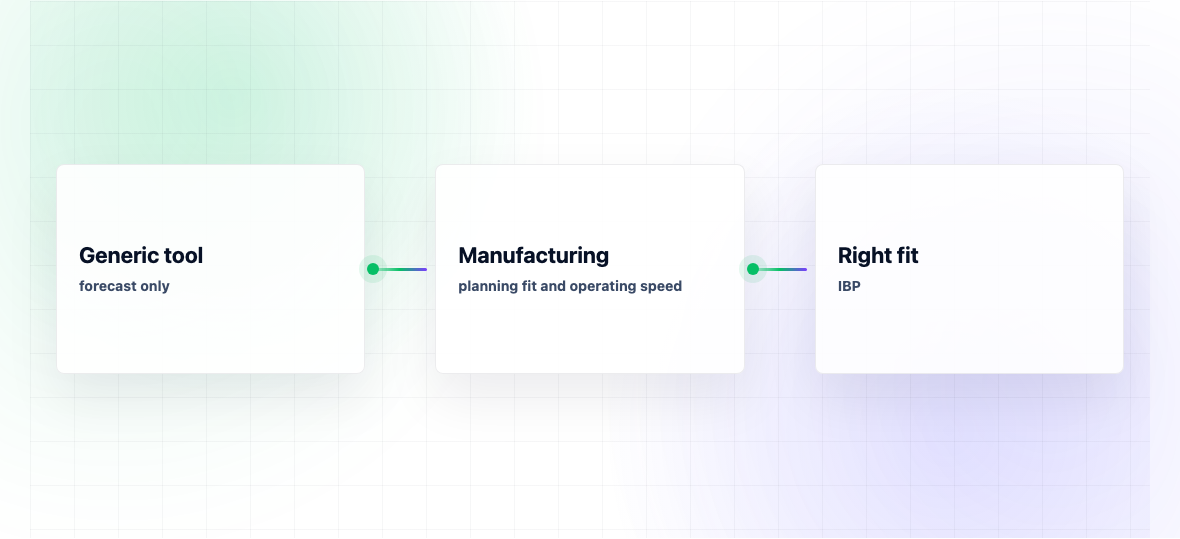
If you're researching Anaplan versus SAP IBP, the underlying question is usually: who should own integrated business planning and what platform supports that ownership? Anaplan and SAP IBP take genuinely different approaches. Anaplan optimizes for connected planning where finance, supply chain, sales, and corporate planning operate on a shared modeling platform. SAP IBP optimizes for supply-chain-led planning with native financial integration through the SAP ecosystem.
The choice between them often reveals organizational realities about who owns planning. We're including Horizon in this comparison because a third common pattern exists: mid-market companies whose supply chain function needs operational planning depth that Anaplan's modeling approach doesn't provide, but whose scale doesn't justify SAP IBP's enterprise cost and timeline. For these companies, mid-market supply-chain-native platforms like Horizon often fit better than either Anaplan or SAP IBP.
The framing throughout: finance-led vs supply-chain-led ownership, and enterprise vs mid-market scale.
Author :
Ben Van Delm

